QUESTION IMAGE
Question
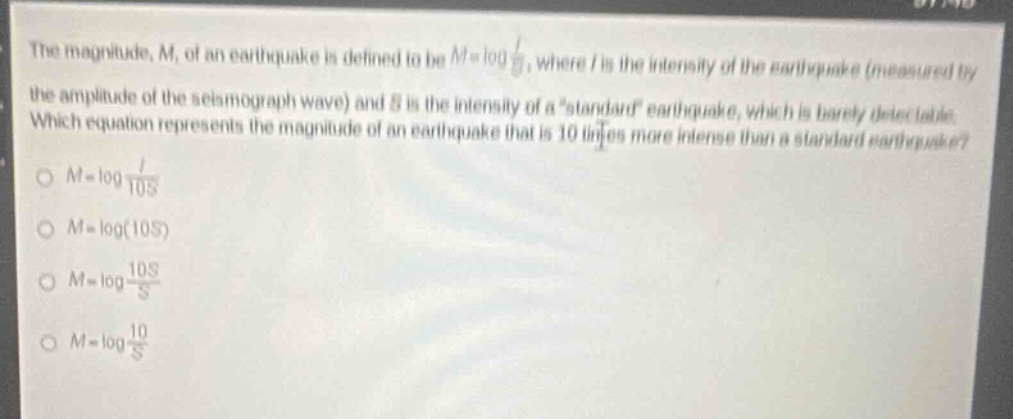
the magnitude, \\(m\\), of an earthquake is defined to be \\(m = \log \frac{i}{s}\\), where \\(i\\) is the intensity of the earthquake (measured by the amplitude of the seismograph wave) and \\(s\\) is the intensity of a \standard\ earthquake, which is barely detectable. which equation represents the magnitude of an earthquake that is 10 times more intense than a standard earthquake?
\\(m = \log \frac{i}{10s}\\)
\\(m = \log(10s)\\)
\\(m = \log \frac{10s}{s}\\)
\\(m = \log \frac{10}{s}\\)
⚡ Using what you learned: Understanding Logarithmic Functions
Step 1: Identify the given formula and variables
The magnitude \(M\) of an earthquake is given by the formula:
where:
- \(I\) is the intensity of the earthquake.
- \(S\) is the intensity of a standard earthquake.
Step 2: Express the new intensity in terms of \(S\)
We are looking for the magnitude of an earthquake that is \(10\) times more intense than a standard earthquake. This means:
Step 3: Substitute the expression into the formula
Substitute \(I = 10S\) into the original magnitude equation:

Snap & solve any problem in the app
Get step-by-step solutions on Sovi AI
Photo-based solutions with guided steps
Explore more problems and detailed explanations
\( M = \log \frac{10S}{S} \)