QUESTION IMAGE
Question
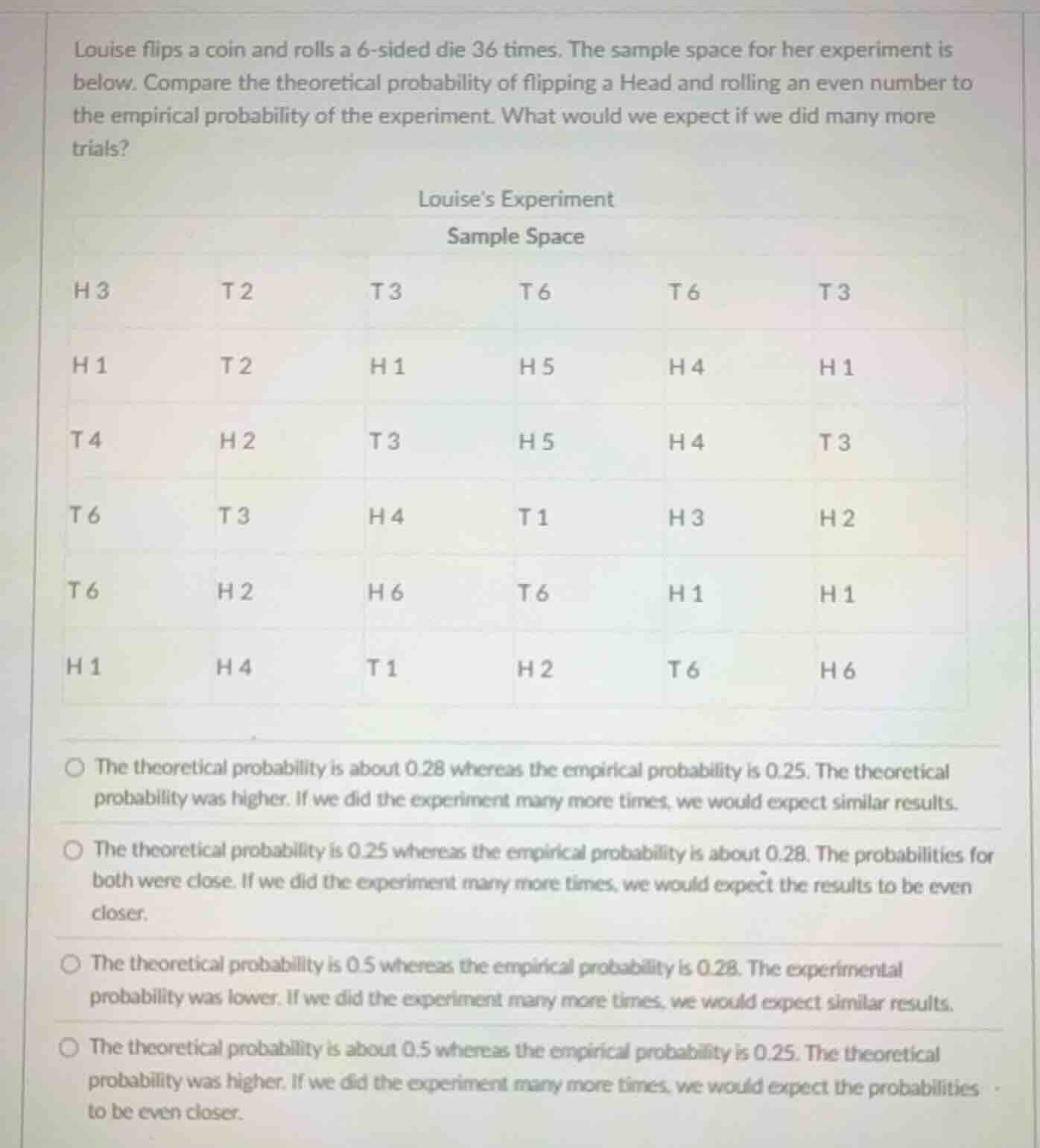
louise flips a coin and rolls a 6-sided die 36 times. the sample space for her experiment is below. compare the theoretical probability of flipping a head and rolling an even number to the empirical probability of the experiment. what would we expect if we did many more trials?
louises experiment
sample space
h 3 | t 2 | t 3 | t 6 | t 6 | t 3
h 1 | t 2 | h 1 | h 5 | h 4 | h 1
t 4 | h 2 | t 3 | h 5 | h 4 | t 3
t 6 | t 3 | h 4 | t 1 | h 3 | h 2
t 6 | h 2 | h 6 | t 6 | h 1 | h 1
h 1 | h 4 | t 1 | h 2 | t 6 | h 6
- the theoretical probability is about 0.28 whereas the empirical probability is 0.25. the theoretical probability was higher. if we did the experiment many more times, we would expect similar results.
- the theoretical probability is 0.25 whereas the empirical probability is about 0.28. the probabilities for both were close. if we did the experiment many more times, we would expect the results to be even closer.
- the theoretical probability is 0.5 whereas the empirical probability is 0.28. the experimental probability was lower. if we did the experiment many more times, we would expect similar results.
- the theoretical probability is about 0.5 whereas the empirical probability is 0.25. the theoretical probability was higher. if we did the experiment many more times, we would expect the probabilities to be even closer.
Calculate theoretical probability
$$
LATEXBLOCK0
$$
Calculate empirical probability from the 36 trials
$$
LATEXBLOCK1
$$
Compare probabilities and apply the Law of Large Numbers
$$
LATEXBLOCK2
$$

Snap & solve any problem in the app
Get step-by-step solutions on Sovi AI
Photo-based solutions with guided steps
Explore more problems and detailed explanations
- (A) The theoretical probability is about 0.28 whereas the empirical probability is 0.25. The theoretical probability was higher. If we did the experiment many more times, we would expect similar results.
- (B) The theoretical probability is 0.25 whereas the empirical probability is about 0.28. The probabilities for both were close. If we did the experiment many more times, we would expect the results to be even closer. (Correct answer)
- (C) The theoretical probability is 0.5 whereas the empirical probability is 0.28. The experimental probability was lower. If we did the experiment many more times, we would expect similar results.
- (D) The theoretical probability is about 0.5 whereas the empirical probability is 0.25. The theoretical probability was higher. If we did the experiment many more times, we would expect the probabilities to be even closer.