QUESTION IMAGE
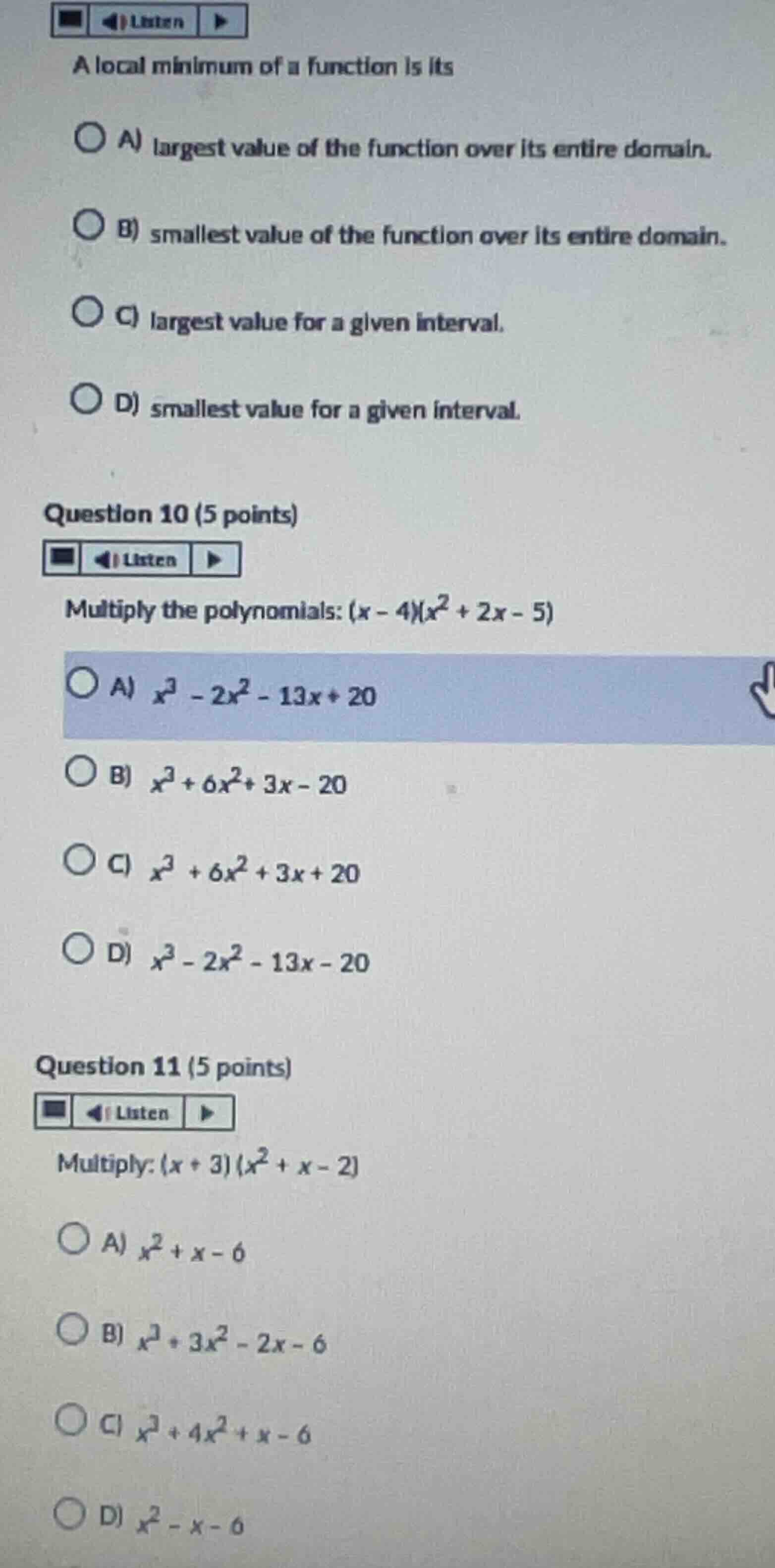
Question
a local minimum of a function is its
a) largest value of the function over its entire domain.
b) smallest value of the function over its entire domain.
c) largest value for a given interval.
d) smallest value for a given interval.
question 10 (5 points)
multiply the polynomials: \\((x - 4)(x^2 + 2x - 5)\\)
a) \\(x^3 - 2x^2 - 13x + 20\\)
b) \\(x^3 + 6x^2 + 3x - 20\\)
c) \\(x^3 + 6x^2 + 3x + 20\\)
d) \\(x^3 - 2x^2 - 13x - 20\\)
question 11 (5 points)
multiply: \\((x + 3)(x^2 + x - 2)\\)
a) \\(x^2 + x - 6\\)
b) \\(x^3 + 3x^2 - 2x - 6\\)
c) \\(x^3 + 4x^2 + x - 6\\)
d) \\(x^2 - x - 6\\)
Define local minimum
Using the Relative Extrema knowledge point
A local minimum is the smallest value that a function takes on within a given neighborhood or interval, rather than over its entire domain.
Multiply first polynomial set
To multiply \((x - 4)(x^2 + 2x - 5)\), we distribute each term in the first polynomial to each term in the second polynomial:
Multiply second polynomial set
To multiply \((x + 3)(x^2 + x - 2)\), we distribute each term in the first polynomial to each term in the second polynomial:

Snap & solve any problem in the app
Get step-by-step solutions on Sovi AI
Photo-based solutions with guided steps
Explore more problems and detailed explanations
Question 1
- (A) largest value of the function over its entire domain.
- (B) smallest value of the function over its entire domain.
- (C) largest value for a given interval.
- (D) smallest value for a given interval. (Correct answer)
Question 10
- (A) \(x^3 - 2x^2 - 13x + 20\) (Correct answer)
- (B) \(x^3 + 6x^2 + 3x - 20\)
- (C) \(x^3 + 6x^2 + 3x + 20\)
- (D) \(x^3 - 2x^2 - 13x - 20\)
Question 11
- (A) \(x^2 + x - 6\)
- (B) \(x^3 + 3x^2 - 2x - 6\)
- (C) \(x^3 + 4x^2 + x - 6\) (Correct answer)
- (D) \(x^2 - x - 6\)