QUESTION IMAGE
Question
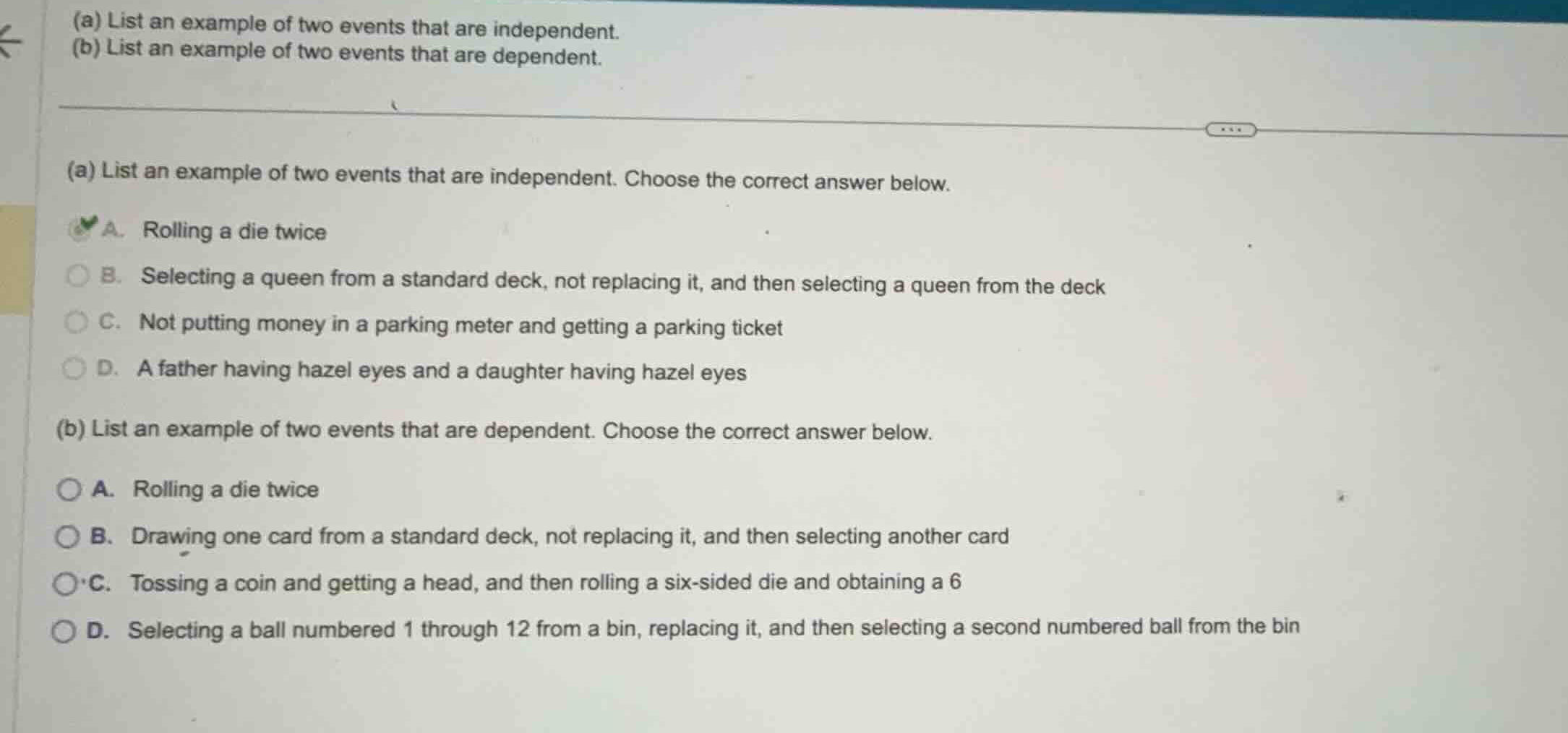
(a) list an example of two events that are independent. choose the correct answer below.
a. rolling a die twice
b. selecting a queen from a standard deck, not replacing it, and then selecting a queen from the deck
c. not putting money in a parking meter and getting a parking ticket
d. a father having hazel eyes and a daughter having hazel eyes
(b) list an example of two events that are dependent. choose the correct answer below.
a. rolling a die twice
b. drawing one card from a standard deck, not replacing it, and then selecting another card
c. tossing a coin and getting a head, and then rolling a six-sided die and obtaining a 6
d. selecting a ball numbered 1 through 12 from a bin, replacing it, and then selecting a second numbered ball from the bin
Analyze independent events
Using the Independent Events Probability knowledge point
Rolling a die twice represents independent events because the outcome of the first roll has absolutely no physical or mathematical influence on the outcome of the second roll.
Analyze dependent events
Using the Dependent Events knowledge point
Drawing a card from a standard deck and not replacing it changes the total number of cards remaining in the deck (from 52 to 51) and alters the composition of the deck, which directly changes the probability of the second draw.

Snap & solve any problem in the app
Get step-by-step solutions on Sovi AI
Photo-based solutions with guided steps
Explore more problems and detailed explanations
Question 1
- A. Rolling a die twice (Correct answer)
- B. Selecting a queen from a standard deck, not replacing it, and then selecting a queen from the deck
- C. Not putting money in a parking meter and getting a parking ticket
- D. A father having hazel eyes and a daughter having hazel eyes
Question 2
- A. Rolling a die twice
- B. Drawing one card from a standard deck, not replacing it, and then selecting another card (Correct answer)
- C. Tossing a coin and getting a head, and then rolling a six-sided die and obtaining a 6
- D. Selecting a ball numbered 1 through 12 from a bin, replacing it, and then selecting a second numbered ball from the bin