QUESTION IMAGE
Question
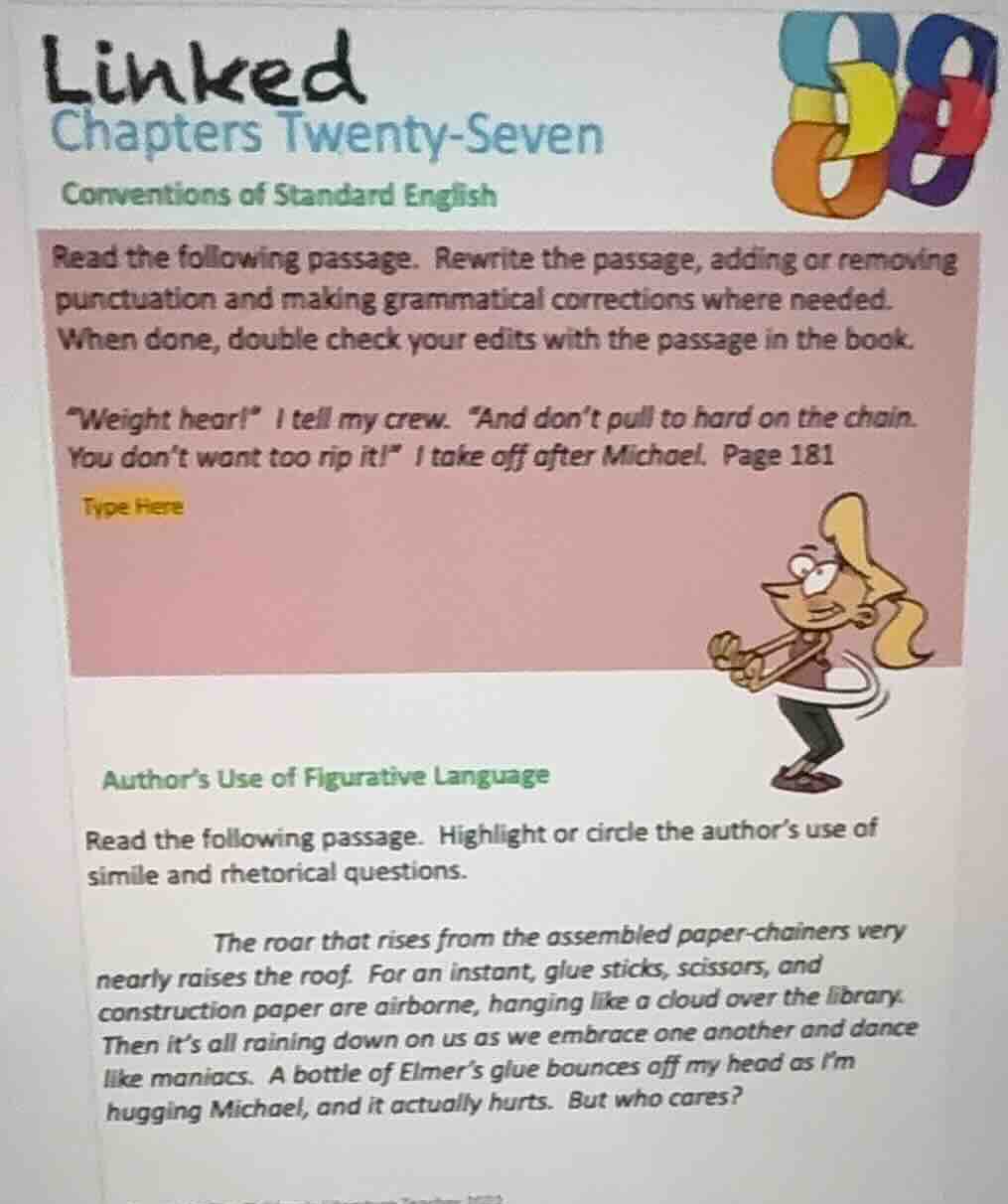
linked
chapters twenty-seven
conventions of standard english
read the following passage. rewrite the passage, adding or removing punctuation and making grammatical corrections where needed. when done, double check your edits with the passage in the book.
\weight hear!\ i tell my crew. \and dont pull to hard on the chain. you dont want too rip it!\ i take off after michael. page 181
authors use of figurative language
read the following passage. highlight or circle the authors use of simile and rhetorical questions.
the roar that rises from the assembled paper-chainers very nearly raises the roof. for an instant, glue sticks, scissors, and construction paper are airborne, hanging like a cloud over the library. then its all raining down on us as we embrace one another and dance like maniacs. a bottle of elmers glue bounces off my head as im hugging michael, and it actually hurts. but who cares?
🆕 New Concept Discovered: Homophones and Figurative Language Devices
Using the correct word spelling and identifying literary comparisons.
---
Step 1: Analyze the first passage for grammatical and spelling errors
Let's look closely at the first passage:
"Weight hear!" I tell my crew. "And don't pull to hard on the chain. You don't want too rip it!" I take off after Michael.
We need to identify and correct the errors:
- "Weight hear!":
- Weight is a homophone for Wait. In this context, the speaker is telling the crew to pause or hold on, so it should be Wait.
- hear is a homophone for here. The phrase "Wait here!" makes grammatical sense as a command indicating location.
- "pull to hard":
- to is a preposition or part of an infinitive verb.
- too is an adverb meaning "excessively" or "also". Since they shouldn't pull excessively hard, it must be corrected to too.
- "want too rip it!":
- too is used incorrectly here before the verb "rip". It should be the infinitive marker to, as in "to rip".
---
Step 2: Rewrite the corrected first passage
Applying the corrections from Step 1:
- "Weight hear!" becomes "Wait here!"
- "...pull to hard..." becomes "...pull too hard..."
- "...want too rip it!" becomes "...want to rip it!"
Corrected Passage:
"Wait here!" I tell my crew. "And don't pull too hard on the chain. You don't want to rip it!" I take off after Michael.
---
Step 3: Identify similes in the second passage
A simile is a figure of speech that directly compares two different things using comparison words such as "like" or "as".
Let's read the second passage to find these comparisons:
- "...hanging like a cloud over the library."
- This compares the airborne craft supplies to a cloud using the word like.
- "...dance like maniacs."
- This compares the way they are dancing to how maniacs behave using the word like.
---
Step 4: Identify rhetorical questions in the second passage
A rhetorical question is a question asked to make a point or for dramatic effect rather than to get an actual answer.
Let's look at the end of the second passage:
- "...But who cares?"
- This is a question that does not expect a literal answer; it is used to emphasize that nobody minds the minor pain because of the excitement.
---

Snap & solve any problem in the app
Get step-by-step solutions on Sovi AI
Photo-based solutions with guided steps
Explore more problems and detailed explanations
Part 1: Conventions of Standard English (Rewritten Passage)
"Wait here!" I tell my crew. "And don't pull too hard on the chain. You don't want to rip it!" I take off after Michael.
---
Part 2: Author's Use of Figurative Language
- Similes:
- "...hanging like a cloud over the library."
- "...dance like maniacs."
- Rhetorical Question:
- "...But who cares?"