QUESTION IMAGE
Question
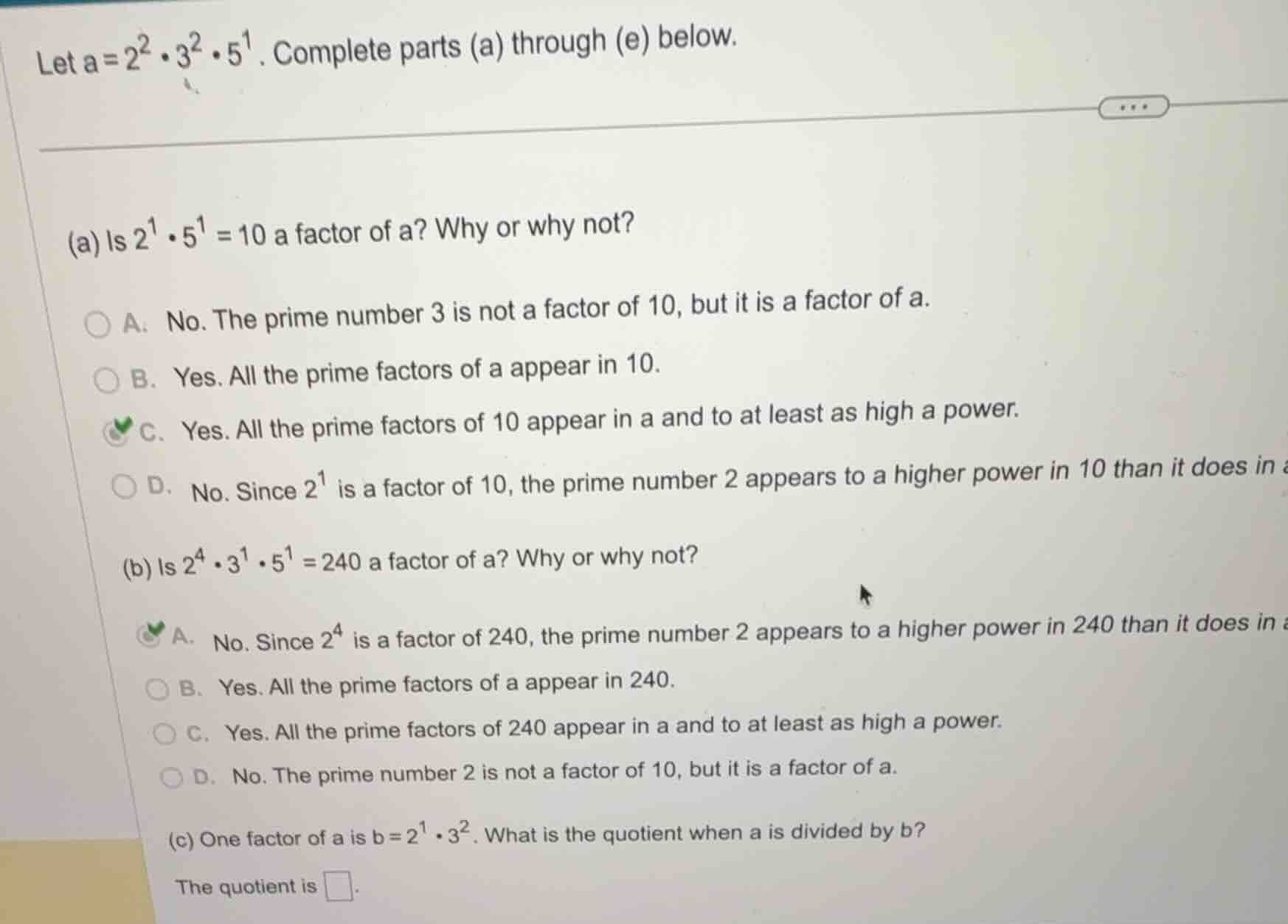
let \\(a = 2^2 \cdot 3^2 \cdot 5^1\\). complete parts (a) through (e) below.
(a) is \\(2^1 \cdot 5^1 = 10\\) a factor of a? why or why not?
a. no. the prime number 3 is not a factor of 10, but it is a factor of a.
b. yes. all the prime factors of a appear in 10.
c. yes. all the prime factors of 10 appear in a and to at least as high a power.
d. no. since \\(2^1\\) is a factor of 10, the prime number 2 appears to a higher power in 10 than it does in a.
(b) is \\(2^4 \cdot 3^1 \cdot 5^1 = 240\\) a factor of a? why or why not?
a. no. since \\(2^4\\) is a factor of 240, the prime number 2 appears to a higher power in 240 than it does in a.
b. yes. all the prime factors of a appear in 240.
c. yes. all the prime factors of 240 appear in a and to at least as high a power.
d. no. the prime number 2 is not a factor of 10, but it is a factor of a.
(c) one factor of a is \\(b = 2^1 \cdot 3^2\\). what is the quotient when a is divided by b?
the quotient is .
Analyze divisibility for part (a)
Using the Prime Factorization Divisibility knowledge point, we compare the prime factorization of \(10 = 2^1 \cdot 5^1\) with \(a = 2^2 \cdot 3^2 \cdot 5^1\).
For \(10\) to be a factor of \(a\), every prime factor of \(10\) must appear in \(a\) with an exponent less than or equal to its exponent in \(a\).
- For prime \(2\): exponent in \(10\) is \(1 \le 2\) (exponent in \(a\)).
- For prime \(5\): exponent in \(10\) is \(1 \le 1\) (exponent in \(a\)).
Thus, \(10\) is a factor of \(a\) because all prime factors of \(10\) appear in \(a\) to at least as high a power. This matches option C.
Analyze divisibility for part (b)
Using the Prime Factorization Divisibility knowledge point, we compare the prime factorization of \(240 = 2^4 \cdot 3^1 \cdot 5^1\) with \(a = 2^2 \cdot 3^2 \cdot 5^1\).
For \(240\) to be a factor of \(a\), every prime factor of \(240\) must appear in \(a\) with an exponent less than or equal to its exponent in \(a\).
- For prime \(2\): exponent in \(240\) is \(4\), which is greater than \(2\) (exponent in \(a\)).
Thus, \(240\) is not a factor of \(a\) because the prime number \(2\) appears to a higher power in \(240\) than it does in \(a\). This matches option A.
Calculate the quotient for part (c)
We divide \(a\) by \(b\) using their prime factorizations:
The quotient is:

Snap & solve any problem in the app
Get step-by-step solutions on Sovi AI
Photo-based solutions with guided steps
Explore more problems and detailed explanations
Question (a)
- A. No. The prime number 3 is not a factor of 10, but it is a factor of a.
- B. Yes. All the prime factors of a appear in 10.
- C. Yes. All the prime factors of 10 appear in a and to at least as high a power. (Correct answer)
- D. No. Since \(2^1\) is a factor of 10, the prime number 2 appears to a higher power in 10 than it does in a.
Question (b)
- A. No. Since \(2^4\) is a factor of 240, the prime number 2 appears to a higher power in 240 than it does in a. (Correct answer)
- B. Yes. All the prime factors of a appear in 240.
- C. Yes. All the prime factors of 240 appear in a and to at least as high a power.
- D. No. The prime number 2 is not a factor of 10, but it is a factor of a.
Question (c)
The quotient is <blank>10</blank>.