QUESTION IMAGE
Question
lesson 9.2 checkpoint
once you have completed the above problems and checked your solutions, complete the lesson checkpoint below.
complete the lesson reflection above by circling your current understanding of the learning goal.
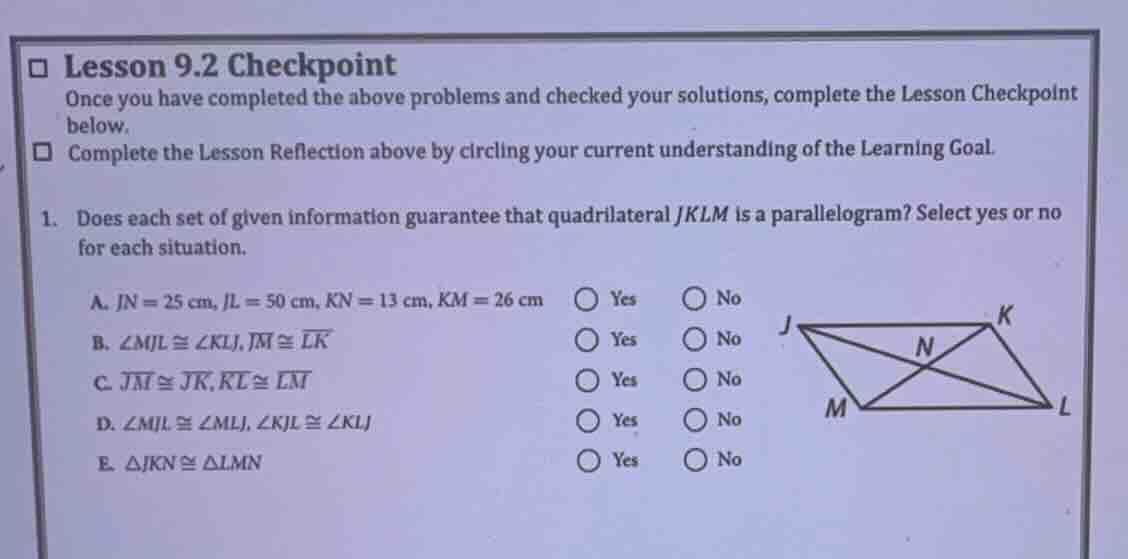
- does each set of given information guarantee that quadrilateral \\(jklm\\) is a parallelogram? select yes or no for each situation.
a. \\(jn = 25\text{ cm}, jl = 50\text{ cm}, kn = 13\text{ cm}, km = 26\text{ cm}\\) yes no
b. \\(\angle mjl \cong \angle klj, jm \cong lk\\) yes no
c. \\(jm \cong jk, kl \cong lm\\) yes no
d. \\(\angle mjl \cong \angle mlj, \angle kjl \cong \angle klj\\) yes no
e. \\(\delta jkn \cong \delta lmn\\) yes no
Analyze diagonal bisection condition
Using the Parallelogram Diagonal Properties and Converse of Parallelogram Theorems knowledge points
Since the diagonals bisect each other, \(JKLM\) is guaranteed to be a parallelogram.
Analyze alternate interior angles and opposite sides
Using the Converse of Parallelogram Theorems knowledge point
One pair of opposite sides is both parallel and congruent, which guarantees a parallelogram.
Analyze adjacent side congruence
Using the Converse of Parallelogram Theorems knowledge point
Congruence of adjacent sides defines a kite, not necessarily a parallelogram. Thus, it does not guarantee a parallelogram.
Analyze angle bisector conditions
Using the Converse of Parallelogram Theorems knowledge point
This implies \(MJ \cong ML\) and \(KJ \cong KL\), which describes a kite, not necessarily a parallelogram.
Analyze triangle congruence condition
Using the Converse of Parallelogram Theorems knowledge point

Snap & solve any problem in the app
Get step-by-step solutions on Sovi AI
Photo-based solutions with guided steps
Explore more problems and detailed explanations
| No. | Problem | Answer |
|---|---|---|
| B | \(\angle MJL \cong \angle KLJ, JM \cong LK\) | Yes |
| C | \(JM \cong JK, KL \cong LM\) | No |
| D | \(\angle MJL \cong \angle MLJ, \angle KJL \cong \angle KLJ\) | No |
| E | \(\Delta JKN \cong \Delta LMN\) | Yes |