QUESTION IMAGE
Question
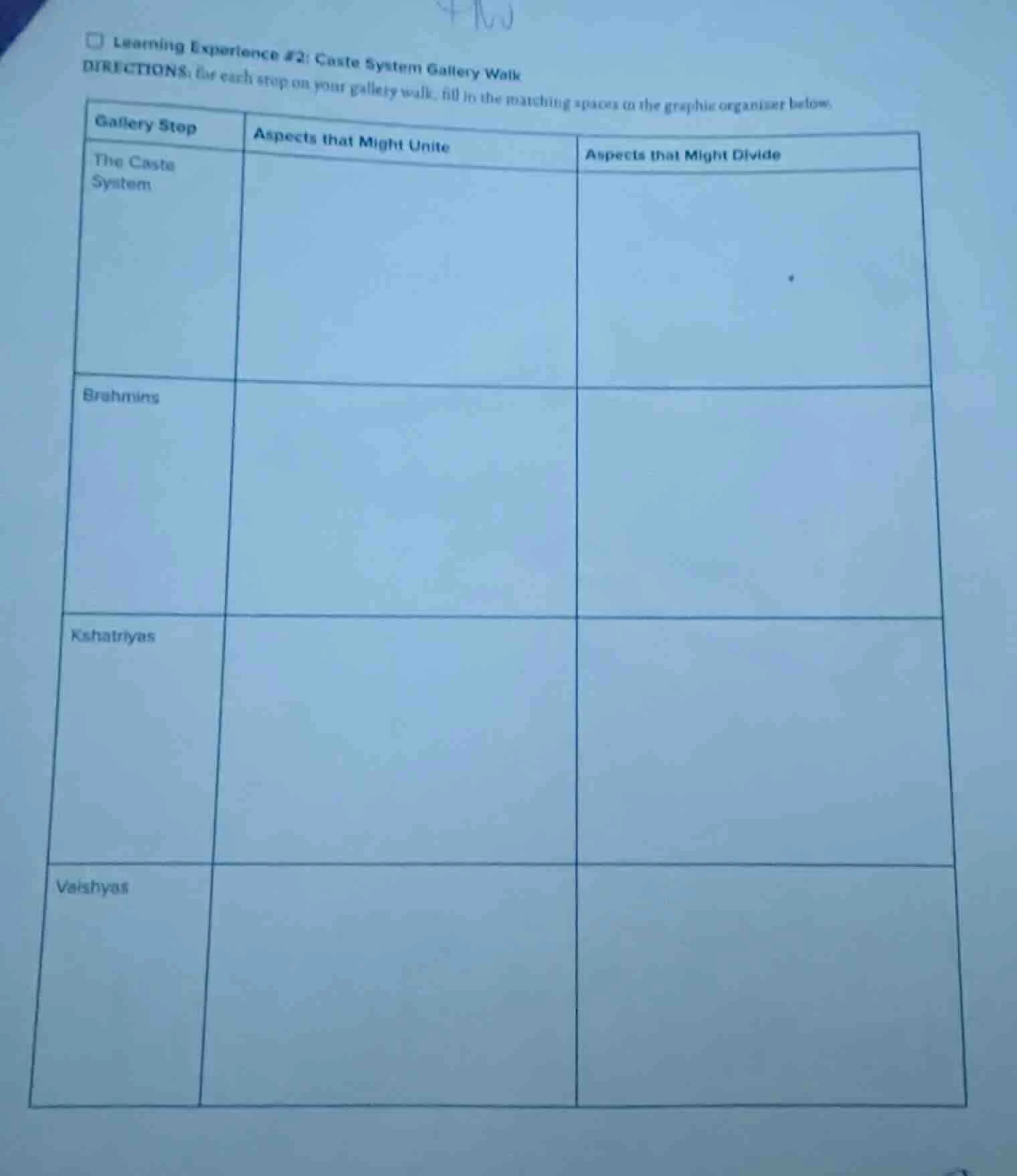
learning experience #2: caste system gallery walk directions: for each stop on your gallery walk, fill in the matching spaces to the graphic organiser below.
gallery stop | aspects that might unite | aspects that might divide
the caste system | |
brahmins | |
kshatriyas | |
vaishyas | |
To complete this graphic organizer about the Caste System, we analyze each gallery stop:
1. The Caste System
- Aspects that Might Unite: Shared cultural/religious traditions (e.g., Hinduism), common historical heritage, adherence to dharma (duty) as a societal framework.
- Aspects that Might Divide: Rigid hierarchical structure (unequal social status), restrictions on inter-caste interactions (marriage, dining), economic exploitation of lower castes.
2. Brahmins
- Aspects that Might Unite: Shared role as religious/intellectual leaders, access to education/scriptures, high social prestige, endogamous marriage practices (marrying within Brahmins).
- Aspects that Might Divide: Sub-caste divisions (e.g., regional Brahmin groups), competition for religious authority, varying economic statuses (some wealthy, some poor).
3. Kshatriyas
- Aspects that Might Unite: Role as warriors/rulers, shared duty to protect society, endogamous marriage, pride in martial heritage.
- Aspects that Might Divide: Regional power struggles (competing kingdoms), sub-caste hierarchies, economic disparities (ruling elites vs. lesser warriors).
4. Vaishyas
- Aspects that Might Unite: Role as merchants/artisans, shared economic goals (trade/production), endogamous marriage, caste-based guilds.
- Aspects that Might Divide: Economic competition (trade rivalries), sub-caste divisions (e.g., different merchant groups), exploitation by higher castes (taxes, social restrictions).
Filled Table (Example):
| Gallery Stop | Aspects that Might Unite | Aspects that Might Divide |
|---|---|---|
| Brahmins | Religious leadership, access to education, endogamy, high prestige. | Sub-caste divisions, competition for authority, economic disparities. |
| Kshatriyas | Warrior/ruler role, martial heritage, endogamy, duty to protect. | Regional power struggles, sub-caste hierarchies, economic gaps. |
| Vaishyas | Merchant/artisan role, economic goals, endogamy, caste guilds. | Trade rivalries, sub-caste divisions, exploitation by higher castes. |
This analysis uses historical and sociological context to identify unifying and dividing factors for each caste-related group.

Snap & solve any problem in the app
Get step-by-step solutions on Sovi AI
Photo-based solutions with guided steps
Explore more problems and detailed explanations
To complete this graphic organizer about the Caste System, we analyze each gallery stop:
1. The Caste System
- Aspects that Might Unite: Shared cultural/religious traditions (e.g., Hinduism), common historical heritage, adherence to dharma (duty) as a societal framework.
- Aspects that Might Divide: Rigid hierarchical structure (unequal social status), restrictions on inter-caste interactions (marriage, dining), economic exploitation of lower castes.
2. Brahmins
- Aspects that Might Unite: Shared role as religious/intellectual leaders, access to education/scriptures, high social prestige, endogamous marriage practices (marrying within Brahmins).
- Aspects that Might Divide: Sub-caste divisions (e.g., regional Brahmin groups), competition for religious authority, varying economic statuses (some wealthy, some poor).
3. Kshatriyas
- Aspects that Might Unite: Role as warriors/rulers, shared duty to protect society, endogamous marriage, pride in martial heritage.
- Aspects that Might Divide: Regional power struggles (competing kingdoms), sub-caste hierarchies, economic disparities (ruling elites vs. lesser warriors).
4. Vaishyas
- Aspects that Might Unite: Role as merchants/artisans, shared economic goals (trade/production), endogamous marriage, caste-based guilds.
- Aspects that Might Divide: Economic competition (trade rivalries), sub-caste divisions (e.g., different merchant groups), exploitation by higher castes (taxes, social restrictions).
Filled Table (Example):
| Gallery Stop | Aspects that Might Unite | Aspects that Might Divide |
|---|---|---|
| Brahmins | Religious leadership, access to education, endogamy, high prestige. | Sub-caste divisions, competition for authority, economic disparities. |
| Kshatriyas | Warrior/ruler role, martial heritage, endogamy, duty to protect. | Regional power struggles, sub-caste hierarchies, economic gaps. |
| Vaishyas | Merchant/artisan role, economic goals, endogamy, caste guilds. | Trade rivalries, sub-caste divisions, exploitation by higher castes. |
This analysis uses historical and sociological context to identify unifying and dividing factors for each caste-related group.