Sovi.AI - AI Math Tutor

Scan to solve math questions

QUESTION IMAGE

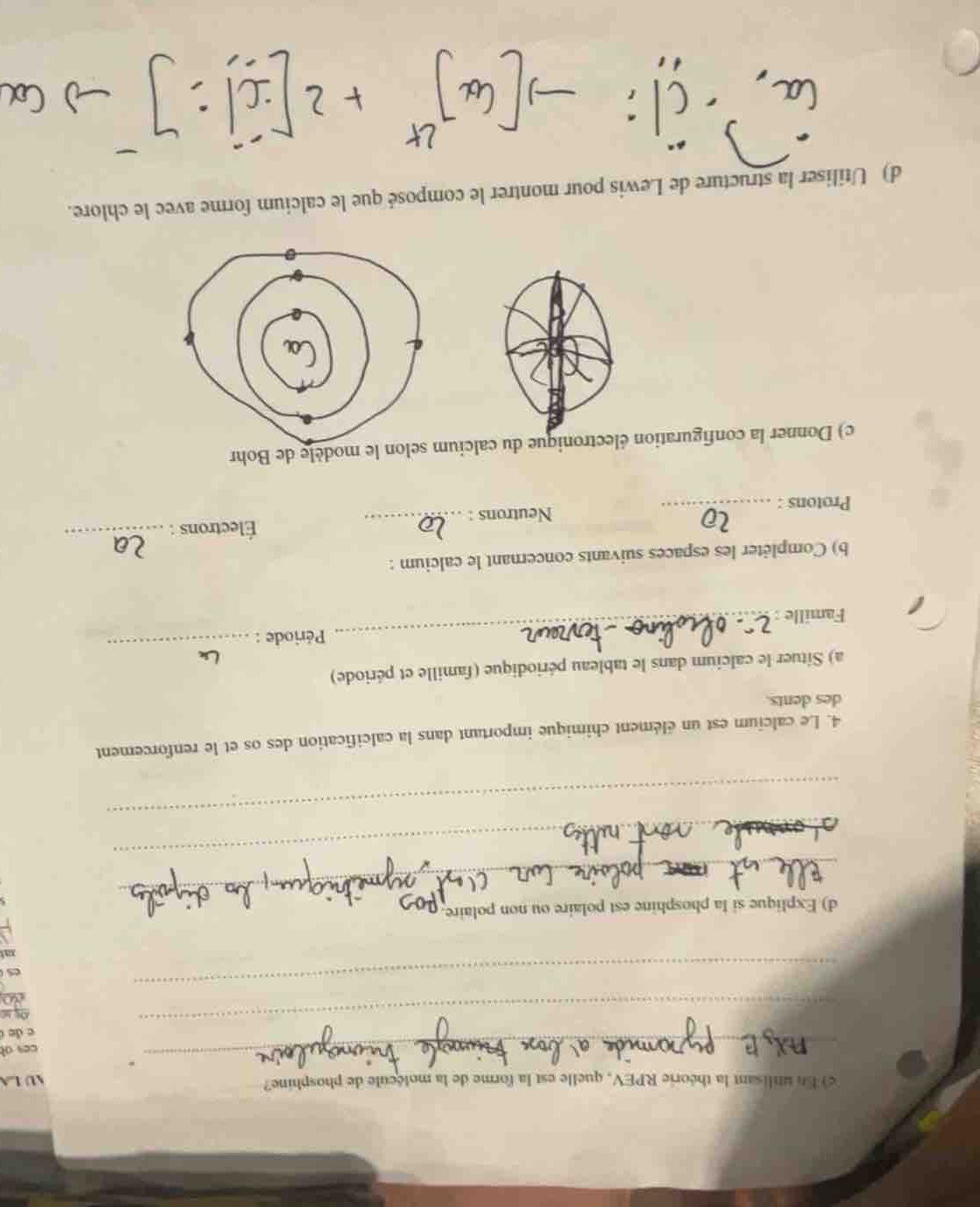
4. le calcium est un élément chimique important dans la calcification d…

Question

  1. le calcium est un élément chimique important dans la calcification des os et le renforcement des dents.

a) situer le calcium dans le tableau périodique (famille et période)
b) compléter les espaces suivants concernant le calcium :
protons : ... neutrons : ... électrons : ...
c) donner la configuration électronique du calcium selon le modèle de bohr
d) utiliser la structure de lewis pour montrer le composé que le calcium forme avec le chlore.

Explanation:

Response

<pre_analysis>
{
"quality": "clear",
"question_count": 6,
"skills_matched": [
"step_cot",
"explain_then_answer",
"tutor",
"mastery_adaptive_brevity"
],
"needs_drawing": false,
"concepts_used": [
"Lewis Structures"
],
"new_concepts": [
"Bohr Model",
"VSEPR Theory",
"Molecular Geometry"
],
"current_concepts": [
"Lewis Structures",
"Bohr Model",
"VSEPR Theory",
"Molecular Geometry",
"Chemical Bond Polarity",
"Periodic Table Trends"
]
}
</pre_analysis>

<reasoning>

Orient the upside-down image

The provided image is oriented upside down (rotated 180 degrees). Let's read and translate the questions from French to English, starting from the top of the page (which is at the bottom of the upside-down image) to the bottom of the page (which is at the top of the upside-down image).

Section 1 (Phosphine questions):

  • c) En utilisant la théorie RPEV, quelle est la forme de la molécule de phosphine?

Translation: Using VSEPR theory, what is the shape of the phosphine molecule?
Student's handwritten answer: \(AX_3E\) pyramide à base triangle triangulaire (Trigonal pyramidal).

  • d) Explique si la phosphine est polaire ou non polaire.

Translation: Explain whether phosphine is polar or non-polar.
Student's handwritten answer: Elle est polaire car c'est asymétrique, les dipôles ne s'annulent pas. (It is polar because it is asymmetrical, the dipoles do not cancel out).

Section 2 (Calcium questions):

  • 4. Le calcium est un élément chimique important dans la calcification des os et le renforcement des dents.

Translation: Calcium is an important chemical element in the calcification of bones and strengthening of teeth.

  • a) Situer le calcium dans le tableau périodique (famille et période)

Translation: Locate calcium in the periodic table (group/family and period).
Student's handwritten answer: Famille: 2 - alcalino-terreux (Alkaline earth metals), Période: 4.

  • b) Compléter les espaces suivants concernant le calcium:

Translation: Complete the following spaces concerning calcium:
Protons: 20, Neutrons: 20, Électrons: 20.

  • c) Donner la configuration électronique du calcium selon le modèle de Bohr

Translation: Give the electron configuration of calcium according to the Bohr model.
Visual: A Bohr model diagram showing shells with 2, 8, 8, and 2 electrons.

  • d) Utiliser la structure de Lewis pour montrer le composé que le calcium forme avec le chlore.

Translation: Use Lewis structures to show the compound that calcium forms with chlorine.
Visual: \(Ca \cdot + 2 \cdot \ddot{Cl}:
ightarrow [Ca]^{2+} + 2 [:\ddot{Cl}:]^-\) (or \(CaCl_2\)).

Analyze Phosphine shape and polarity

Using the Lewis Structures knowledge point:

  • Phosphine (\(PH_3\)) has phosphorus (\(P\)) as the central atom. Phosphorus has 5 valence electrons, and each hydrogen has 1 valence electron.
  • The Lewis structure shows \(P\) bonded to three \(H\) atoms with one lone pair remaining on \(P\).
  • This corresponds to the VSEPR steric formula \(AX_3E\).
  • The electron-pair geometry is tetrahedral, and the molecular geometry (shape) is trigonal pyramidal.
  • Because of the lone pair, the molecule is asymmetrical, meaning the individual polar \(P-H\) bond dipoles do not cancel out. Therefore, phosphine is a polar molecule.

Analyze Calcium properties

Using the Lewis Structures knowledge point:

  • Location: Calcium (\(Ca\)) has atomic number 20. It is located in Period 4, Group 2 (Alkaline Earth Metals).
  • **Subatom…

Answer:

<pre_analysis>
{
"quality": "clear",
"question_count": 6,
"skills_matched": [
"step_cot",
"explain_then_answer",
"tutor",
"mastery_adaptive_brevity"
],
"needs_drawing": false,
"concepts_used": [
"Lewis Structures"
],
"new_concepts": [
"Bohr Model",
"VSEPR Theory",
"Molecular Geometry"
],
"current_concepts": [
"Lewis Structures",
"Bohr Model",
"VSEPR Theory",
"Molecular Geometry",
"Chemical Bond Polarity",
"Periodic Table Trends"
]
}
</pre_analysis>

<reasoning>

Orient the upside-down image

The provided image is oriented upside down (rotated 180 degrees). Let's read and translate the questions from French to English, starting from the top of the page (which is at the bottom of the upside-down image) to the bottom of the page (which is at the top of the upside-down image).

Section 1 (Phosphine questions):

  • c) En utilisant la théorie RPEV, quelle est la forme de la molécule de phosphine?

Translation: Using VSEPR theory, what is the shape of the phosphine molecule?
Student's handwritten answer: \(AX_3E\) pyramide à base triangle triangulaire (Trigonal pyramidal).

  • d) Explique si la phosphine est polaire ou non polaire.

Translation: Explain whether phosphine is polar or non-polar.
Student's handwritten answer: Elle est polaire car c'est asymétrique, les dipôles ne s'annulent pas. (It is polar because it is asymmetrical, the dipoles do not cancel out).

Section 2 (Calcium questions):

  • 4. Le calcium est un élément chimique important dans la calcification des os et le renforcement des dents.

Translation: Calcium is an important chemical element in the calcification of bones and strengthening of teeth.

  • a) Situer le calcium dans le tableau périodique (famille et période)

Translation: Locate calcium in the periodic table (group/family and period).
Student's handwritten answer: Famille: 2 - alcalino-terreux (Alkaline earth metals), Période: 4.

  • b) Compléter les espaces suivants concernant le calcium:

Translation: Complete the following spaces concerning calcium:
Protons: 20, Neutrons: 20, Électrons: 20.

  • c) Donner la configuration électronique du calcium selon le modèle de Bohr

Translation: Give the electron configuration of calcium according to the Bohr model.
Visual: A Bohr model diagram showing shells with 2, 8, 8, and 2 electrons.

  • d) Utiliser la structure de Lewis pour montrer le composé que le calcium forme avec le chlore.

Translation: Use Lewis structures to show the compound that calcium forms with chlorine.
Visual: \(Ca \cdot + 2 \cdot \ddot{Cl}:
ightarrow [Ca]^{2+} + 2 [:\ddot{Cl}:]^-\) (or \(CaCl_2\)).

Analyze Phosphine shape and polarity

Using the Lewis Structures knowledge point:

  • Phosphine (\(PH_3\)) has phosphorus (\(P\)) as the central atom. Phosphorus has 5 valence electrons, and each hydrogen has 1 valence electron.
  • The Lewis structure shows \(P\) bonded to three \(H\) atoms with one lone pair remaining on \(P\).
  • This corresponds to the VSEPR steric formula \(AX_3E\).
  • The electron-pair geometry is tetrahedral, and the molecular geometry (shape) is trigonal pyramidal.
  • Because of the lone pair, the molecule is asymmetrical, meaning the individual polar \(P-H\) bond dipoles do not cancel out. Therefore, phosphine is a polar molecule.

Analyze Calcium properties

Using the Lewis Structures knowledge point:

  • Location: Calcium (\(Ca\)) has atomic number 20. It is located in Period 4, Group 2 (Alkaline Earth Metals).
  • Subatomic Particles: For a neutral calcium-40 atom (\(^{40}_{20}Ca\)):
  • Protons = 20
  • Electrons = 20
  • Neutrons = Mass number - Atomic number = 40 - 20 = 20.
  • Bohr Model: The 20 electrons are distributed in shells as: 2 in the first shell (\(n=1\)), 8 in the second (\(n=2\)), 8 in the third (\(n=3\)), and 2 in the fourth (\(n=4\)).
  • Lewis Structure Reaction:
  • Calcium has 2 valence electrons: \(\cdot Ca \cdot\)
  • Chlorine has 7 valence electrons: \(\cdot \ddot{Cl}:\)
  • Calcium transfers its 2 valence electrons to two chlorine atoms, forming \(Ca^{2+}\) and two \(Cl^-\) ions:

\[ \cdot Ca \cdot + 2 \cdot \ddot{Cl}:
ightarrow [Ca]^{2+} + 2 [:\ddot{Cl}:]^- \]

Format the final answers

We will present the translated questions and their correct answers clearly.
</reasoning>

<answer>

Question c (Phosphine Shape)

Using VSEPR theory, the shape of the phosphine (\(PH_3\)) molecule is trigonal pyramidal (steric formula \(AX_3E\)).

Question d (Phosphine Polarity)

Phosphine is a polar molecule. Because of the lone pair of electrons on the central phosphorus atom, the molecular geometry is asymmetrical, meaning the individual bond dipoles do not cancel each other out.

---

Question 4a (Calcium Location)

  • Group (Family): Group 2 (Alkaline earth metals)
  • Period: Period 4

Question 4b (Calcium Subatomic Particles)

  • Protons: 20
  • Neutrons: 20 (for the most common isotope, Calcium-40)
  • Electrons: 20

Question 4c (Bohr Model of Calcium)

The electron configuration of calcium (\(Ca\)) according to the Bohr model is 2, 8, 8, 2:

  • Shell 1 (\(n=1\)): 2 electrons
  • Shell 2 (\(n=2\)): 8 electrons
  • Shell 3 (\(n=3\)): 8 electrons
  • Shell 4 (\(n=4\)): 2 electrons

Question 4d (Lewis Structure of Calcium Chloride Formation)

The ionic compound formation between calcium and chlorine using Lewis structures is represented as:
\[ \cdot\text{Ca}\cdot + 2 \cdot\ddot{\text{Cl}}:
ightarrow [\text{Ca}]^{2+} + 2 [:\ddot{\text{Cl}}:]^- \]
This forms the ionic compound calcium chloride, \(\text{CaCl}_2\).
</answer>

<post_analysis>
{
"subject": "Natural Science",
"question_type": "Multi-part",
"knowledge_point": [
"Natural Science",
"Chemistry",
"VSEPR Theory and Molecular Geometry"
]
}
</post_analysis>