Sovi.AI - AI Math Tutor

Scan to solve math questions

QUESTION IMAGE

layla tried to define a rotation. * for the center point \\(c\\), the i…

Question

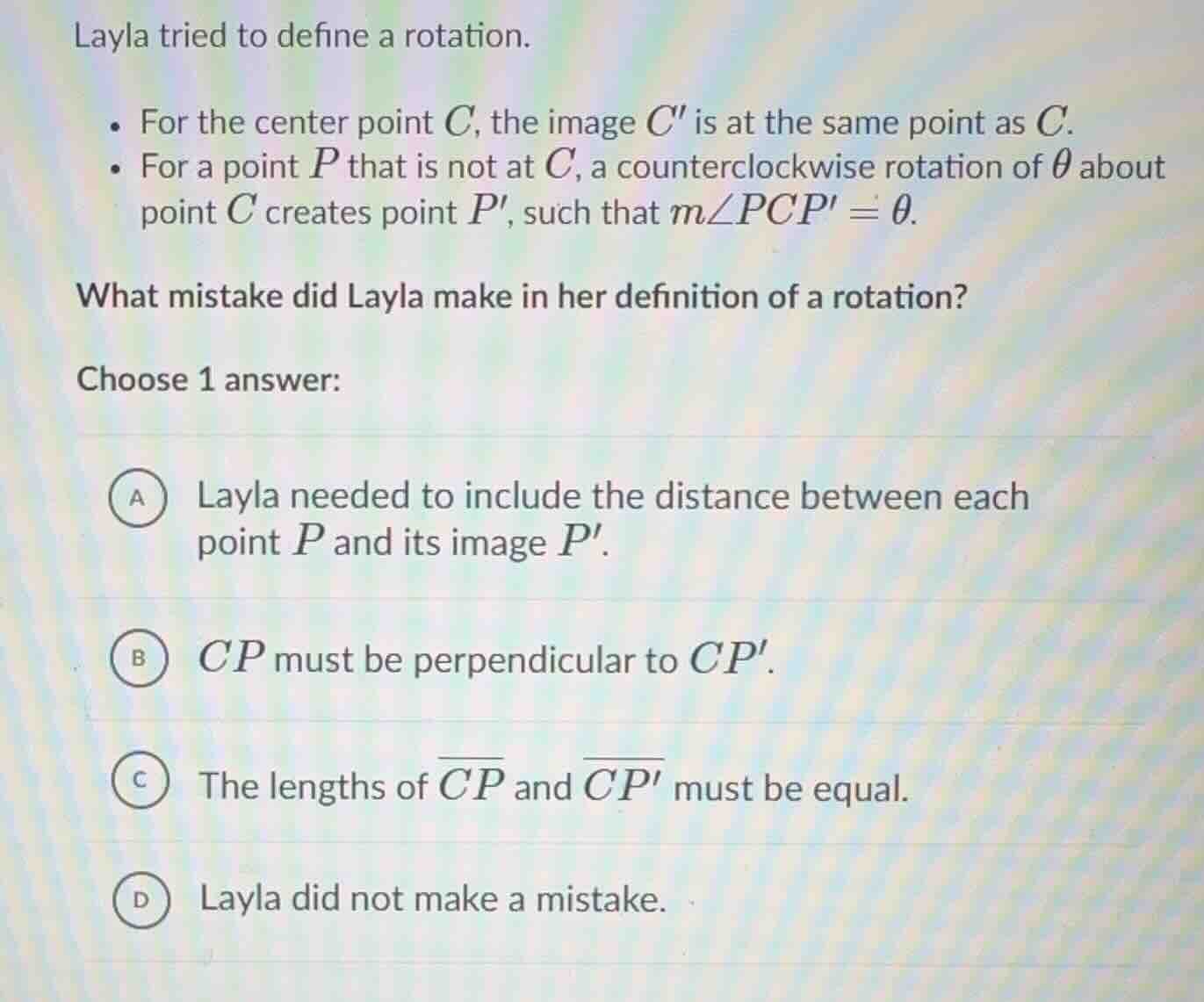
layla tried to define a rotation.

  • for the center point \\(c\\), the image \\(c\\) is at the same point as \\(c\\).
  • for a point \\(p\\) that is not at \\(c\\), a counterclockwise rotation of \\(\theta\\) about point \\(c\\) creates point \\(p\\), such that \\(m\angle pcp = \theta\\).

what mistake did layla make in her definition of a rotation?

choose 1 answer:

(a) layla needed to include the distance between each point \\(p\\) and its image \\(p\\).
(b) \\(cp\\) must be perpendicular to \\(cp\\).
(c) the lengths of \\(\overline{cp}\\) and \\(\overline{cp}\\) must be equal.
(d) layla did not make a mistake.

Explanation:

Response

<pre_analysis>
{
"quality": "clear",
"question_count": 1,
"skills_matched": [
"direct_cot",
"multiple_choice_formatter",
"explain_then_answer",
"tutor",
"mastery_adaptive_brevity"
],
"needs_drawing": false,
"concepts_used": [
"Rotations in Geometry",
"Angle of Rotation"
],
"new_concepts": [],
"current_concepts": [
"Rotations in Geometry",
"Angle of Rotation"
]
}
</pre_analysis>

<reasoning>

Analyze the definition of rotation

Using the Rotations in Geometry knowledge point, we examine Layla's proposed definition. A complete geometric rotation about a center point \(C\) by an angle \(\theta\) must specify two conditions for any point \(P\) (where \(P
eq C\)):

  1. The angle of rotation: \(m\angle PCP' = \theta\).
  2. The preservation of distance from the center: \(CP = CP'\).

Identify the missing condition

Using the Angle of Rotation knowledge point, we see Layla correctly stated the angle condition \(m\angle PCP' = \theta\). However, without specifying that the distance from the center \(C\) to the point \(P\) must equal the distance from \(C\) to the image \(P'\), the point \(P'\) could lie anywhere along the ray forming the angle \(\theta\) with ray \(CP\). Thus, the lengths of segment \(\overline{CP}\) and segment \(\overline{CP'}\) must be equal.

Evaluate the given options

  • Option (A) is incorrect because the absolute distance between \(P\) and \(P'\) varies depending on the angle and distance from the center, so it is not a fixed part of the definition.
  • Option (B) is incorrect because \(CP\) is only perpendicular to \(CP'\) when \(\theta = 90^\circ\).
  • Option (C) correctly identifies that the lengths of \(\overline{CP}\) and \(\overline{CP'}\) must be equal to preserve distance.
  • Option (D) is incorrect because Layla did make a mistake.

</reasoning>

<answer>
<mcq-option>(A) Layla needed to include the distance between each point \(P\) and its image \(P'\).</mcq-option>
<mcq-option>(B) \(CP\) must be perpendicular to \(CP'\).</mcq-option>
<mcq-correct>(C) The lengths of \(\overline{CP}\) and \(\overline{CP'}\) must be equal.</mcq-correct>
<mcq-option>(D) Layla did not make a mistake.</mcq-option>
</answer>

<post_analysis>
{
"subject": "Mathematics",
"question_type": "Multiple Choice",
"knowledge_point": [
"Mathematics",
"Geometry",
"Rotations in Geometry"
]
}
</post_analysis>

Answer:

<pre_analysis>
{
"quality": "clear",
"question_count": 1,
"skills_matched": [
"direct_cot",
"multiple_choice_formatter",
"explain_then_answer",
"tutor",
"mastery_adaptive_brevity"
],
"needs_drawing": false,
"concepts_used": [
"Rotations in Geometry",
"Angle of Rotation"
],
"new_concepts": [],
"current_concepts": [
"Rotations in Geometry",
"Angle of Rotation"
]
}
</pre_analysis>

<reasoning>

Analyze the definition of rotation

Using the Rotations in Geometry knowledge point, we examine Layla's proposed definition. A complete geometric rotation about a center point \(C\) by an angle \(\theta\) must specify two conditions for any point \(P\) (where \(P
eq C\)):

  1. The angle of rotation: \(m\angle PCP' = \theta\).
  2. The preservation of distance from the center: \(CP = CP'\).

Identify the missing condition

Using the Angle of Rotation knowledge point, we see Layla correctly stated the angle condition \(m\angle PCP' = \theta\). However, without specifying that the distance from the center \(C\) to the point \(P\) must equal the distance from \(C\) to the image \(P'\), the point \(P'\) could lie anywhere along the ray forming the angle \(\theta\) with ray \(CP\). Thus, the lengths of segment \(\overline{CP}\) and segment \(\overline{CP'}\) must be equal.

Evaluate the given options

  • Option (A) is incorrect because the absolute distance between \(P\) and \(P'\) varies depending on the angle and distance from the center, so it is not a fixed part of the definition.
  • Option (B) is incorrect because \(CP\) is only perpendicular to \(CP'\) when \(\theta = 90^\circ\).
  • Option (C) correctly identifies that the lengths of \(\overline{CP}\) and \(\overline{CP'}\) must be equal to preserve distance.
  • Option (D) is incorrect because Layla did make a mistake.

</reasoning>

<answer>
<mcq-option>(A) Layla needed to include the distance between each point \(P\) and its image \(P'\).</mcq-option>
<mcq-option>(B) \(CP\) must be perpendicular to \(CP'\).</mcq-option>
<mcq-correct>(C) The lengths of \(\overline{CP}\) and \(\overline{CP'}\) must be equal.</mcq-correct>
<mcq-option>(D) Layla did not make a mistake.</mcq-option>
</answer>

<post_analysis>
{
"subject": "Mathematics",
"question_type": "Multiple Choice",
"knowledge_point": [
"Mathematics",
"Geometry",
"Rotations in Geometry"
]
}
</post_analysis>