QUESTION IMAGE
Question
kuta software - infinite geometry
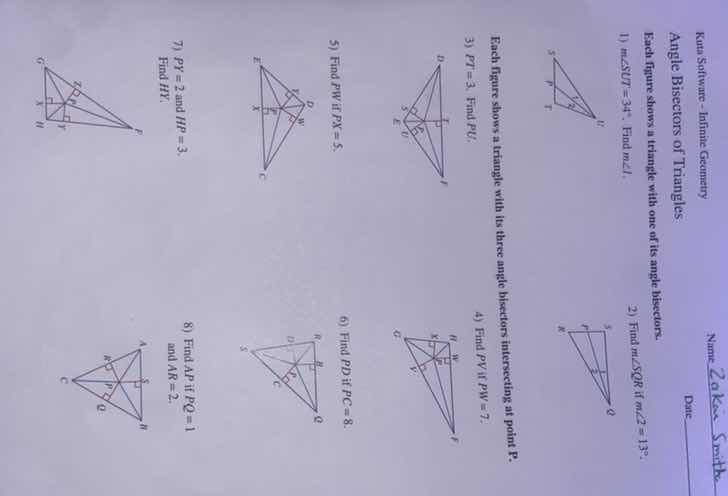
angle bisectors of triangles
each figure shows a triangle with one of its angle bisectors.
- (m\angle sut = 34^{\circ}). find (m\angle 1).
- find (m\angle sqr) if (m\angle 2 = 13^{\circ}).
each figure shows a triangle with its three angle bisectors intersecting at point p.
- (pt = 3). find (pu).
- find (pv) if (pw = 7).
- find (pw) if (px = 5).
- find (pd) if (pc = 8).
- (py = 2) and (hp = 3). find (hy).
- find (ap) if (pq = 1) and (ar = 2).
Identify the geometric principles for each section
In this worksheet, we solve two types of problems related to angle bisectors in triangles:
- Questions 1 and 2: An angle bisector divides an angle into two equal halves. Thus, the measure of the whole angle is twice the measure of either half:
- Questions 3 to 8: The three angle bisectors of a triangle intersect at a single point called the incenter (labeled as point \(P\)). The Incenter Theorem states that the incenter is equidistant from all three sides of the triangle. The perpendicular segments from \(P\) to the sides represent these distances, meaning:
Solve Questions 1 and 2 (Angle Bisectors)
- Question 1: \(UT\) is an angle bisector of \(\angle SUT\). We are given \(m\angle SUT = 34^\circ\). Since the bisector divides the angle into two equal parts, \(\angle 1\) is half of the total angle:
- Question 2: \(QS\) is an angle bisector of \(\angle SQR\). We are given \(m\angle 2 = 13^\circ\). Since \(\angle 2\) is one of the bisected halves, the entire angle is twice this measure:
Solve Questions 3, 4, and 5 (Incenter Equidistance)
- Question 3: Point \(P\) is the incenter. The perpendicular segments from \(P\) to the sides are \(PT\), \(PU\), and \(PS\). By the Incenter Theorem, these distances are equal:
- Question 4: Point \(P\) is the incenter. The perpendicular segments to the sides are \(PV\), \(PW\), and \(PX\). Therefore:
- Question 5: Point \(P\) is the incenter. The perpendicular segments to the sides are \(PW\), \(PX\), and \(PY\). Therefore:
Solve Questions 6, 7, and 8 (Incenter Equidistance)
- Question 6: Point \(P\) is the incenter. The perpendicular segments to the sides are \(PD\), \(PE\), and \(PF\). Therefore:
(Note: The segment from the incenter to the vertex is \(PC\), but the perpendicular segments to the sides are \(PD\), \(PE\), and \(PF\). Looking closely at the diagram, \(PD\), \(PE\), and \(PF\) are the perpendiculars to the sides. The label \(PC = 8\) refers to the perpendicular segment to side \(QR\), which is labeled as \(PC\). Thus, \(PD = PC = 8\).)
- Question 7: Point \(P\) is the incenter. The perpendicular segments to the sides are \(PX\), \(PY\), and \(PZ\). Therefore:
*(Note: The question asks to find \(HY\). In this right triangle \(\triangle HPY\), \(HP\) is the hypotenuse. However, looking at the standard incenter diagram, \(PY\), \(PX\), and \(PZ\) are the perpendiculars to the sides, which are all equal. Here, \(PY = 2\). The segment \(HP\) is a segment from a vertex to the incenter, with \(HP = 3\). In the right triangle \(\triangle HPY\), we can use the Pythagorean theorem: \(HY = \sqrt{HP^2 - PY^2} = \sqrt{3^2 - 2^2} = \sqrt{9…

Snap & solve any problem in the app
Get step-by-step solutions on Sovi AI
Photo-based solutions with guided steps
Explore more problems and detailed explanations
| No. | Problem | Answer |
|---|---|---|
| 2 | Find \(m\angle SQR\) if \(m\angle 2 = 13^\circ\) | \(26^\circ\) |
| 3 | Find \(PU\) if \(PT = 3\) | \(3\) |
| 4 | Find \(PV\) if \(PW = 7\) | \(7\) |
| 5 | Find \(PW\) if \(PX = 5\) | \(5\) |
| 6 | Find \(PD\) if \(PC = 8\) | \(8\) |
| 7 | Find \(HY\) if \(PY = 2\) and \(HP = 3\) | \(\sqrt{5}\) |
| 8 | Find \(AP\) if \(PQ = 1\) and \(AR = 2\) | \(\sqrt{5}\) |