QUESTION IMAGE
Question
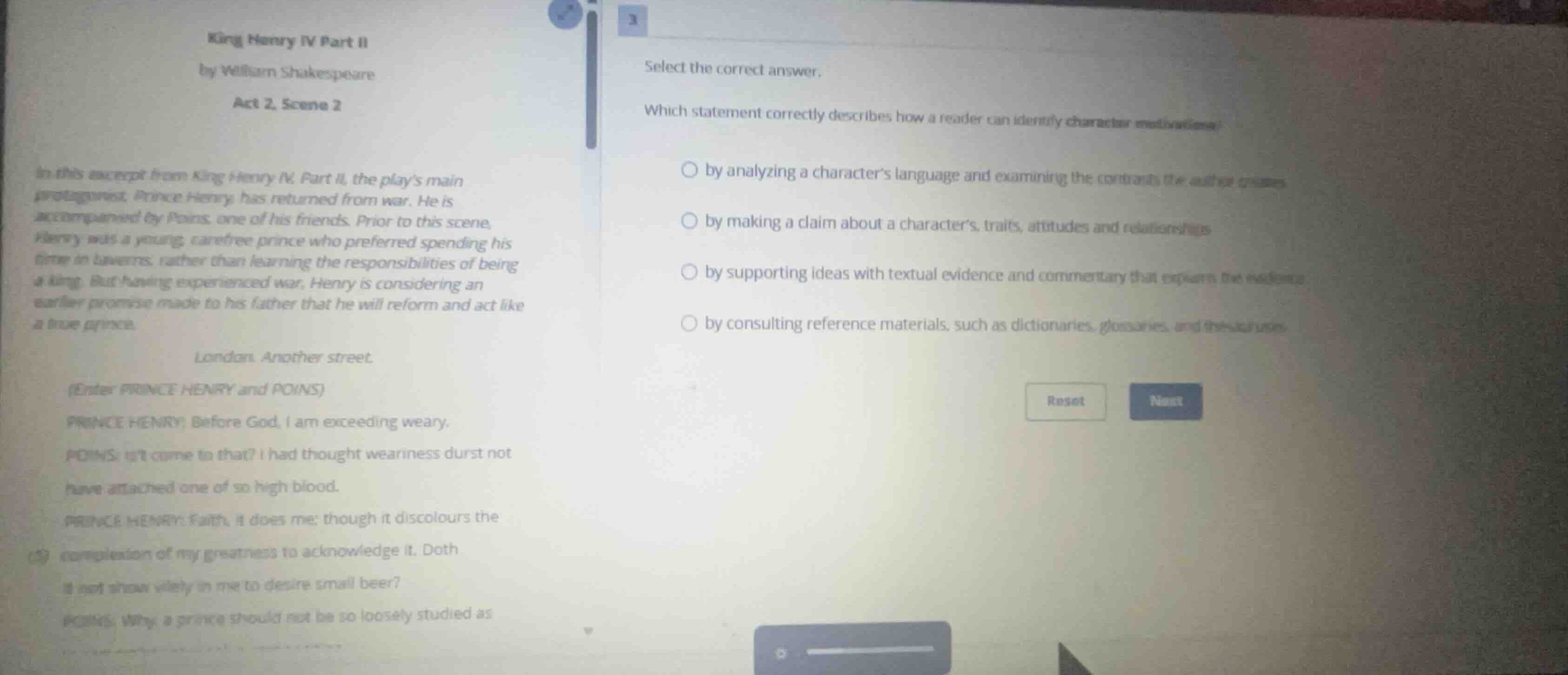
king henry iv part ii
by william shakespeare
act 2, scene 2
in this excerpt from king henry iv, part ii, the plays main protagonist, prince henry, has returned from war. he is accompanied by poins, one of his friends. prior to this scene, henry was a young, carefree prince who preferred spending his time in taverns, rather than learning the responsibilities of being a king. but having experienced war, henry is considering an earlier promise made to his father that he will reform and act like a true prince.
london. another street.
(enter prince henry and poins)
prince henry: before god, i am exceeding weary.
poins: ist come to that? i had thought weariness durst not have attached one of so high blood.
prince henry: faith, it does me; though it discolours the complexion of my greatness to acknowledge it. doth it not show vilely in me to desire small beer?
poins: why, a prince should not be so loosely studied as
select the correct answer.
which statement correctly describes how a reader can identify character motivations?
by analyzing a characters language and examining the contrasts the author creates
by making a claim about a characters traits, attitudes and relationships
by supporting ideas with textual evidence and commentary that explains the evidence
by consulting reference materials, such as dictionaries, glossaries, and thesauruses
Analyze the question prompt
The question asks how a reader can correctly identify character motivations.
Evaluate the options
- Option 1: Analyzing language and examining contrasts created by the author directly reveals the underlying reasons (motivations) behind a character's actions and thoughts.
- Option 2: Making a claim about traits, attitudes, and relationships describes characterization, but does not explain the process of identifying motivations.
- Option 3: Supporting ideas with textual evidence and commentary describes how to write an analytical essay, not how to identify motivation itself.
- Option 4: Consulting reference materials helps with vocabulary, not literary analysis of character motivation.
Determine the correct choice
Option 1 is the correct method for identifying character motivations.

Snap & solve any problem in the app
Get step-by-step solutions on Sovi AI
Photo-based solutions with guided steps
Explore more problems and detailed explanations
- (A) by analyzing a character's language and examining the contrasts the author creates (Correct answer)
- (B) by making a claim about a character's traits, attitudes, and relationships
- (C) by supporting ideas with textual evidence and commentary that explains the evidence
- (D) by consulting reference materials, such as dictionaries, glossaries, and thesauruses