Sovi.AI - AI Math Tutor

Scan to solve math questions

QUESTION IMAGE

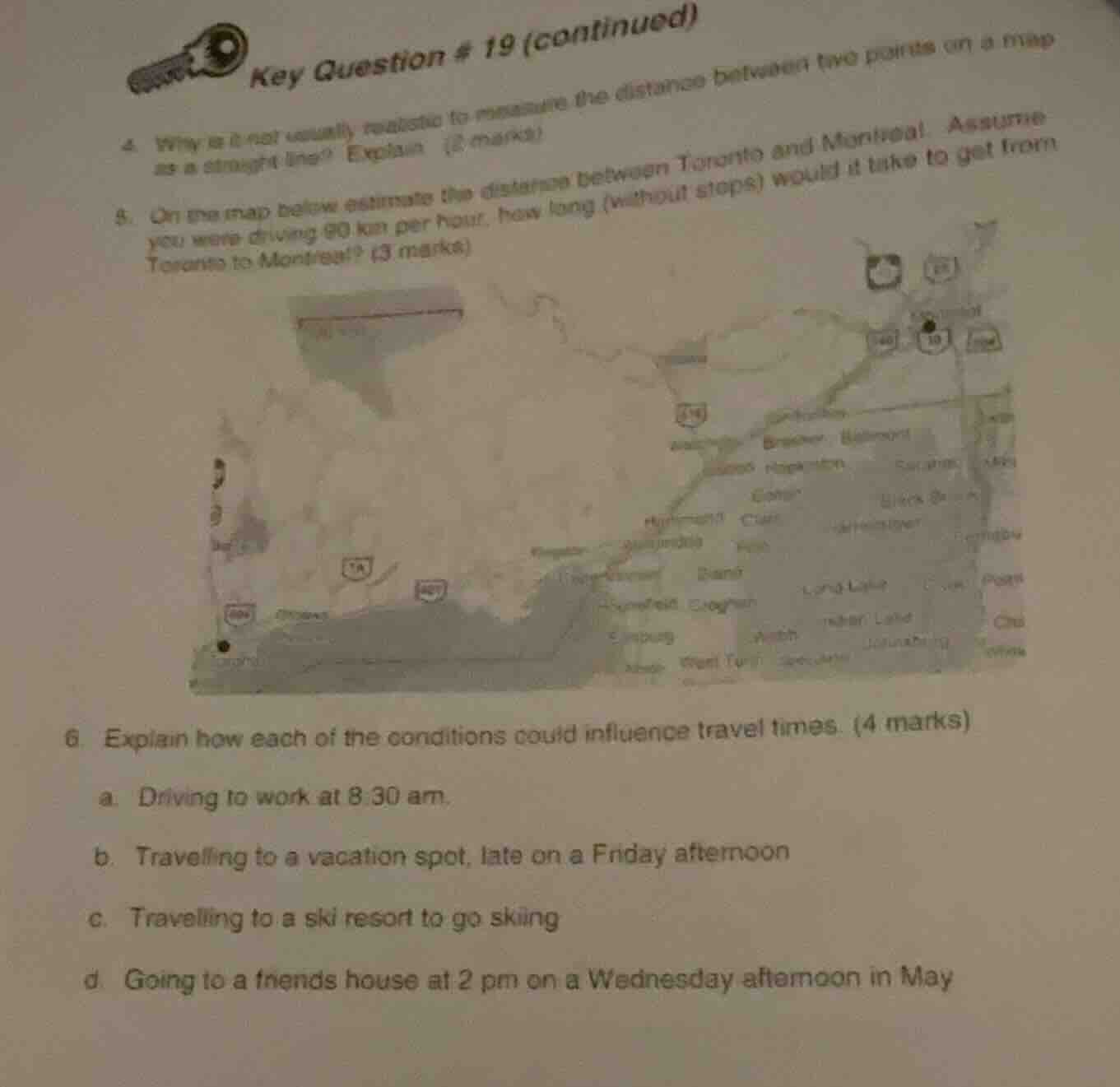
key question # 19 (continued) 4. why is it not usually realistic to mea…

Question

key question # 19 (continued)

  1. why is it not usually realistic to measure the distance between two points on a map as a straight line? explain. (2 marks)
  1. on the map below estimate the distance between toronto and montreal. assume you were driving 90 km per hour, how long (without stops) would it take to get from toronto to montreal? (3 marks)
  1. explain how each of the conditions could influence travel times. (4 marks)

a. driving to work at 8:30 am.
b. travelling to a vacation spot, late on a friday afternoon.
c. travelling to a ski resort to go skiing.
d. going to a friends house at 2 pm on a wednesday afternoon in may.

Explanation:

Response

<pre_analysis>
{
"quality": "clear",
"question_count": 3,
"skills_matched": [
"step_cot",
"explain_then_answer",
"tutor",
"mastery_adaptive_brevity"
],
"needs_drawing": false,
"concepts_used": [
"Real-world Distance Estimation",
"Travel Time Factors"
],
"new_concepts": [],
"current_concepts": [
"Real-world Distance Estimation",
"Travel Time Factors",
"Map Scale Distance"
]
}
</pre_analysis>

<reasoning>

Real-world vs. straight-line distance

Using the Real-world Distance Estimation knowledge point
\[
\text{Actual Route Distance} > \text{Straight-line Distance}
\]
Roads must navigate around geographical obstacles (lakes, mountains) and follow established infrastructure grids rather than a direct geometric line.

Estimate distance and travel time

Using the Real-world Distance Estimation and Travel Time Factors knowledge points
\[

$$\begin{aligned} &\text{Estimated Road Distance } (d) \approx 540\text{ km}\\ &\text{Speed } (v) = 90\text{ km/h}\\ &\text{Time } (t) = \frac{d}{v} = \frac{540\text{ km}}{90\text{ km/h}} = 6\text{ hours} \end{aligned}$$

\]

Analyze morning rush hour impact

Using the Travel Time Factors knowledge point

  • Condition: Driving to work at 8:30 am.
  • Influence: High volume of commuter traffic (rush hour) leads to congestion, delays, and increased travel times.

Analyze weekend getaway traffic

Using the Travel Time Factors knowledge point

  • Condition: Travelling to a vacation spot, late on a Friday afternoon.
  • Influence: Heavy weekend getaway traffic increases congestion on major highways, significantly lengthening travel times.

Analyze seasonal weather impacts

Using the Travel Time Factors knowledge point

  • Condition: Travelling to a ski resort to go skiing.
  • Influence: Winter weather conditions (snow, ice, reduced visibility) require slower driving speeds, increasing travel times.

Analyze off-peak weekday travel

Using the Travel Time Factors knowledge point

  • Condition: Going to a friend's house at 2 pm on a Wednesday afternoon in May.
  • Influence: Mid-day, mid-week travel avoids peak rush hours and seasonal hazards, resulting in minimal traffic and standard travel times.

</reasoning>

<answer>

Question 4

It is not realistic because roads are rarely perfectly straight. Roads must follow terrain, navigate around natural obstacles like lakes and hills, and conform to municipal grid systems, making the actual driving distance longer than a straight line.

Question 5

  • Estimated Distance: Approximately \(540\text{ km}\) (actual highway distance is about \(540\text{ km}\) to \(550\text{ km}\)).
  • Travel Time:

\[
\text{Time} = \frac{540\text{ km}}{90\text{ km/h}} = 6\text{ hours}
\]

Question 6

  • a. Driving to work at 8:30 am: Increases travel time due to heavy morning rush-hour commuter traffic and congestion.
  • b. Travelling to a vacation spot, late on a Friday afternoon: Increases travel time significantly due to weekend-bound travelers creating highway bottlenecks.
  • c. Travelling to a ski resort to go skiing: Increases travel time because winter weather (snow, ice, slush) forces slower, more cautious driving speeds.
  • d. Going to a friend's house at 2 pm on a Wednesday afternoon in May: Has little to no negative impact on travel time, as mid-afternoon on a weekday is an off-peak traffic period with favorable spring weather.

</answer>

<post_analysis>
{
"subject": "Mathematics",
"question_type": "Multi-part",
"knowledge_point": [
"Mathematics",
"Ge…

Answer:

<pre_analysis>
{
"quality": "clear",
"question_count": 3,
"skills_matched": [
"step_cot",
"explain_then_answer",
"tutor",
"mastery_adaptive_brevity"
],
"needs_drawing": false,
"concepts_used": [
"Real-world Distance Estimation",
"Travel Time Factors"
],
"new_concepts": [],
"current_concepts": [
"Real-world Distance Estimation",
"Travel Time Factors",
"Map Scale Distance"
]
}
</pre_analysis>

<reasoning>

Real-world vs. straight-line distance

Using the Real-world Distance Estimation knowledge point
\[
\text{Actual Route Distance} > \text{Straight-line Distance}
\]
Roads must navigate around geographical obstacles (lakes, mountains) and follow established infrastructure grids rather than a direct geometric line.

Estimate distance and travel time

Using the Real-world Distance Estimation and Travel Time Factors knowledge points
\[

$$\begin{aligned} &\text{Estimated Road Distance } (d) \approx 540\text{ km}\\ &\text{Speed } (v) = 90\text{ km/h}\\ &\text{Time } (t) = \frac{d}{v} = \frac{540\text{ km}}{90\text{ km/h}} = 6\text{ hours} \end{aligned}$$

\]

Analyze morning rush hour impact

Using the Travel Time Factors knowledge point

  • Condition: Driving to work at 8:30 am.
  • Influence: High volume of commuter traffic (rush hour) leads to congestion, delays, and increased travel times.

Analyze weekend getaway traffic

Using the Travel Time Factors knowledge point

  • Condition: Travelling to a vacation spot, late on a Friday afternoon.
  • Influence: Heavy weekend getaway traffic increases congestion on major highways, significantly lengthening travel times.

Analyze seasonal weather impacts

Using the Travel Time Factors knowledge point

  • Condition: Travelling to a ski resort to go skiing.
  • Influence: Winter weather conditions (snow, ice, reduced visibility) require slower driving speeds, increasing travel times.

Analyze off-peak weekday travel

Using the Travel Time Factors knowledge point

  • Condition: Going to a friend's house at 2 pm on a Wednesday afternoon in May.
  • Influence: Mid-day, mid-week travel avoids peak rush hours and seasonal hazards, resulting in minimal traffic and standard travel times.

</reasoning>

<answer>

Question 4

It is not realistic because roads are rarely perfectly straight. Roads must follow terrain, navigate around natural obstacles like lakes and hills, and conform to municipal grid systems, making the actual driving distance longer than a straight line.

Question 5

  • Estimated Distance: Approximately \(540\text{ km}\) (actual highway distance is about \(540\text{ km}\) to \(550\text{ km}\)).
  • Travel Time:

\[
\text{Time} = \frac{540\text{ km}}{90\text{ km/h}} = 6\text{ hours}
\]

Question 6

  • a. Driving to work at 8:30 am: Increases travel time due to heavy morning rush-hour commuter traffic and congestion.
  • b. Travelling to a vacation spot, late on a Friday afternoon: Increases travel time significantly due to weekend-bound travelers creating highway bottlenecks.
  • c. Travelling to a ski resort to go skiing: Increases travel time because winter weather (snow, ice, slush) forces slower, more cautious driving speeds.
  • d. Going to a friend's house at 2 pm on a Wednesday afternoon in May: Has little to no negative impact on travel time, as mid-afternoon on a weekday is an off-peak traffic period with favorable spring weather.

</answer>

<post_analysis>
{
"subject": "Mathematics",
"question_type": "Multi-part",
"knowledge_point": [
"Mathematics",
"Geometry",
"Real-world Distance Estimation"
]
}
</post_analysis>