QUESTION IMAGE
Question
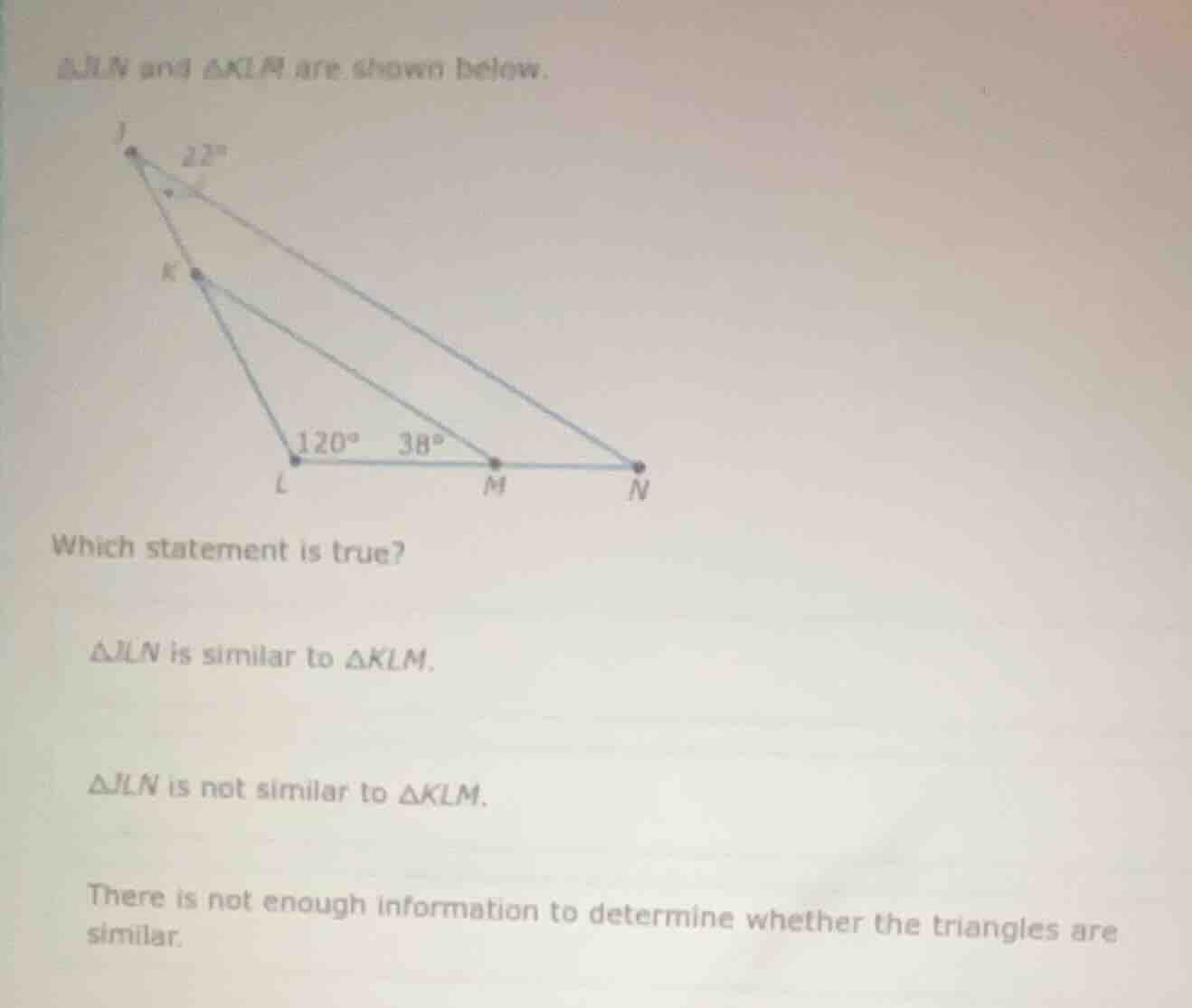
△jln and △klm are shown below. which statement is true? △jln is similar to △klm. △jln is not similar to △klm. there is not enough information to determine whether the triangles are similar.
Step1: Find the measure of $\angle JNL$ in $\triangle JLN$
In $\triangle JLN$, we know that the sum of angles in a triangle is $180^{\circ}$. Given $\angle JLN = 180^{\circ}- 120^{\circ}=60^{\circ}$ (linear - pair of angles) and $\angle LJN = 22^{\circ}$.
Using the angle - sum property of a triangle $\angle JNL=180^{\circ}-\angle LJN - \angle JLN$.
Substitute the values: $\angle JNL=180^{\circ}-22^{\circ}-60^{\circ}=98^{\circ}$.
Step2: Find the measure of $\angle KML$ in $\triangle KLM$
In $\triangle KLM$, we know that the sum of angles in a triangle is $180^{\circ}$. Given $\angle KLM = 120^{\circ}$. Let's check the other angles.
We know that if two angles of one triangle are equal to two angles of another triangle, then the triangles are similar.
In $\triangle KLM$, $\angle KML = 180^{\circ}-\angle KLM-\angle LKM$. But we can also use the fact that for similarity, we can check the AA (angle - angle) criterion.
We know that $\angle JLN = 60^{\circ}$ (from step 1, since $\angle JLN$ and the angle adjacent to $120^{\circ}$ form a linear pair, $\angle JLN = 180 - 120=60^{\circ}$) and in $\triangle KLM$, if we assume the AA criterion.
We know that $\angle KLM = 120^{\circ}$ and $\angle JLN = 60^{\circ}$ (complementary to the angle adjacent to $120^{\circ}$ in $\triangle JLN$). Also, if we consider the angle at $L$ (in $\triangle KLM$) and the relationship with the angles in $\triangle JLN$.
Another way: In $\triangle JLN$, $\angle JLN = 60^{\circ}$, $\angle LJN=22^{\circ}$, $\angle JNL = 98^{\circ}$.
In $\triangle KLM$, $\angle KLM = 120^{\circ}$, let's assume we use the AA criterion.
We know that $\angle JLN$ and $\angle KLM$ are supplementary. But if we consider the non - supplementary angles.
We know that for two triangles $\triangle ABC$ and $\triangle DEF$, if $\angle A=\angle D$ and $\angle B=\angle E$, then $\triangle ABC\sim\triangle DEF$.
In $\triangle JLN$ and $\triangle KLM$, $\angle JLN = 60^{\circ}$, $\angle KLM = 120^{\circ}$ (not equal). But if we consider the other angles.
We know that $\angle LKM$ (let's find it). Since $\angle KLM = 120^{\circ}$, and if we assume the AA criterion.
We know that in $\triangle JLN$, $\angle JLN = 60^{\circ}$ (adjacent to $120^{\circ}$) and in $\triangle KLM$, if we consider the angles.
We use the AA (angle - angle) similarity criterion.
We know that $\angle JLN = 60^{\circ}$ (calculated as $180 - 120$) and in $\triangle KLM$, if we assume that the ratio of angles.
Wait, a better approach:
In $\triangle JLN$, $\angle JLN = 60^{\circ}$ (since $\angle JLN+120^{\circ}=180^{\circ}$), $\angle LJN = 22^{\circ}$, so $\angle JNL=180-(60 + 22)=98^{\circ}$
In $\triangle KLM$, $\angle KLM = 120^{\circ}$, and if we assume that $\angle LKM$ and $\angle LJN$ and $\angle KML$ and $\angle JNL$ follow the AA criterion.
We know that $\angle JLN$ and $\angle KLM$ are supplementary. But for similarity (AA), we need two pairs of equal angles.
Let's calculate the third angle of $\triangle KLM$. Let $\angle KML=x$ and $\angle LKM = y$. We know that $x + y+120^{\circ}=180^{\circ}$, so $x + y = 60^{\circ}$.
In $\triangle JLN$, $\angle JLN = 60^{\circ}$, $\angle LJN=22^{\circ}$, $\angle JNL = 98^{\circ}$
If we assume that $\angle LKM=\angle LJN = 22^{\circ}$ (by the AA criterion, if two angles of one triangle are equal to two angles of another triangle).
Since $\angle KLM = 120^{\circ}$ (given) and $\angle JLN = 60^{\circ}$ (linear - pair with $120^{\circ}$), but $\angle LKM+\angle KLM+\angle KML = 180^{\circ}$ and $\angle LJN+\angle JLN+\angle JNL=180^{\circ}$.
If we use the AA (angle - angle) similarity cri…
Snap & solve any problem in the app
Get step-by-step solutions on Sovi AI
Photo-based solutions with guided steps
Explore more problems and detailed explanations
$\triangle JLN$ is similar to $\triangle KLM$.