QUESTION IMAGE
Question
inverse and log functions frq graded assignment
12 evaluate
each part a = 10 points, part b = 10 points, part c = 5 points
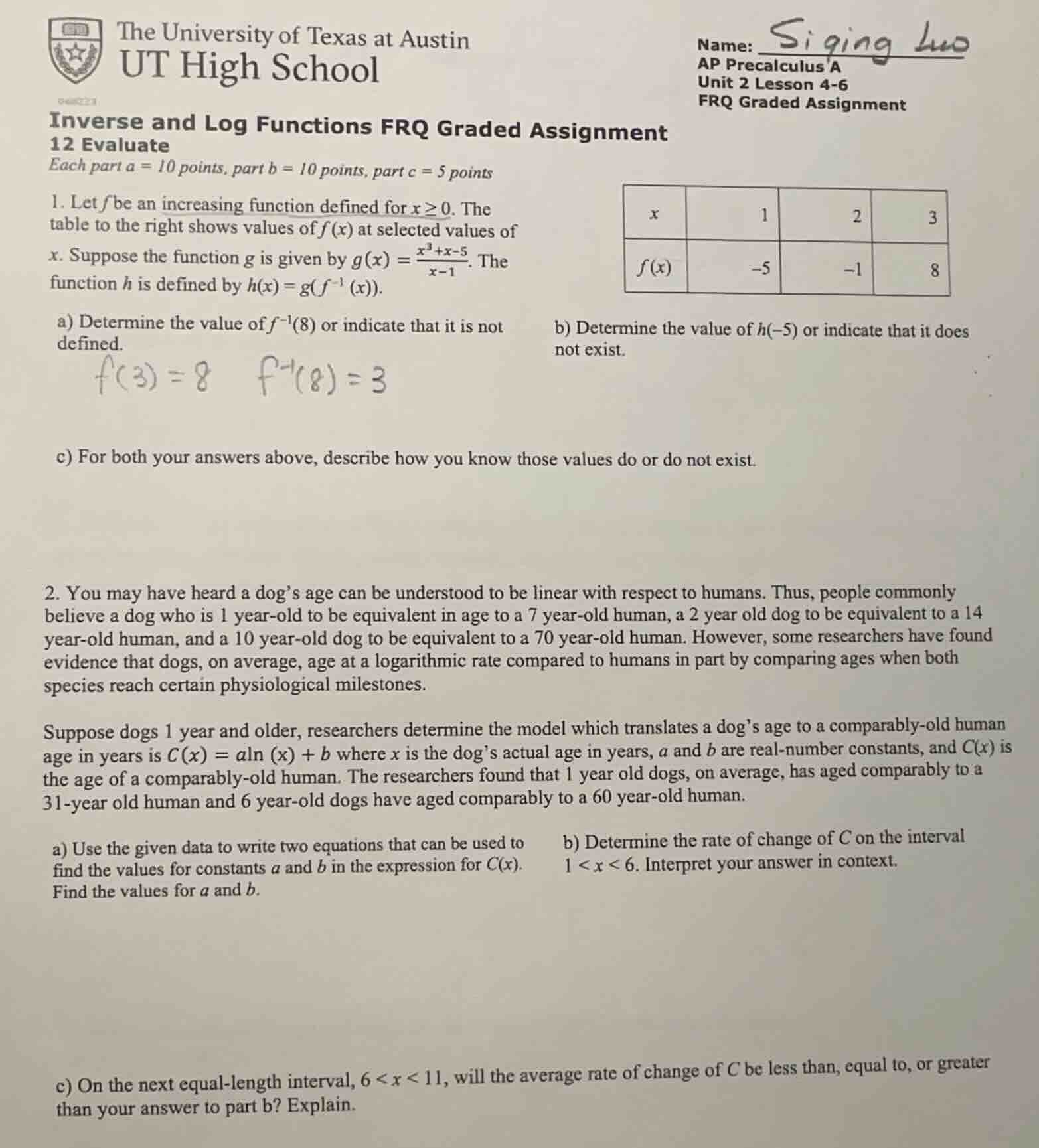
- let (f) be an increasing function defined for (x \ge 0). the table to the right shows values of (f(x)) at selected values of (x). suppose the function (g) is given by (g(x) = \frac{x^3+x-5}{x-1}). the function (h) is defined by (h(x) = g(f^{-1}(x))).
a) determine the value of (f^{-1}(8)) or indicate that it is not defined.
b) determine the value of (h(-5)) or indicate that it does not exist.
c) for both your answers above, describe how you know those values do or do not exist.
- you may have heard a dogs age can be understood to be linear with respect to humans. thus, people commonly believe a dog who is 1 year-old to be equivalent in age to a 7 year-old human, a 2 year old dog to be equivalent to a 14 year-old human, and a 10 year-old dog to be equivalent to a 70 year-old human. however, some researchers have found evidence that dogs, on average, age at a logarithmic rate compared to humans in part by comparing ages when both species reach certain physiological milestones.
suppose dogs 1 year and older, researchers determine the model which translates a dogs age to a comparably-old human age in years is (c(x) = a \ln(x) + b) where (x) is the dogs actual age in years, (a) and (b) are real-number constants, and (c(x)) is the age of a comparably-old human. the researchers found that 1 year old dogs, on average, has aged comparably to a 31-year old human and 6 year-old dogs have aged comparably to a 60 year-old human.
a) use the given data to write two equations that can be used to find the values for constants (a) and (b) in the expression for (c(x)). find the values for (a) and (b).
b) determine the rate of change of (c) on the interval (1 < x < 6). interpret your answer in context.
c) on the next equal-length interval, (6 < x < 11), will the average rate of change of (c) be less than, equal to, or greater than your answer to part b? explain.
Evaluate inverse function value
Using the Inverse Functions knowledge point
We are given that \(f\) is an increasing function.
From the table, when \(x = 3\), we have \(f(3) = 8\).
Since \(f\) is strictly increasing, it is one-to-one, meaning its inverse function \(f^{-1}\) exists.
Therefore, \(f^{-1}(8) = 3\).
Evaluate composite function value
Using the Inverse Functions knowledge point
The function \(h\) is defined as \(h(x) = g(f^{-1}(x))\).
We need to find \(h(-5) = g(f^{-1}(-5))\).
From the table, when \(x = 1\), \(f(1) = -5\), which means \(f^{-1}(-5) = 1\).
Now we evaluate \(g(1)\) using the definition \(g(x) = \frac{x^3+x-5}{x-1}\).
Substituting \(x = 1\) into \(g(x)\) yields a denominator of \(1 - 1 = 0\).
Since division by zero is undefined, \(g(1)\) is undefined, and thus \(h(-5)\) does not exist.
Justify existence of values
Using the Inverse Functions knowledge point
For part (a), \(f^{-1}(8) = 3\) because the table explicitly shows \(f(3) = 8\), and since \(f\) is strictly increasing, it is one-to-one, ensuring a unique inverse.
For part (b), \(h(-5)\) does not exist because \(f^{-1}(-5) = 1\), but \(g(1)\) is undefined due to a zero in the denominator of \(g(x)\).
Solve for model constants
Using the Logarithmic Models knowledge point
The model is \(C(x) = a \ln(x) + b\).
Using the data point \((1, 31)\):
Using the data point \((6, 60)\) and \(b = 31\):
Thus, the system of equations is:
The values are \(a = \frac{29}{\ln(6)}\) and \(b = 31\).
Calculate average rate of change
Using the Average Rate of Change knowledge point
The average rate of change of \(C(x)\) on the interval \(1 < x < 6\) is:
In context, this means that between the ages of 1 and 6 years, a dog's equivalent human age increases at an average rate of 5.8 human years per dog year.
Compare rates of change on adjacent intervals
Using the Logarithmic Models knowledge point
The function \(C(x) = a \ln(x) + b\) is a logarithmic function with \(a > 0\).
The derivative \(C'(x) = \frac{a}{x}\) is strictly decreasing for \(x > 0\), meaning the function is concave down.
For any concave down function, the average rate of change over consecutive intervals of equal length decreases as \(x\) increases.
Therefore, the average rate of change on the interval \(6 < x < 11\) will be less than the average rate of change on \(1 < x < 6\).
Since \(C(x)\) is a logarithmic model with \(a > 0\), its rate of increase is strictly decreasing (the function is concave down). Therefore, the average rate of change over the subsequent equal-length interval \(6 < x < 11\) must be less than the average rate of change over \(1 < x < 6\).
</answer>

Snap & solve any problem in the app
Get step-by-step solutions on Sovi AI
Photo-based solutions with guided steps
Explore more problems and detailed explanations
Question 1
a) \(f^{-1}(8) = 3\)
b) \(h(-5)\) does not exist.
c) \(f^{-1}(8) = 3\) because \(f(3) = 8\) and \(f\) is strictly increasing (one-to-one). \(h(-5)\) does not exist because \(f^{-1}(-5) = 1\), but \(g(1) = \frac{1^3+1-5}{1-1} = \frac{-3}{0}\), which is undefined.
Question 2
a) Equations:
Values:
b) Average rate of change:
Interpretation: Between the actual ages of 1 and 6 years, a dog's equivalent human age increases at an average rate of 5.8 human years for every 1 dog year.
c) Less than.
Explanation: Since \(C(x)\) is a logarithmic model with \(a > 0\), its rate of increase is strictly decreasing (the function is concave down). Therefore, the average rate of change over the subsequent equal-length interval \(6 < x < 11\) must be less than the average rate of change over \(1 < x < 6\).