QUESTION IMAGE
Question
introduction to linear functions
pre-test
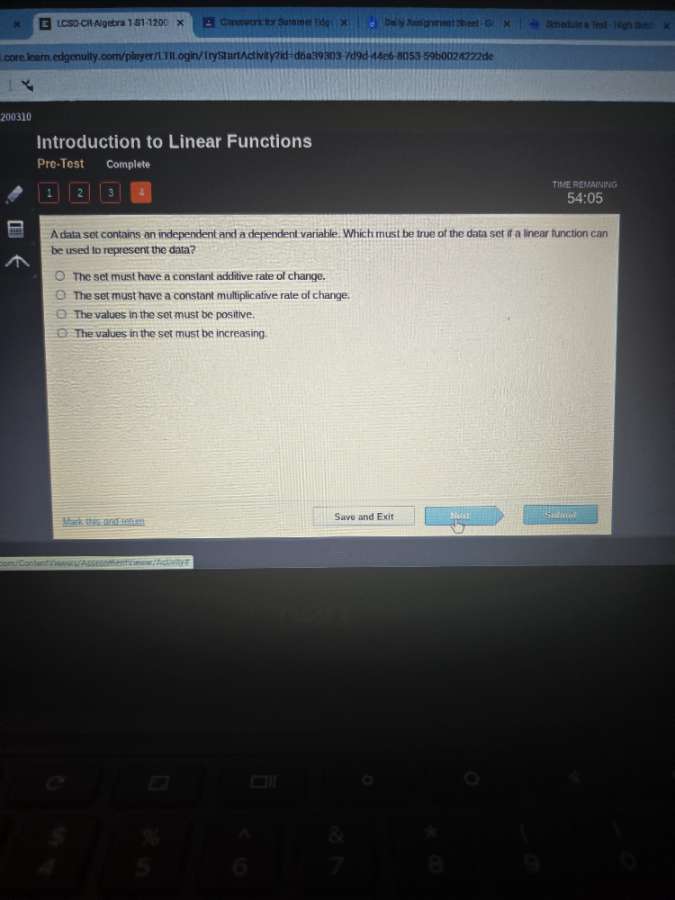
a data set contains an independent and a dependent variable. which must be true of the data set if a linear function can be used to represent the data?
- the set must have a constant additive rate of change.
- the set must have a constant multiplicative rate of change.
- the values in the set must be positive.
- the values in the set must be increasing.
⚡ Using what you learned: understanding linear functions
Step 1: Analyze the definition of a linear function
A linear function is characterized by a constant rate of change. This means that for any equal change in the independent variable, the dependent variable changes by a constant added or subtracted amount.
Step 2: Evaluate the given options
- The set must have a constant additive rate of change: This is the defining property of a linear function (e.g., \( y = mx + b \), where the slope \( m \) represents a constant amount added to \( y \) for each unit increase in \( x \)).
- The set must have a constant multiplicative rate of change: This describes an exponential function (e.g., \( y = ab^x \)), not a linear function.
- The values in the set must be positive: Linear functions can have negative values, zero, or positive values.
- The values in the set must be increasing: Linear functions can be decreasing (negative slope) or constant (zero slope).

Snap & solve any problem in the app
Get step-by-step solutions on Sovi AI
Photo-based solutions with guided steps
Explore more problems and detailed explanations
The set must have a constant additive rate of change.