QUESTION IMAGE
Question
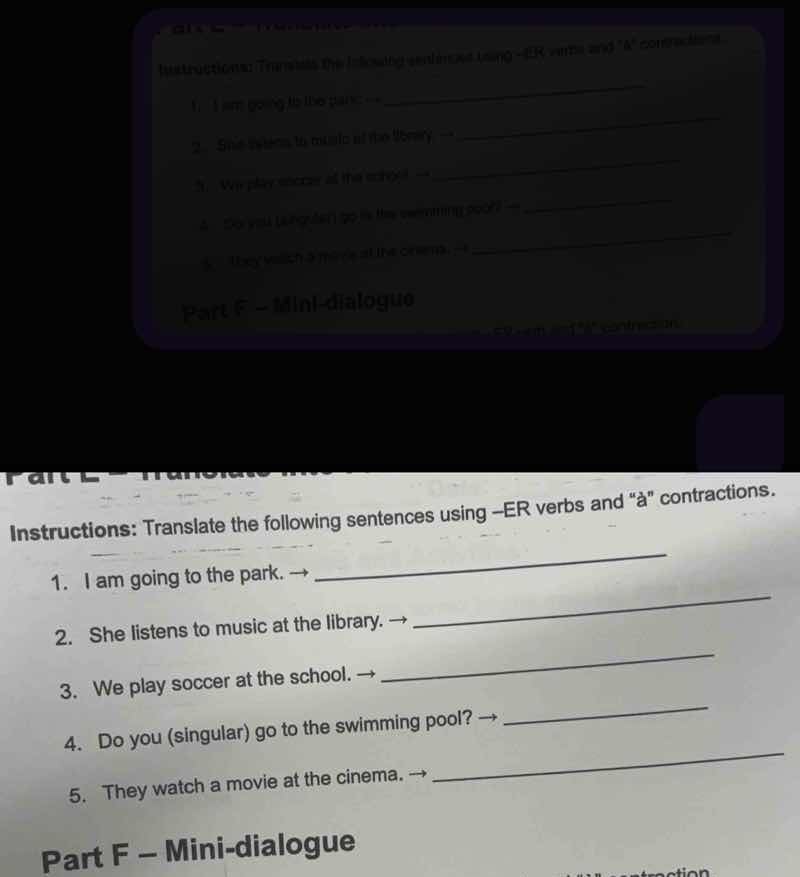
instructions: translate the following sentences using -er verbs and \à\ contractions.
- i am going to the park. →
- she listens to music at the library. →
- we play soccer at the school. →
- do you (singular) go to the swimming pool? →
- they watch a movie at the cinema. →
part f – mini - dialogue
To solve this, we translate each sentence into French using -ER verbs and "à" contractions (like "au", "à la", "à l'", "aux").
1. I am going to the park.
- "I" is "Je", "go" (aller, but for -ER verbs, we use "aller" in present? Wait, no—wait, the instruction is -ER verbs. Wait, maybe a mistake? Wait, "aller" is an -ER verb? Wait, "aller" is a special -ER verb (irregular). But maybe the intended is to use "aller" with "à" contractions. "Park" is "parc" (masculine), so "à + le" = "au".
So "Je vais au parc."
2. She listens to music at the library.
- "She" is "Elle", "listen" is "écouter" ( -ER verb). "Music" is "la musique", "library" is "la bibliothèque" (feminine, so "à la").
Conjugate "écouter" for elle: "écoute".
So "Elle écoute de la musique à la bibliothèque."
3. We play soccer at the school.
- "We" is "Nous", "play" is "jouer" ( -ER verb). "Soccer" is "le foot" (masculine), "school" is "l'école" (feminine, "à l'école" since "école" starts with a vowel).
Conjugate "jouer" for nous: "jouons".
So "Nous jouons au foot à l'école."
4. Do you (singular) go to the swimming pool?
- "You (singular)" is "Tu", "go" is "aller" ( -ER verb, irregular). "Swimming pool" is "la piscine" (feminine, "à la").
Conjugate "aller" for tu: "vas". The question form: "Tu vas à la piscine ?"
5. They watch a movie at the cinema.
- "They" is "Ils/Elles" (let's use "Ils" as default), "watch" is "regarder" ( -ER verb). "A movie" is "un film", "cinema" is "le cinéma" (masculine, "au").
Conjugate "regarder" for ils: "regardent".
So "Ils regardent un film au cinéma."
Final Answers:
- Je vais au parc.
- Elle écoute de la musique à la bibliothèque.
- Nous jouons au foot à l'école.
- Tu vas à la piscine ?
- Ils regardent un film au cinéma.

Snap & solve any problem in the app
Get step-by-step solutions on Sovi AI
Photo-based solutions with guided steps
Explore more problems and detailed explanations
To solve this, we translate each sentence into French using -ER verbs and "à" contractions (like "au", "à la", "à l'", "aux").
1. I am going to the park.
- "I" is "Je", "go" (aller, but for -ER verbs, we use "aller" in present? Wait, no—wait, the instruction is -ER verbs. Wait, maybe a mistake? Wait, "aller" is an -ER verb? Wait, "aller" is a special -ER verb (irregular). But maybe the intended is to use "aller" with "à" contractions. "Park" is "parc" (masculine), so "à + le" = "au".
So "Je vais au parc."
2. She listens to music at the library.
- "She" is "Elle", "listen" is "écouter" ( -ER verb). "Music" is "la musique", "library" is "la bibliothèque" (feminine, so "à la").
Conjugate "écouter" for elle: "écoute".
So "Elle écoute de la musique à la bibliothèque."
3. We play soccer at the school.
- "We" is "Nous", "play" is "jouer" ( -ER verb). "Soccer" is "le foot" (masculine), "school" is "l'école" (feminine, "à l'école" since "école" starts with a vowel).
Conjugate "jouer" for nous: "jouons".
So "Nous jouons au foot à l'école."
4. Do you (singular) go to the swimming pool?
- "You (singular)" is "Tu", "go" is "aller" ( -ER verb, irregular). "Swimming pool" is "la piscine" (feminine, "à la").
Conjugate "aller" for tu: "vas". The question form: "Tu vas à la piscine ?"
5. They watch a movie at the cinema.
- "They" is "Ils/Elles" (let's use "Ils" as default), "watch" is "regarder" ( -ER verb). "A movie" is "un film", "cinema" is "le cinéma" (masculine, "au").
Conjugate "regarder" for ils: "regardent".
So "Ils regardent un film au cinéma."
Final Answers:
- Je vais au parc.
- Elle écoute de la musique à la bibliothèque.
- Nous jouons au foot à l'école.
- Tu vas à la piscine ?
- Ils regardent un film au cinéma.