QUESTION IMAGE
Question
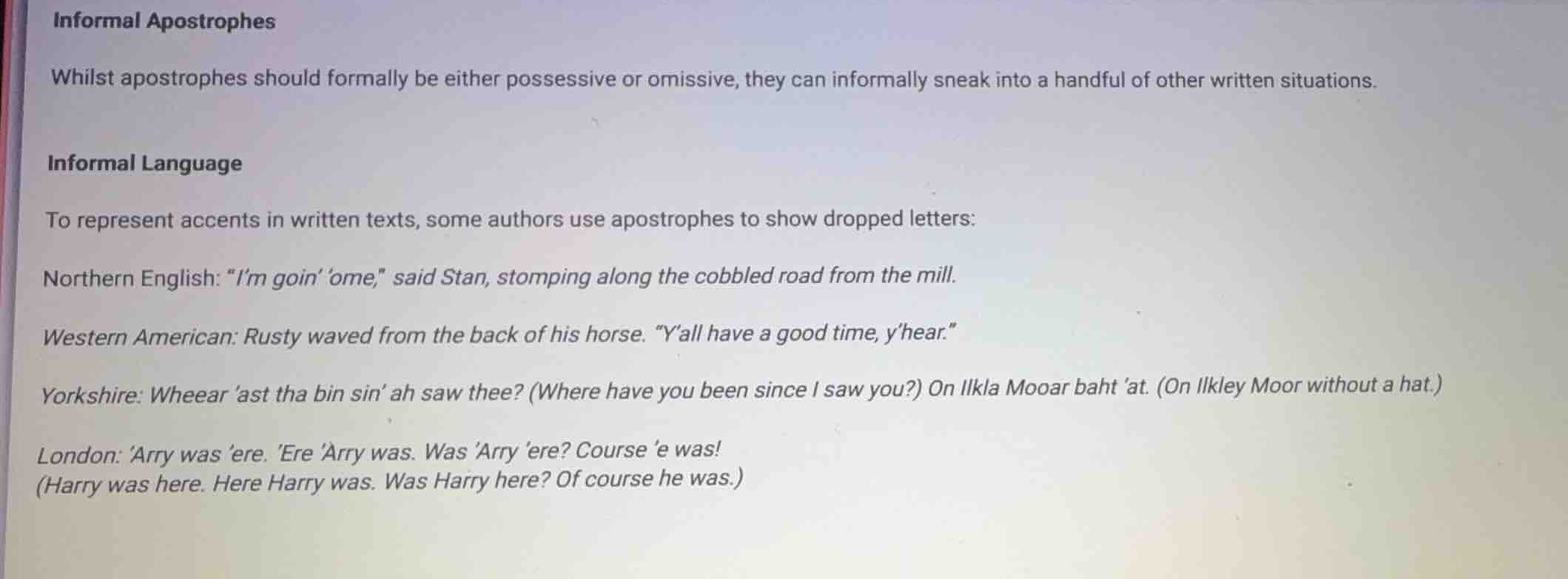
informal apostrophes
whilst apostrophes should formally be either possessive or omissive, they can informally sneak into a handful of other written situations.
informal language
to represent accents in written texts, some authors use apostrophes to show dropped letters:
northern english: \im goin ome,\ said stan, stomping along the cobbled road from the mill.
western american: rusty waved from the back of his horse. \yall have a good time, yhear.\
yorkshire: wheear ast tha bin sin ah saw thee? (where have you been since i saw you?) on ilkla mooar baht at. (on ilkley moor without a hat.)
london: arry was ere. ere arry was. was arry ere? course e was!
(harry was here. here harry was. was harry here? of course he was.)
Analyze the provided text
The image contains an informational text explaining the use of informal apostrophes to represent accents and spoken dialects in written English. It provides examples from Northern English, Western American, Yorkshire, and London dialects.
Identify the purpose of the text
The text serves as an educational guide or reference sheet. It explains how authors use apostrophes to indicate dropped letters (omission) to reflect regional pronunciation and informal language in dialogue.
Summarize the key concepts
- Informal Apostrophes: Used outside of standard possessive or formal contraction rules.
- Accent Representation: Showing how words are pronounced in regional dialects by replacing omitted letters with apostrophes (e.g., "goin'" for "going", "'ome" for "home", "'ere" for "here").
- Examples:
- Northern English: "goin' 'ome" (dropping 'g' and 'h').
- Western American: "Y'all", "y'hear" (contracting "you all" and "you hear").
- Yorkshire: "'ast" (hast), "sin'" (since), "baht 'at" (without hat).
- London: "'Arry" (Harry), "'ere" (here), "'e" (he), "Course" (Of course).

Snap & solve any problem in the app
Get step-by-step solutions on Sovi AI
Photo-based solutions with guided steps
Explore more problems and detailed explanations
This image provides an instructional overview of Informal Apostrophes used to represent regional accents and dialects in written English.
Key Takeaways:
- Purpose: Authors use apostrophes informally to show dropped letters, mimicking spoken accents and conversational speech.
- Dialect Examples:
- Northern English: Drops the final "g" in "going" (\(
ightarrow\) goin') and the initial "h" in "home" (\(
ightarrow\) 'ome).
- Western American: Combines and shortens words like "you all" (\(
ightarrow\) Y'all) and "you hear" (\(
ightarrow\) y'hear).
- Yorkshire: Replaces omitted letters in traditional regional phrases, such as "since" (\(
ightarrow\) sin') and "hat" (\(
ightarrow\) 'at).
- London (Cockney): Frequently drops the initial "h" sound in names and pronouns, such as "Harry" (\(
ightarrow\) 'Arry), "here" (\(
ightarrow\) 'ere), and "he" (\(
ightarrow\) 'e).