QUESTION IMAGE
Question
independent practice
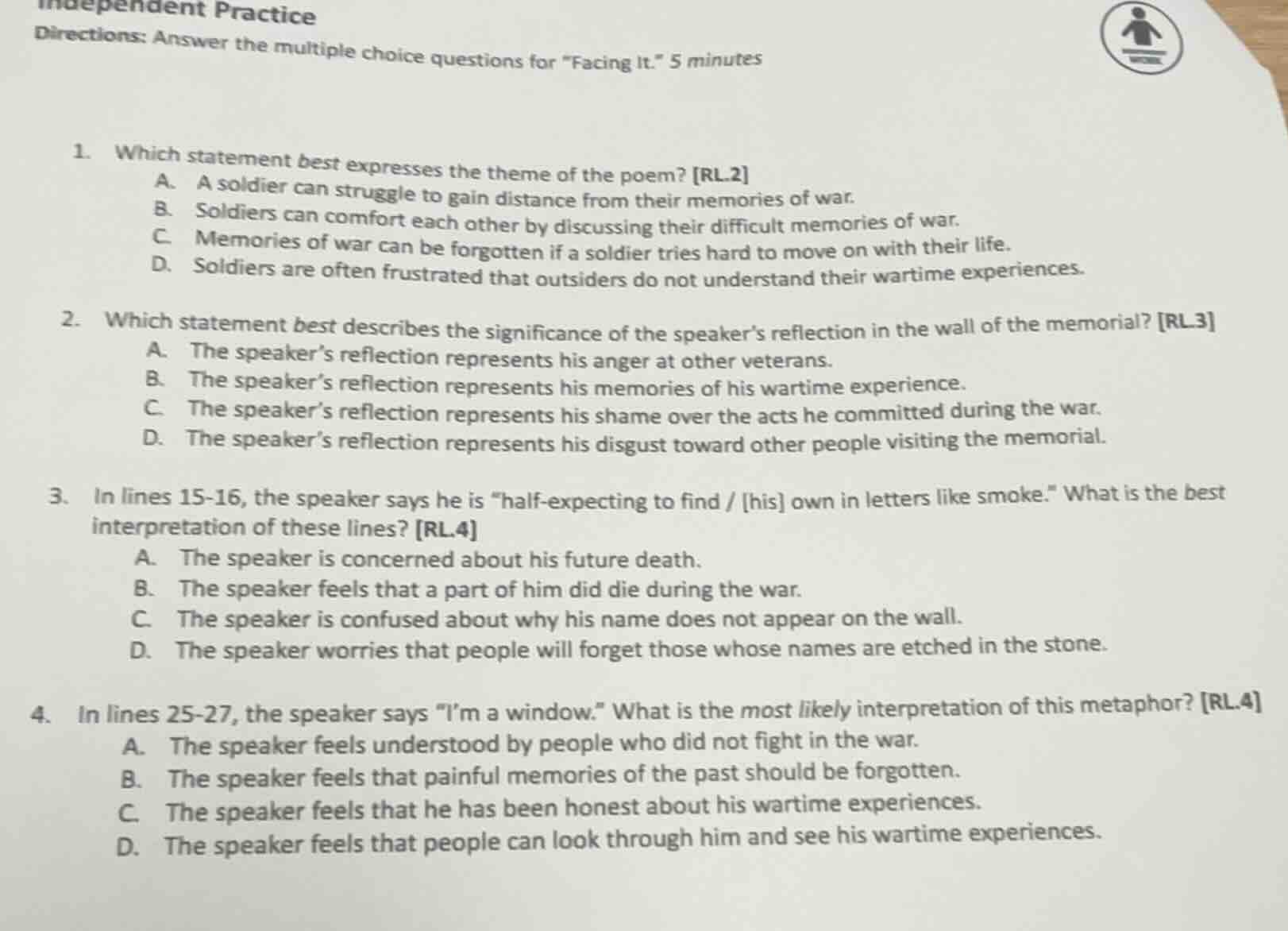
directions: answer the multiple choice questions for \facing it.\ 5 minutes
- which statement best expresses the theme of the poem? rl.2
a. a soldier can struggle to gain distance from their memories of war.
b. soldiers can comfort each other by discussing their difficult memories of war.
c. memories of war can be forgotten if a soldier tries hard to move on with their life.
d. soldiers are often frustrated that outsiders do not understand their wartime experiences.
- which statement best describes the significance of the speakers reflection in the wall of the memorial? rl.3
a. the speakers reflection represents his anger at other veterans.
b. the speakers reflection represents his memories of his wartime experience.
c. the speakers reflection represents his shame over the acts he committed during the war.
d. the speakers reflection represents his disgust toward other people visiting the memorial.
- in lines 15-16, the speaker says he is \half-expecting to find / his own in letters like smoke.\ what is the best interpretation of these lines? rl.4
a. the speaker is concerned about his future death.
b. the speaker feels that a part of him did die during the war.
c. the speaker is confused about why his name does not appear on the wall.
d. the speaker worries that people will forget those whose names are etched in the stone.
- in lines 25-27, the speaker says \im a window.\ what is the most likely interpretation of this metaphor? rl.4
a. the speaker feels understood by people who did not fight in the war.
b. the speaker feels that painful memories of the past should be forgotten.
c. the speaker feels that he has been honest about his wartime experiences.
d. the speaker feels that people can look through him and see his wartime experiences.
Question 1: Theme of the poem
The poem "Facing It" by Yusef Komunyakaa depicts a Vietnam War veteran visiting the Vietnam Veterans Memorial. The speaker struggles with the overwhelming, inescapable memories of the war that are triggered by seeing the wall, illustrating how a soldier constantly struggles to distance themselves from their traumatic past.
Question 2: Significance of the reflection
As the speaker looks at the black granite wall, his physical reflection merges with the names of the dead. This visual reflection serves as a literal and symbolic mirror of his internal state, representing his inescapable memories and the psychological imprint of his wartime experiences.
Question 3: Interpretation of lines 15-16
The phrase "half-expecting to find / [his] own in letters like smoke" suggests a feeling of survivorship guilt and the sensation that a part of him died in Vietnam along with his fallen comrades, making him feel as though his name belongs on the memorial wall.
Question 4: Interpretation of the "window" metaphor
In lines 25-27, the speaker says "I'm a window." This metaphor suggests transparency and vulnerability, indicating that his outer self cannot hide his inner trauma; people can look right through him and see the painful wartime experiences he carries inside.

Snap & solve any problem in the app
Get step-by-step solutions on Sovi AI
Photo-based solutions with guided steps
Explore more problems and detailed explanations
Question 1
- A. A soldier can struggle to gain distance from their memories of war. (Correct answer)
- B. Soldiers can comfort each other by discussing their difficult memories of war.
- C. Memories of war can be forgotten if a soldier tries hard to move on with their life.
- D. Soldiers are often frustrated that outsiders do not understand their wartime experiences.
Question 2
- A. The speaker's reflection represents his anger at other veterans.
- B. The speaker's reflection represents his memories of his wartime experience. (Correct answer)
- C. The speaker's reflection represents his shame over the acts he committed during the war.
- D. The speaker's reflection represents his disgust toward other people visiting the memorial.
Question 3
- A. The speaker is concerned about his future death.
- B. The speaker feels that a part of him did die during the war. (Correct answer)
- C. The speaker is confused about why his name does not appear on the wall.
- D. The speaker worries that people will forget those whose names are etched in the stone.
Question 4
- A. The speaker feels understood by people who did not fight in the war.
- B. The speaker feels that painful memories of the past should be forgotten.
- C. The speaker feels that he has been honest about his wartime experiences.
- D. The speaker feels that people can look through him and see his wartime experiences. (Correct answer)