QUESTION IMAGE
Question
this image cannot be easily described. if you need an explanation of this image, please ask your teacher for help.
the value of the function decreases throughout its domain.
the function has an x-intercept of (0, 1) and no y-intercepts.
as x approaches positive infinity, y approaches negative infinity.
as x approaches negative infinity, y approaches 0, which means that the function has an asymptote of y=0
the function has a y-intercept of (0, 1) and no x-intercepts
the value of the function increases throughout its domain.
Analyze the graph's behavior
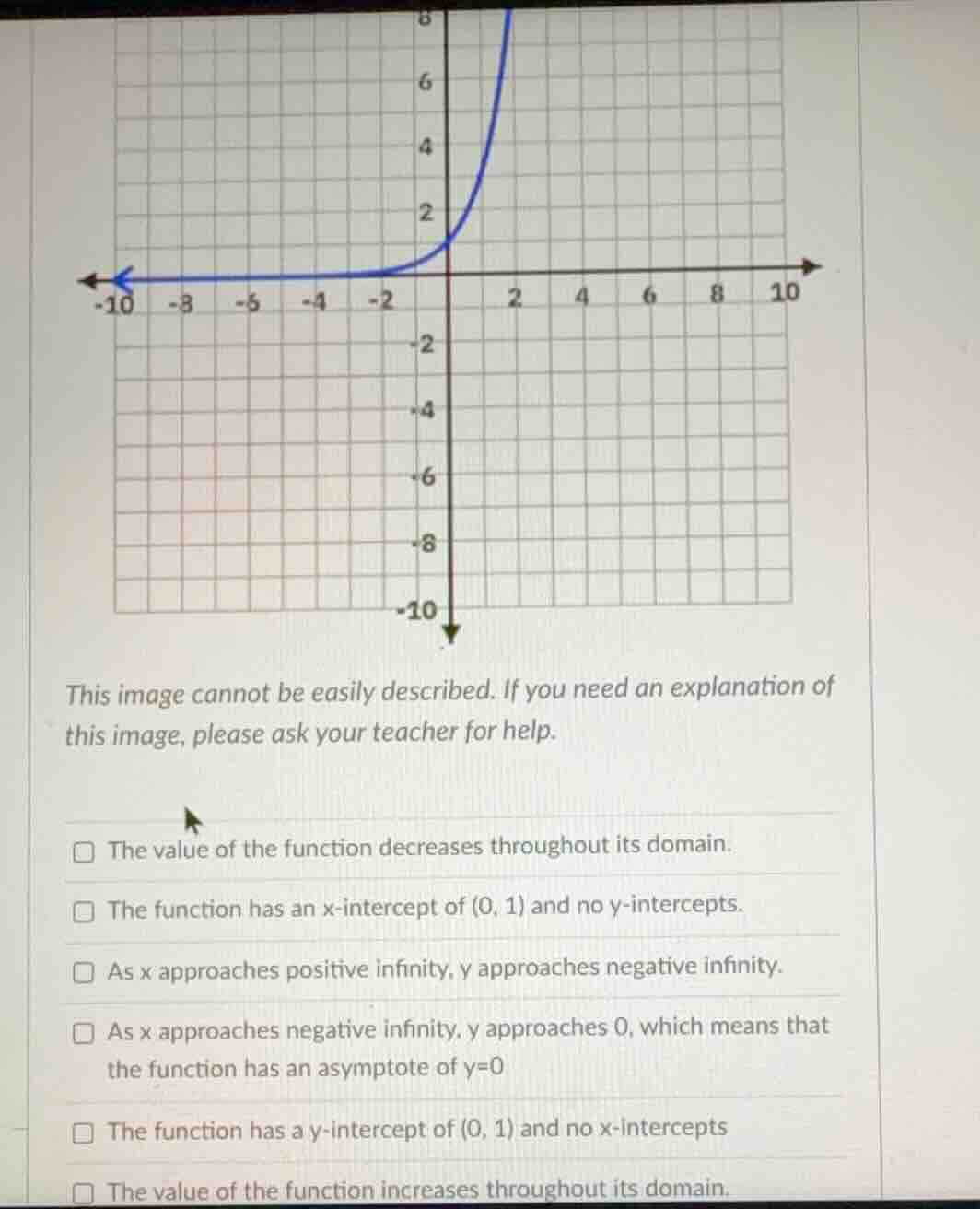
The graph shows an exponential growth curve.
Using the Exponential Functions knowledge point, we observe that as \(x\) increases, \(y\) increases rapidly.
Thus, the function increases throughout its domain.
Identify the intercepts
Using the Function Key Features knowledge point, we locate where the curve crosses the axes.
The curve crosses the y-axis at \((0, 1)\), which is the y-intercept.
The curve approaches but never crosses the x-axis, meaning there is no x-intercept.
Determine the asymptotic behavior
As \(x\) approaches negative infinity, the curve flattens out.
The values of \(y\) approach \(0\), which means \(y = 0\) is a horizontal asymptote.
This confirms the end behavior of the exponential function.
Evaluate the given statements
We check each statement against our findings:
- "The value of the function decreases throughout its domain" is false.
- "The function has an x-intercept of (0, 1) and no y-intercepts" is false (it is a y-intercept).
- "As x approaches positive infinity, y approaches negative infinity" is false (y approaches positive infinity).
- "As x approaches negative infinity, y approaches 0, which means that the function has an asymptote of y=0" is true.
- "The function has a y-intercept of (0, 1) and no x-intercepts" is true.
- "The value of the function increases throughout its domain" is true.

Snap & solve any problem in the app
Get step-by-step solutions on Sovi AI
Photo-based solutions with guided steps
Explore more problems and detailed explanations
- The value of the function decreases throughout its domain.
- The function has an x-intercept of (0, 1) and no y-intercepts.
- As x approaches positive infinity, y approaches negative infinity.
- As x approaches negative infinity, y approaches 0, which means that the function has an asymptote of y=0 (Correct answer)
- The function has a y-intercept of (0, 1) and no x-intercepts (Correct answer)
- The value of the function increases throughout its domain. (Correct answer)