QUESTION IMAGE
Question
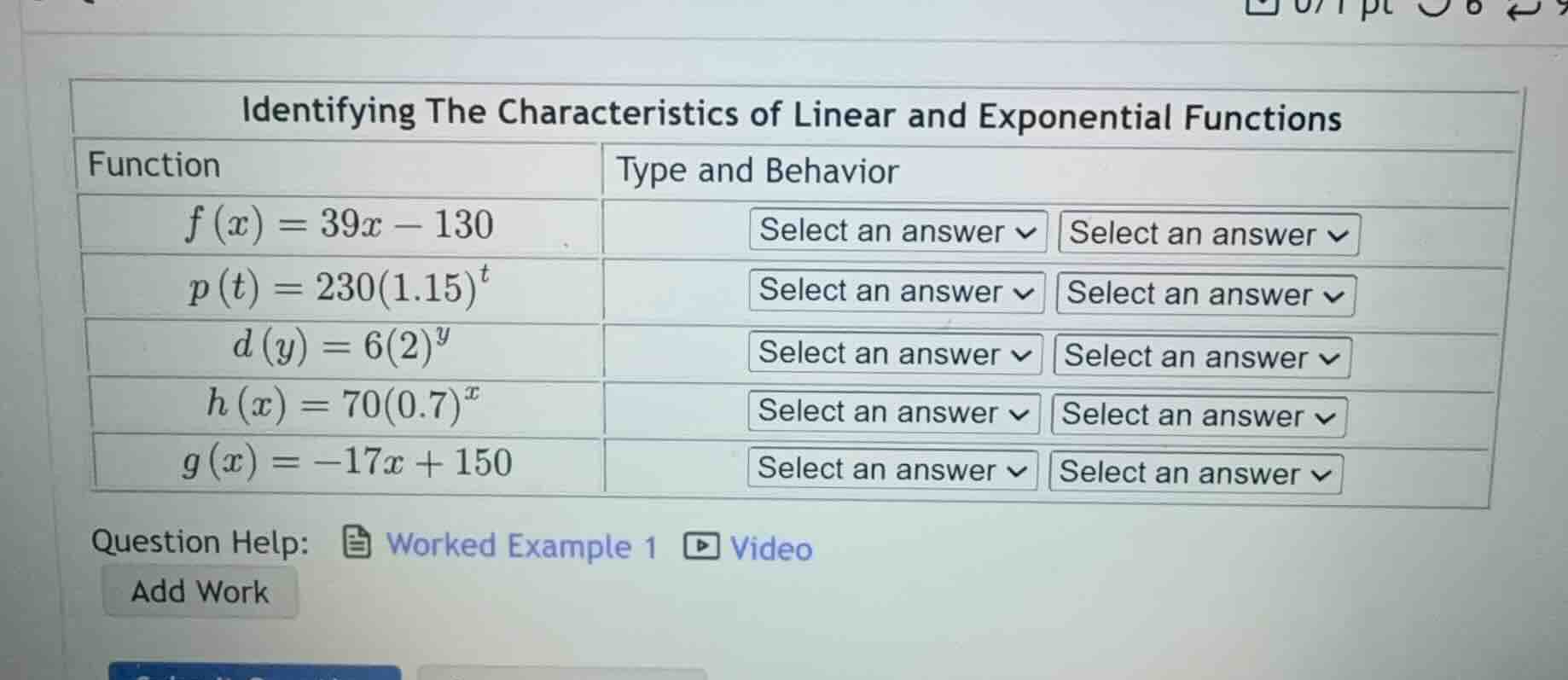
identifying the characteristics of linear and exponential functions
\
🆕 New Concept Discovered: Linear vs. Exponential Functions
Linear grows by adding; exponential grows by multiplying.
Step 1: Analyze \( f(x) = 39x - 130 \)
This function is in the slope-intercept form \( y = mx + b \), where \( m = 39 \) and \( b = -130 \).
- Type: Since the variable \( x \) is multiplied by a constant, it is a Linear function.
- Behavior: The slope \( m = 39 \) is positive, meaning the function increases by a constant amount for each unit increase in \( x \). Thus, it is Increasing.
Step 2: Analyze \( p(t) = 230(1.15)^t \)
This function is in the exponential form \( y = ab^t \), where \( a = 230 \) and the base \( b = 1.15 \).
- Type: Since the variable \( t \) is in the exponent, it is an Exponential function.
- Behavior: The base \( b = 1.15 \) is greater than \( 1 \), which means the value multiplies by \( 1.15 \) at each step. Thus, it is Increasing (Exponential Growth).
Step 3: Analyze \( d(y) = 6(2)^y \)
This function is in the exponential form \( ab^y \), where \( a = 6 \) and the base \( b = 2 \).
- Type: Since the variable \( y \) is in the exponent, it is an Exponential function.
- Behavior: The base \( b = 2 \) is greater than \( 1 \), meaning the value doubles at each step. Thus, it is Increasing (Exponential Growth).
Step 4: Analyze \( h(x) = 70(0.7)^x \)
This function is in the exponential form \( ab^x \), where \( a = 70 \) and the base \( b = 0.7 \).
- Type: Since the variable \( x \) is in the exponent, it is an Exponential function.
- Behavior: The base \( b = 0.7 \) is between \( 0 \) and \( 1 \), meaning the value shrinks to \( 70\% \) of its previous value at each step. Thus, it is Decreasing (Exponential Decay).
Step 5: Analyze \( g(x) = -17x + 150 \)
This function is in the slope-intercept form \( y = mx + b \), where \( m = -17 \) and \( b = 150 \).
- Type: Since the variable \( x \) is multiplied by a constant, it is a Linear function.
- Behavior: The slope \( m = -17 \) is negative, meaning the function decreases by \( 17 \) units for each unit increase in \( x \). Thus, it is Decreasing.

Snap & solve any problem in the app
Get step-by-step solutions on Sovi AI
Photo-based solutions with guided steps
Explore more problems and detailed explanations
| Function | Type | Behavior |
|---|---|---|
| \( p(t) = 230(1.15)^t \) | Exponential | Increasing |
| \( d(y) = 6(2)^y \) | Exponential | Increasing |
| \( h(x) = 70(0.7)^x \) | Exponential | Decreasing |
| \( g(x) = -17x + 150 \) | Linear | Decreasing |