QUESTION IMAGE
Question
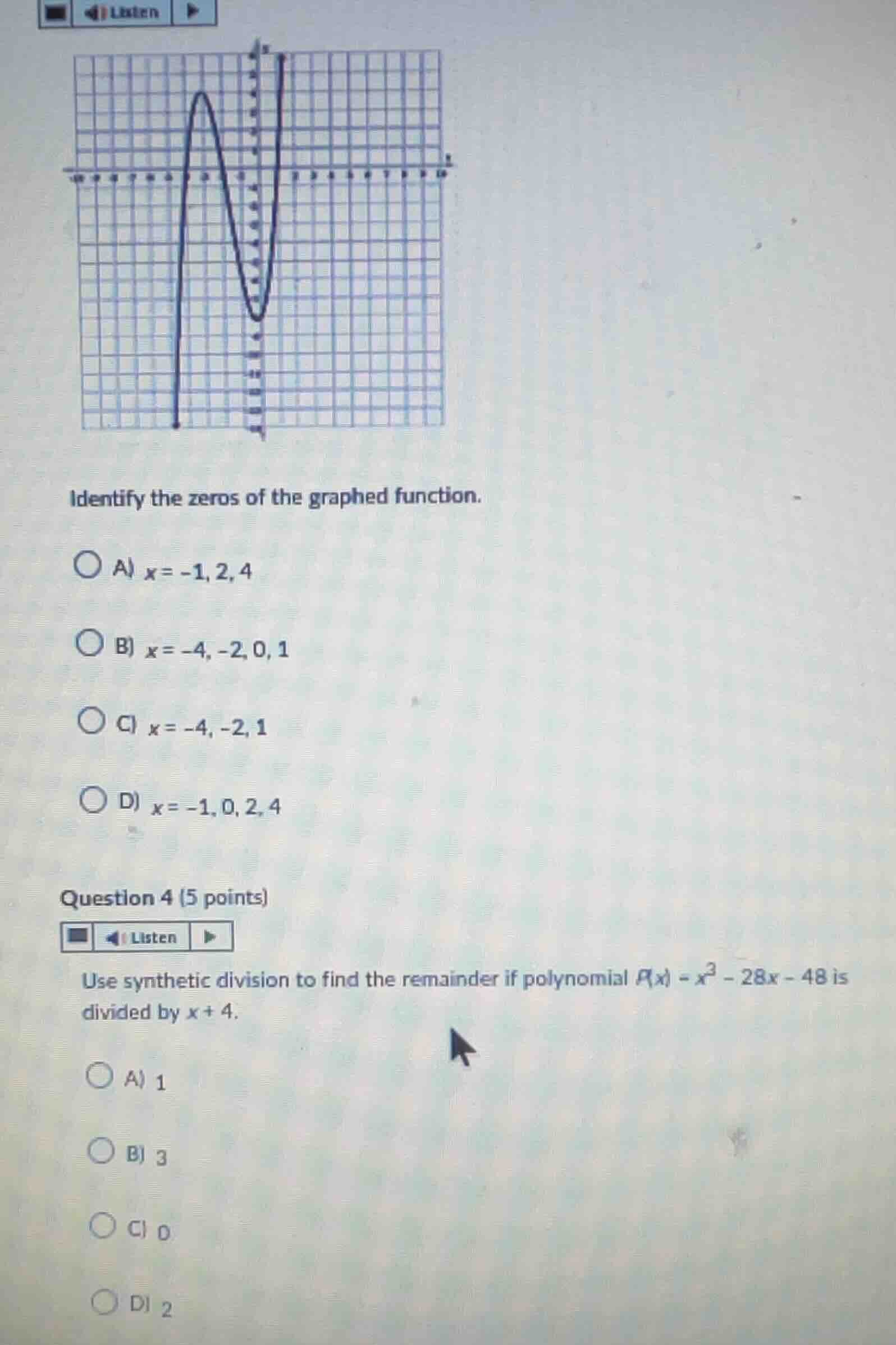
identify the zeros of the graphed function.
a) \\(x = -1, 2, 4\\)
b) \\(x = -4, -2, 0, 1\\)
c) \\(x = -4, -2, 1\\)
d) \\(x = -1, 0, 2, 4\\)
question 4 (5 points)
use synthetic division to find the remainder if polynomial \\(p(x) = x^3 - 28x - 48\\) is divided by \\(x + 4\\).
a) 1
b) 3
c) 0
d) 2
Identify x-intercepts from the graph
To find the zeros of the graphed function, we look for the \(x\)-coordinates where the graph intersects or touches the \(x\)-axis (where \(y = 0\)). Looking closely at the grid:
- The curve crosses the \(x\)-axis on the left at \(x = -4\).
- The curve crosses the \(x\)-axis in the middle at \(x = -2\).
- The curve crosses the \(x\)-axis on the right at \(x = 1\).
Thus, the zeros of the graphed function are \(x = -4, -2, 1\). This matches option C.
Set up synthetic division
For the second question, we want to divide the polynomial \(P(x) = x^3 - 28x - 48\) by \(x + 4\).
- The divisor is \(x + 4\), so the test value for synthetic division is \(c = -4\).
- Write down the coefficients of \(P(x)\). Note that there is no \(x^2\) term, so its coefficient is \(0\).
- The coefficients are: \(1\) (for \(x^3\)), \(0\) (for \(x^2\)), \(-28\) (for \(x\)), and \(-48\) (constant).
Perform synthetic division calculation
We set up the synthetic division table:
-4 |   1    0   -28   -48
   |       -4    16    48
   ----------------------
       1   -4   -12     0
Let's calculate each column:
- Bring down the first coefficient: \(1\).
- Multiply \(1\) by \(-4\) to get \(-4\). Add to \(0\): \(0 + (-4) = -4\).
- Multiply \(-4\) by \(-4\) to get \(16\). Add to \(-28\): \(-28 + 16 = -12\).
- Multiply \(-12\) by \(-4\) to get \(48\). Add to \(-48\): \(-48 + 48 = 0\).
Determine the remainder
The last value in the bottom row of our synthetic division is the remainder.
- The remainder is \(0\).
- This corresponds to option C.

Snap & solve any problem in the app
Get step-by-step solutions on Sovi AI
Photo-based solutions with guided steps
Explore more problems and detailed explanations
Question 1
- A) \(x = -1, 2, 4\)
- B) \(x = -4, -2, 0, 1\)
- C) \(x = -4, -2, 1\) (Correct answer)
- D) \(x = -1, 0, 2, 4\)
Question 2
- A) 1
- B) 3
- C) 0 (Correct answer)
- D) 2