QUESTION IMAGE
Question
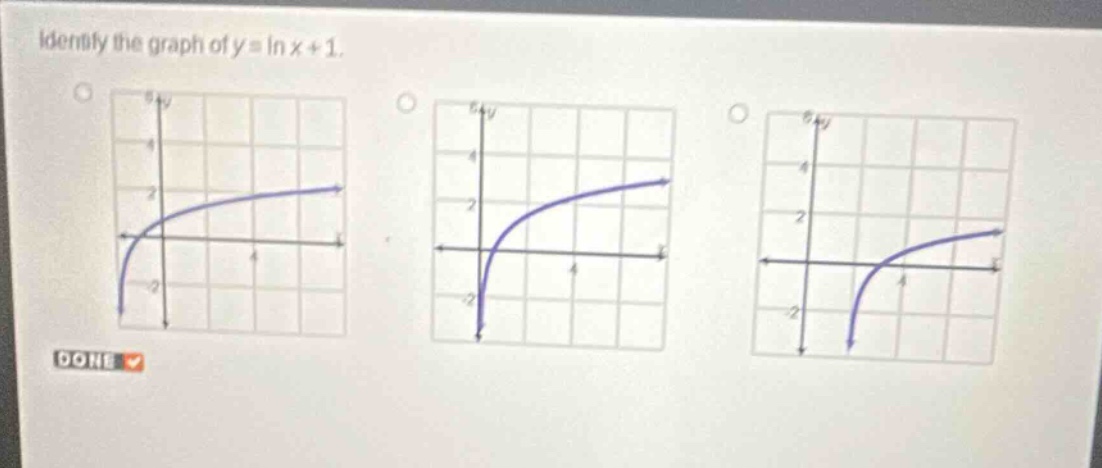
identify the graph of (y = \ln x + 1).
⚡ Using what you learned: Understanding Logarithmic Functions
Step 1: Identify key points of the parent function
The parent function is:
$$ y = \ln x $$
Key points for the natural logarithm function include:
- When \( x = 1 \), \( y = \ln(1) = 0 \), giving the point \((1, 0)\).
- When \( x = e \approx 2.718 \), \( y = \ln(e) = 1 \), giving the point \((2.718, 1)\).
- There is a vertical asymptote at \( x = 0 \).
Step 2: Apply the vertical shift
The given equation is:
$$ y = \ln x + 1 $$
This represents a vertical shift upward by \( 1 \) unit. We apply this shift to our key points:
- The point \((1, 0)\) shifts up to \((1, 1)\).
- The point \((e, 1) \approx (2.718, 1)\) shifts up to \((e, 2) \approx (2.718, 2)\).
- The vertical asymptote remains at \( x = 0 \) (the y-axis).
Step 3: Match with the correct graph
Let's examine the given graphs to find the one containing the point \((1, 1)\) with a vertical asymptote at \( x = 0 \):
- First Graph:
- At \( x = 1 \), the curve passes through \( y = 1 \).
- The vertical asymptote is at \( x = 0 \) (the y-axis).
- This matches our shifted function \( y = \ln x + 1 \).
- Second Graph:
- At \( x = 1 \), the curve passes through \( y = 0 \). This is the unshifted parent function \( y = \ln x \).
- Third Graph:
- The vertical asymptote is shifted to the right at \( x = 2 \), which would represent a horizontal shift like \( y = \ln(x - 2) \).

Snap & solve any problem in the app
Get step-by-step solutions on Sovi AI
Photo-based solutions with guided steps
Explore more problems and detailed explanations
The correct graph is the first graph (the leftmost option), which passes through the point \((1, 1)\) and has a vertical asymptote at the y-axis (\( x = 0 \)).