QUESTION IMAGE
Question
human experience
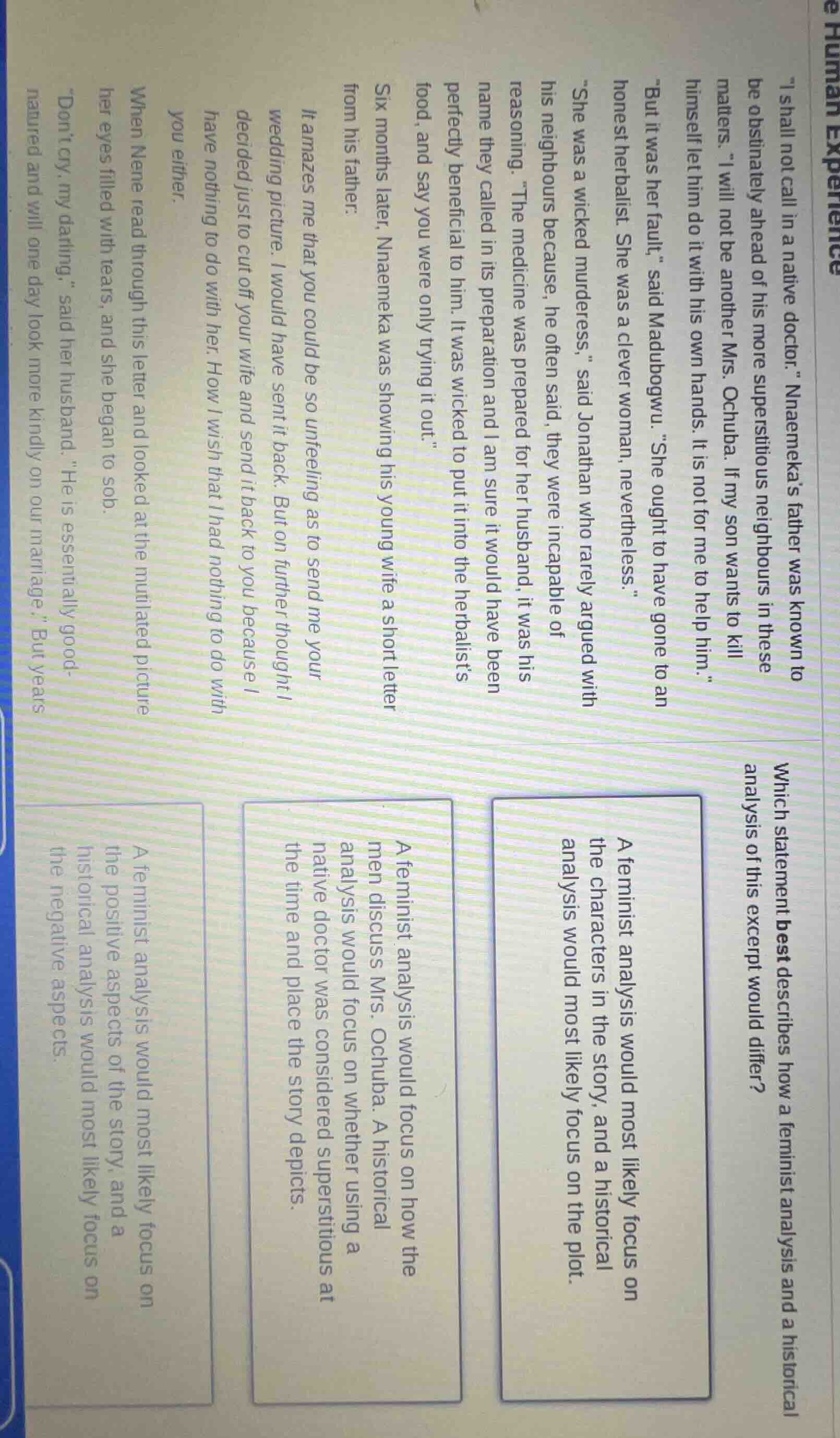
\i shall not call in a native doctor.\ nnaemeka’s father was known to be obstinately ahead of his more superstitious neighbours in these matters. \i will not be another mrs. ochuba. if my son wants to kill himself let him do it with his own hands. it is not for me to help him.\
\but it was her fault,\ said madubogwu. \she ought to have gone to an honest herbalist. she was a clever woman, nevertheless.\
\she was a wicked murderess,\ said jonathan who rarely argued with his neighbours because, he often said, they were incapable of reasoning. \the medicine was prepared for her husband, it was his name they called in its preparation and i am sure it would have been perfectly beneficial to him. it was wicked to put it into the herbalist’s food, and say you were only trying it out.\
six months later, nnaemeka was showing his young wife a short letter from his father:
it amazes me that you could be so unfeeling as to send me your wedding picture. i would have sent it back. but on further thought i decided just to cut off your wife and send it back to you because i have nothing to do with her. how i wish that i had nothing to do with you either.
when nene read through this letter and looked at the mutilated picture her eyes filled with tears, and she began to sob.
\don’t cry, my darling,\ said her husband. \he is essentially good - natured and will one day look more kindly on our marriage.\ but years
which statement best describes how a feminist analysis and a historical analysis of this excerpt would differ?
a feminist analysis would most likely focus on the characters in the story, and a historical analysis would most likely focus on the plot.
a feminist analysis would focus on how the men discuss mrs. ochuba. a historical analysis would focus on whether using a native doctor was considered superstitious at the time and place the story depicts.
a feminist analysis would most likely focus on the positive aspects of the story, and a historical analysis would most likely focus on the negative aspects.
To solve this, we analyze each option:
- Option 1: A feminist analysis focuses on gender dynamics (e.g., women's roles, male - female interactions), while a historical analysis focuses on the time - period context (social norms, cultural practices). The first option's description of their focuses (characters vs plot) is incorrect.
- Option 2: A feminist analysis would look at how men (like the characters discussing Mrs. Ochuba) interact with women and gender - based power dynamics. A historical analysis would examine if the native doctor's perception as superstitious was typical of the story's time. This matches the difference between the two types of analysis.
- Option 3: A feminist analysis is about gender, not positive/negative aspects of the story. A historical analysis is about the time - period context, not just positive/negative aspects. So this option is incorrect.

Snap & solve any problem in the app
Get step-by-step solutions on Sovi AI
Photo-based solutions with guided steps
Explore more problems and detailed explanations
B. A feminist analysis would focus on how the men discuss Mrs. Ochuba. A historical analysis would focus on whether using a native doctor was considered superstitious at the time and place the story depicts.