QUESTION IMAGE
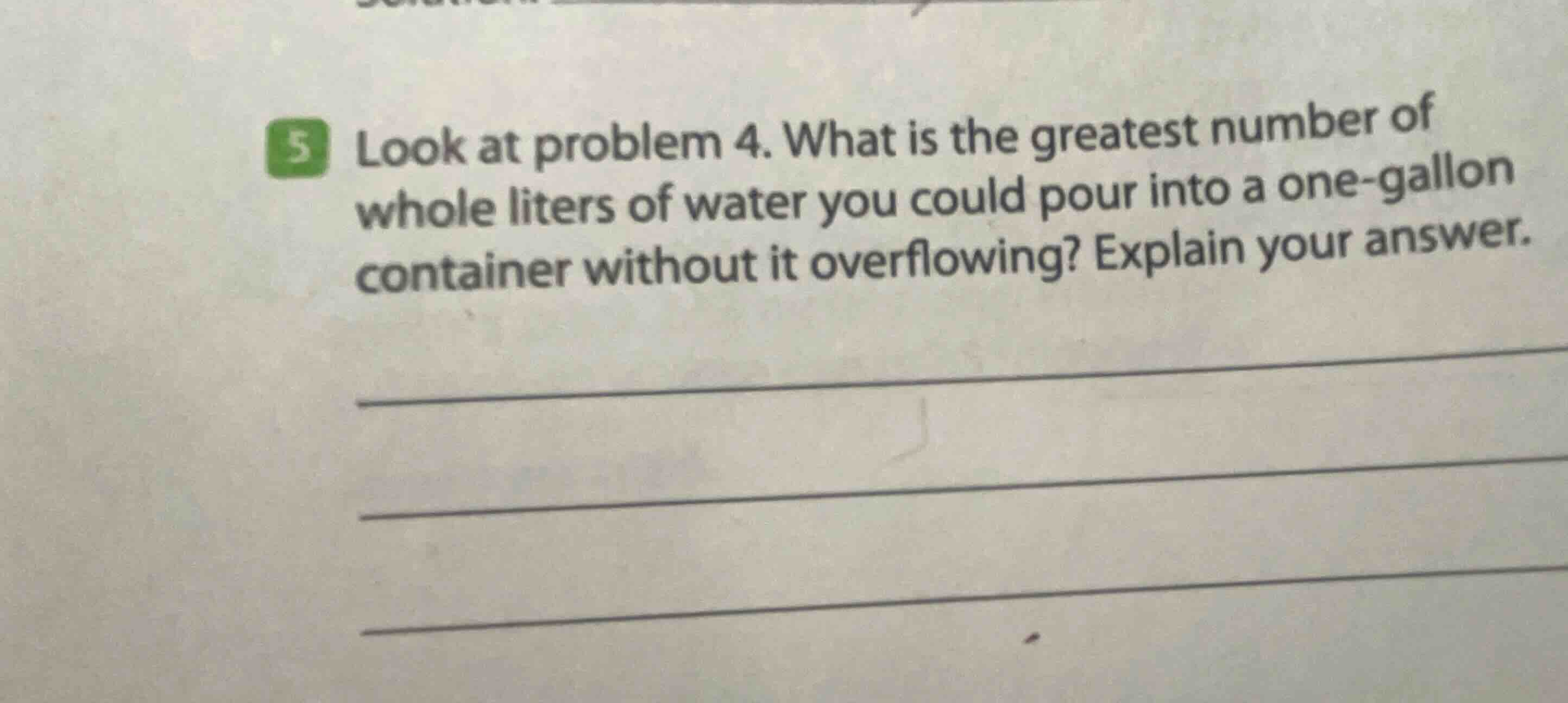
Question
Question was provided via image upload.
Identify the conversion factor
To solve this problem, we need the relationship between gallons and liters. One US gallon is approximately equal to \(3.785\) liters:
Compare whole liters to the capacity
We want to find the greatest number of whole liters, \(L\), that can fit inside a 1-gallon container without overflowing. This means:
Determine the greatest whole number
Since \(L\) must be a whole number (an integer), we look at the integers less than \(3.785\), which are \(1, 2,\) and \(3\). The greatest of these whole numbers is \(3\).
Explain the result
Pouring \(3\) whole liters equals \(3\) liters, which is less than \(3.785\) liters (1 gallon), so it will not overflow. Pouring \(4\) whole liters would exceed the \(3.785\)-liter capacity and cause an overflow.

Snap & solve any problem in the app
Get step-by-step solutions on Sovi AI
Photo-based solutions with guided steps
Explore more problems and detailed explanations
3 liters.
Since 1 gallon is approximately equal to 3.785 liters, a 1-gallon container can hold up to 3.785 liters of water. The greatest whole number of liters that is less than 3.785 is 3. Pouring 4 liters would exceed the container's capacity and cause it to overflow.