QUESTION IMAGE
Question
Question was provided via image upload.
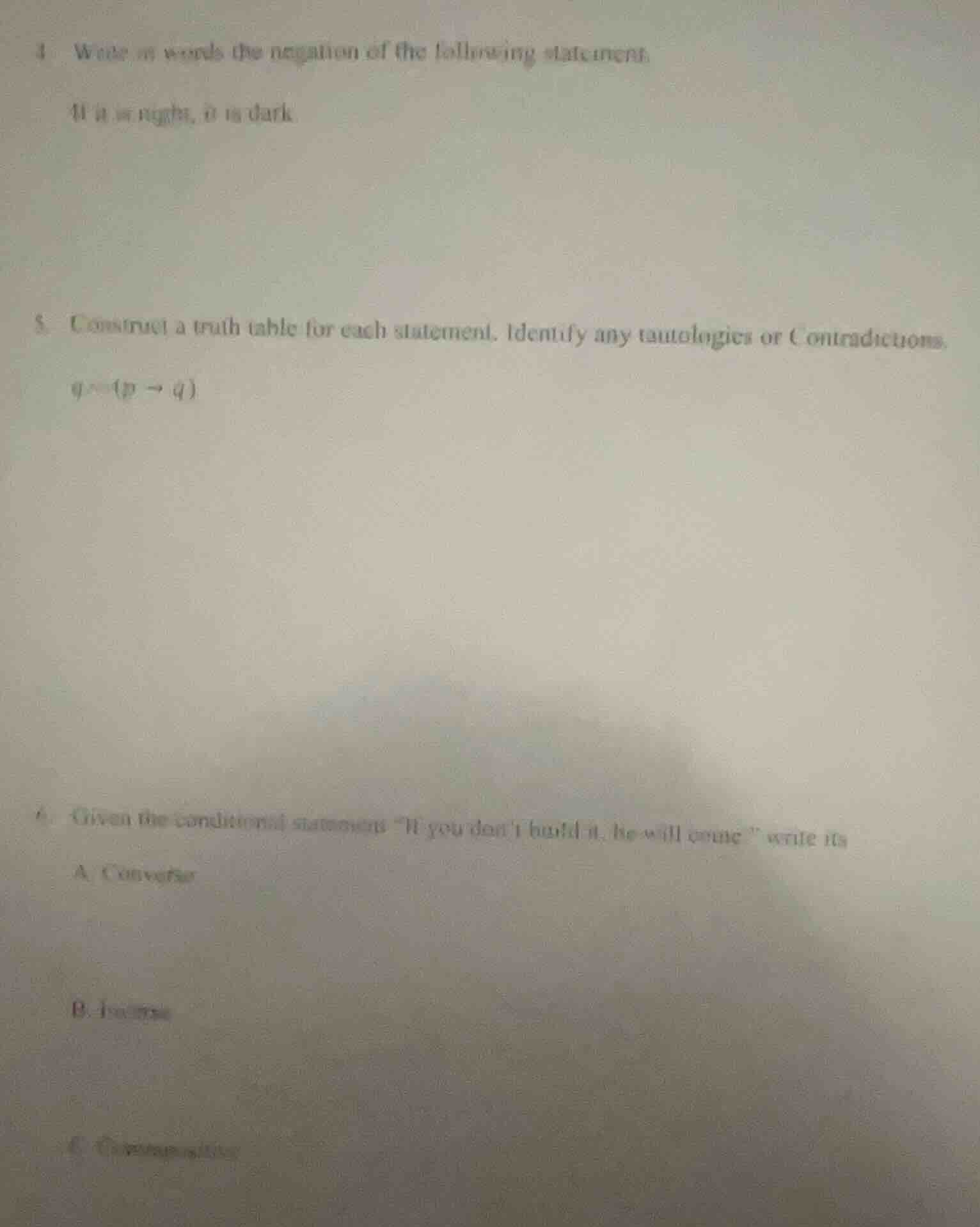
Negate the conditional statement
Using the Conditional Statements knowledge point
The original statement is: "If it is night, it is dark."
Let \(p\) be "It is night" and \(q\) be "It is dark."
The statement is \(p
ightarrow q\).
The negation is \(
eg(p
ightarrow q) \equiv p \land
eg q\).
In words, this is: "It is night and it is not dark."
Construct the truth table
Using the Truth Tables knowledge point
Since all truth values in the final column are True, the statement is a tautology.
Write converse, inverse, and contrapositive
Using the Conditional Statements knowledge point
The conditional statement is: "If you don't build it, he will come."
Let \(p\) be "You don't build it" and \(q\) be "He will come."
- Converse (\(q
ightarrow p\)): "If he will come, you don't build it."
- Inverse (\(
eg p
ightarrow
eg q\)): "If you build it, he will not come."
- Contrapositive (\(
eg q
ightarrow
eg p\)): "If he will not come, you build it."

Snap & solve any problem in the app
Get step-by-step solutions on Sovi AI
Photo-based solutions with guided steps
Explore more problems and detailed explanations
Question 4
"It is night and it is not dark."
Question 5
The truth table for \(q
ightarrow (p
ightarrow q)\) is:
| \(p\) | \(q\) | \(p |
ightarrow q\) | \(q
ightarrow (p
ightarrow q)\) |
| T | T | T | T |
| T | F | F | T |
| F | T | T | T |
| F | F | T | T |
The statement is a tautology.
Question 6
- A. Converse: "If he will come, you don't build it."
- B. Inverse: "If you build it, he will not come."
- C. Contrapositive: "If he will not come, you build it."