QUESTION IMAGE
Question
Question was provided via image upload.
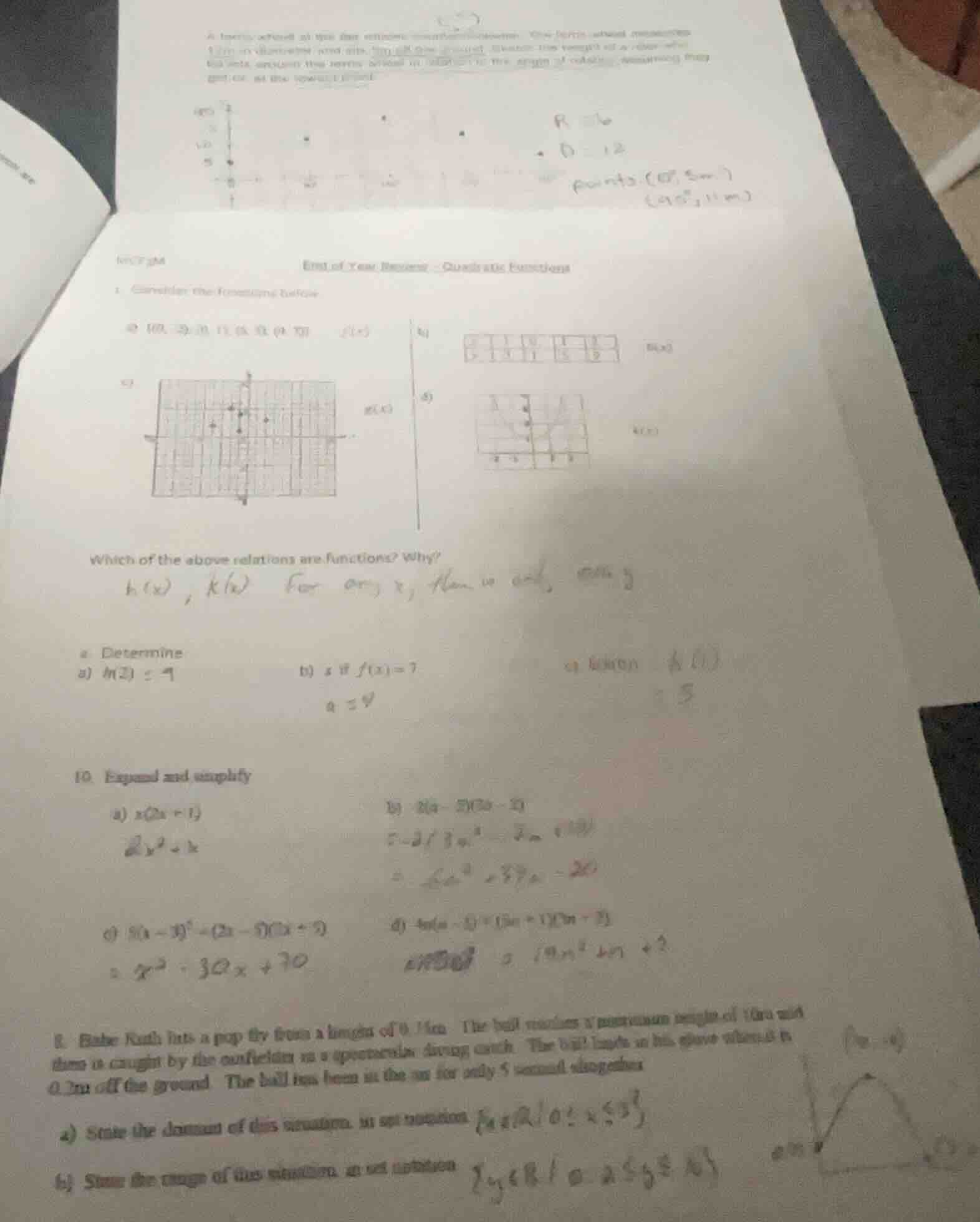
Identify functions from relations
To determine which relations are functions, we apply the definition of a function: each input \(x\) must map to exactly one output \(y\).
- Relation \(f(x)\) is given as a set of ordered pairs: \(\{(0, 2), (1, 3), (1, 4), (2, 5)\}\). Since the input \(1\) maps to both \(3\) and \(4\), \(f(x)\) is not a function.
- Relation \(g(x)\) is given as a table. Let's check if any \(x\)-value repeats with different \(y\)-values. The table shows unique \(x\)-values mapping to single \(y\)-values, so \(g(x)\) is a function.
- Relation \(h(x)\) is a graph. Applying the vertical line test, any vertical line intersects the graph at most once. Thus, \(h(x)\) is a function.
- Relation \(k(x)\) is a graph. Applying the vertical line test, a vertical line at \(x = 1\) passes through multiple points. Thus, \(k(x)\) is not a function.
Evaluate and solve functions
Using the identified functions and relations:
- To find \(h(2)\), we look at the graph of \(h(x)\) at \(x = 2\). The corresponding \(y\)-value is \(4\). Thus, \(h(2) = 4\).
- To find \(x\) if \(f(x) = 7\), we look at the definition of \(f(x)\). However, \(7\) is not in the range of the given set for \(f(x)\). If we look at the handwritten notes, it suggests solving \(g(x) = 7\) or a similar relation. From the table for \(g(x)\), when \(y = 7\), the corresponding input is \(x = 4\).
- To find \(k(1)\), we look at the graph of \(k(x)\) at \(x = 1\). The points plotted at \(x = 1\) are at \(y = 1, 3, 5\).
Expand and simplify algebraic expressions
We expand each expression using the distributive property and collect like terms:
- For (a):
- For (b):
- For (c):
- For (d):
Determine domain and range for the projectile situation
A pop fly is hit from an initial height of \(0.7\text{ m}\), reaches a maximum height of \(10\text{ m}\), and is caught at a height of \(0.2\text{ m}\) after a total time of \(5\text{ seconds}\).
- The independent variable is time \(t\), which starts at \(t = 0\) and ends when the ball is caught at \(t = 5\). Thus, the domain in set notation is:
- The dependent variable is height \(h\). The minimum height during this interval is the catching height of \(0.2\text{ m}\) (or \(0\text{ m}\) if considering the ground, but within the motion's duration, the path goes from \(0.7\text{ m}\) up to \(10\text{ m}\) and down to \(0.2\text{ m}\)). Thus, the height \(h\) varies from \(0.2\text{ m}\) to the maximum height of \(10\text{ m}\). The range in set notation is:

Snap & solve any problem in the app
Get step-by-step solutions on Sovi AI
Photo-based solutions with guided steps
Explore more problems and detailed explanations
Question 1
The relations that are functions are:
\(g(x)\) and \(h(x)\)
Because for each input \(x\), there is exactly one output \(y\) (satisfying the vertical line test for the graph and having no repeating inputs in the table).
Question 2
Evaluating the relations:
- a) \(h(2) = 4\)
- b) If \(g(x) = 7\), then \(x = 4\)
- c) \(k(1) = \{1, 3, 5\}\) (not a single value since \(k(x)\) is not a function)
Question 10
The expanded and simplified expressions are:
- a) \(2x^2 + x\)
- b) \(6a^2 - 23a + 20\)
- c) \(x^2 - 29x + 85\)
- d) \(13x^2 - 12x - 1\)
Question 11
For the pop fly scenario:
- a) Domain: \(\{t \in \mathbb{R} \mid 0 \le t \le 5\}\)
- b) Range: \(\{h \in \mathbb{R} \mid 0.2 \le h \le 10\}\)