QUESTION IMAGE
Question
Question was provided via image upload.
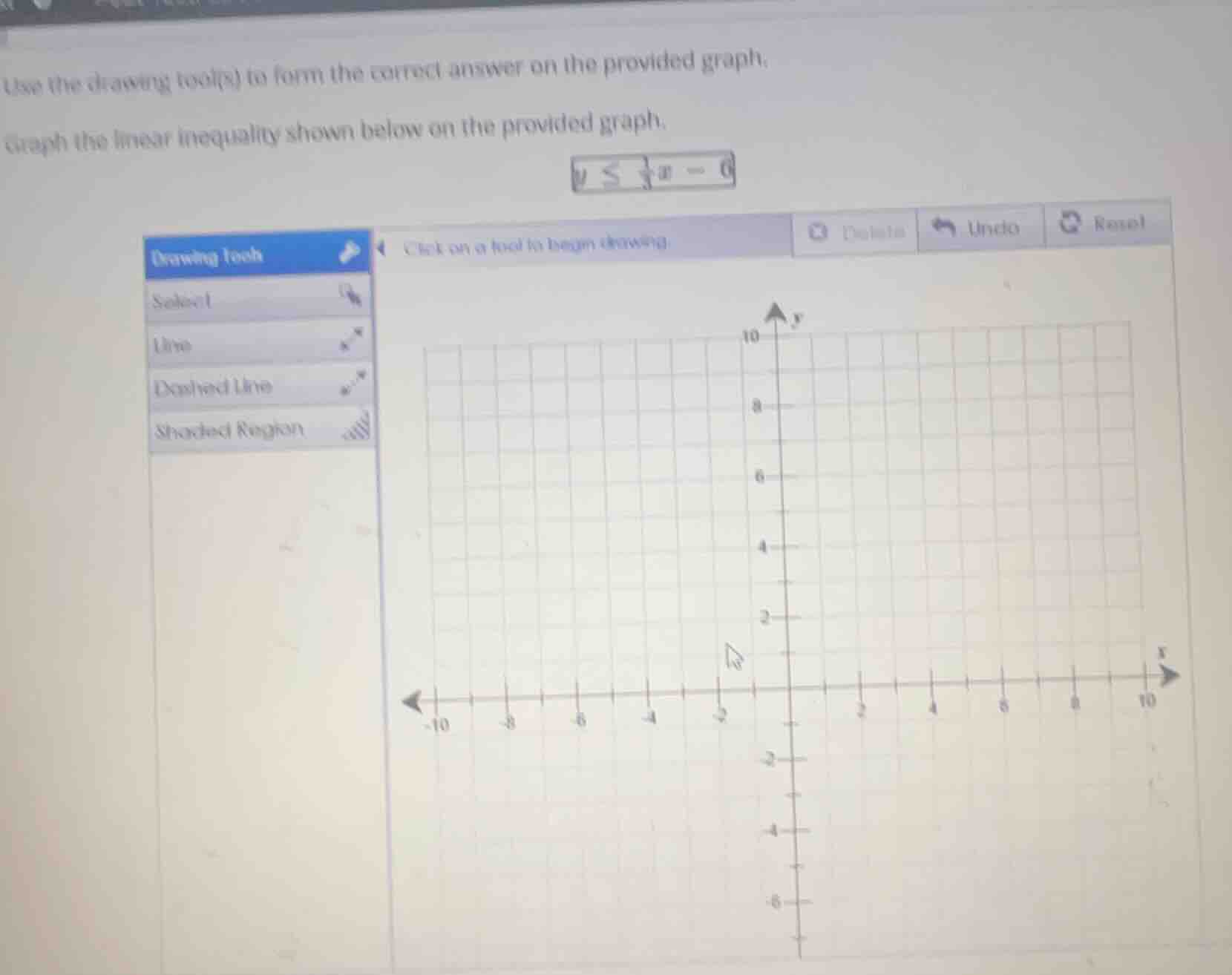
Identify the inequality and boundary line
The linear inequality shown in the image is:
$$
y \le \frac{2}{3}x - 6
$$
The corresponding boundary line is:
$$
y = \frac{2}{3}x - 6
$$
Determine the line style and points
Since the inequality symbol is \(\le\) (less than or equal to), the boundary line is solid.
We find two points on the line:
- When \(x = 0\):
$$
y = -6 \implies (0, -6)
$$
- When \(x = 9\):
$$
y = \frac{2}{3}(9) - 6 = 0 \implies (9, 0)
$$
Determine the shaded region
Since the inequality is \(y \le \frac{2}{3}x - 6\), we shade the region below the solid boundary line.
Testing the origin \((0,0)\):
$$
0 \le \frac{2}{3}(0) - 6 \implies 0 \le -6 \quad (\text{False})
$$
Thus, the region containing \((0,0)\) is not shaded; the region below the line is shaded.

Snap & solve any problem in the app
Get step-by-step solutions on Sovi AI
Photo-based solutions with guided steps
Explore more problems and detailed explanations
To graph the linear inequality \(y \le \frac{2}{3}x - 6\):
- Draw the boundary line: Plot a solid line passing through the y-intercept \((0, -6)\) and the x-intercept \((9, 0)\).
- Shade the region: Shade the region below the boundary line.