QUESTION IMAGE
Question
Question was provided via image upload.
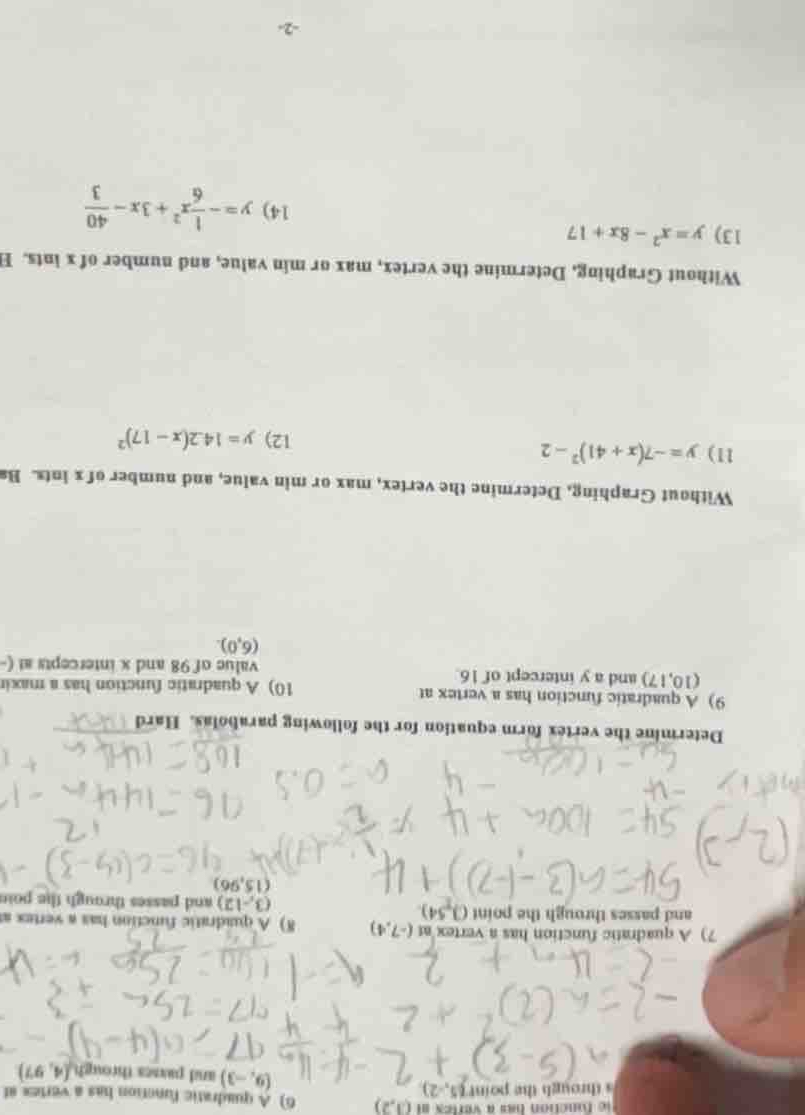
The image is upside down. Let's orient ourselves and solve the visible questions.
The questions are numbered 6 through 14.
Let's list each question clearly:
Section 1: Determine the vertex form equation for the following parabolas.
- Question 6: A quadratic function has a vertex at \((9, -3)\) and passes through \((4, 97)\).
- Question 7: A quadratic function has a vertex at \((-7, 4)\) and passes through the point \((3, 54)\).
- Question 8: A quadratic function has a vertex at \((3, -12)\) and passes through the point \((15, 96)\).
- Question 9: A quadratic function has a vertex at \((10, 17)\) and a y-intercept of \(16\).
- Question 10: A quadratic function has a maximum value of \(98\) and x-intercepts at \((-6, 0)\) and \((6, 0)\).
Section 2: Without Graphing, Determine the vertex, max or min value, and number of x ints.
- Question 11: \(y = -7(x + 41)^2 - 2\)
- Question 12: \(y = 14.2(x - 17)^2\)
- Question 13: \(y = x^2 - 8x + 17\)
- Question 14: \(y = -\frac{1}{6}x^2 + 3x - \frac{40}{3}\)
---
Find vertex form equations (Questions 6 to 10)
Using the Quadratic Vertex Form knowledge point:
The vertex form is \(y = a(x - h)^2 + k\), where \((h, k)\) is the vertex.
Using the Determining Quadratic Equations knowledge point:
We substitute the vertex \((h, k)\) and the given point \((x, y)\) to solve for \(a\).
Question 6
Using the Quadratic Vertex Form and Determining Quadratic Equations knowledge points
Vertex \((h, k) = (9, -3)\), point \((x, y) = (4, 97)\).
Equation: \(y = 4(x - 9)^2 - 3\)
Question 7
Using the Quadratic Vertex Form and Determining Quadratic Equations knowledge points
Vertex \((h, k) = (-7, 4)\), point \((x, y) = (3, 54)\).
Equation: \(y = 0.5(x + 7)^2 + 4\)
Question 8
Using the Quadratic Vertex Form and Determining Quadratic Equations knowledge points
Vertex \((h, k) = (3, -12)\), point \((x, y) = (15, 96)\).
Equation: \(y = 0.75(x - 3)^2 - 12\)
Question 9
Using the Quadratic Vertex Form and Determining Quadratic Equations knowledge points
Vertex \((h, k) = (10, 17)\), y-intercept is \(16\), which means it passes through \((0, 16)\).
Equation: \(y = -0.01(x - 10)^2 + 17\)
Question 10
Using the Quadratic Vertex Form and Determining Quadratic Equations knowledge points
The x-intercepts are symmetric at \(-6\) and \(6\), so the axis of symmetry is \(x = 0\).
The vertex is at \((0, 98)\) since the maximum value i…

Snap & solve any problem in the app
Get step-by-step solutions on Sovi AI
Photo-based solutions with guided steps
Explore more problems and detailed explanations
| No. | Answer |
|---|---|
| 7 | \(y = 0.5(x + 7)^2 + 4\) |
| 8 | \(y = 0.75(x - 3)^2 - 12\) |
| 9 | \(y = -0.01(x - 10)^2 + 17\) |
| 10 | \(y = -\frac{49}{18}x^2 + 98\) |
| 11 | Vertex: \((-41, -2)\), Max value: \(-2\), Number of x-intercepts: \(0\) |
| 12 | Vertex: \((17, 0)\), Min value: \(0\), Number of x-intercepts: \(1\) |
| 13 | Vertex: \((4, 1)\), Min value: \(1\), Number of x-intercepts: \(0\) |
| 14 | Vertex: \((9, \frac{1}{6})\), Max value: \(\frac{1}{6}\), Number of x-intercepts: \(2\) |