QUESTION IMAGE
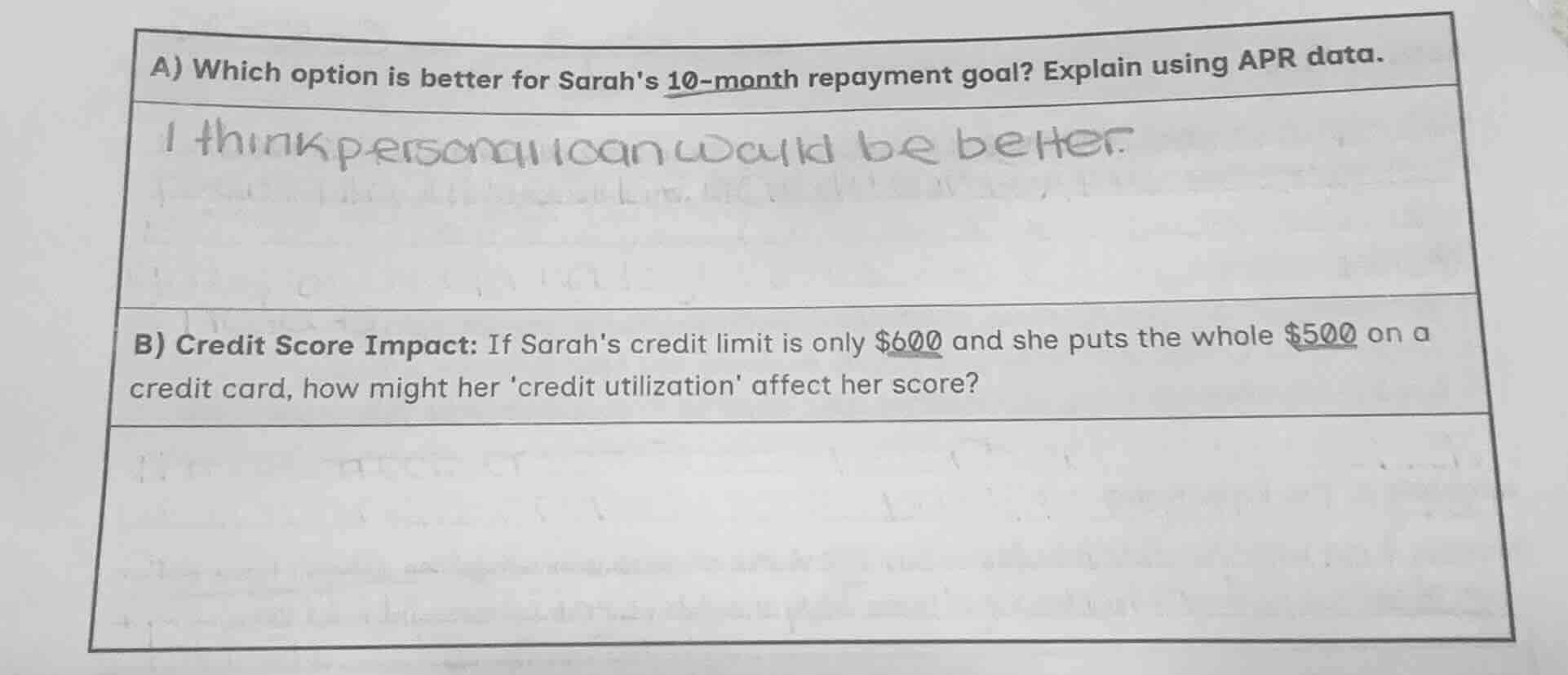
Question
Question was provided via image upload.
Analyze the missing context for Question A
The image asks to compare options using "APR data" for a 10-month repayment goal, but the specific APR values and options are not visible in the cropped image. Since the prompt requires a best-effort solution without inventing missing numbers, we will explain the general financial principle: a lower Annual Percentage Rate (APR) reduces the total interest paid over a fixed repayment period, making the option with the lower APR the better choice.
Calculate the credit utilization ratio for Question B
We need to calculate the credit utilization ratio using the given values.
The formula is:
Substituting the given values:
Analyze the impact on credit score
A credit utilization ratio of \(83.33\%\) is extremely high. Generally, lenders and credit scoring models (like FICO) recommend keeping credit utilization below \(30\%\) to maintain a healthy credit score. A ratio above \(80\%\) signals high risk to creditors and is highly likely to negatively affect (lower) her credit score.

Snap & solve any problem in the app
Get step-by-step solutions on Sovi AI
Photo-based solutions with guided steps
Explore more problems and detailed explanations
Question A
Because the specific APR data for the options is not visible in the image, the general rule is that the option with the lower Annual Percentage Rate (APR) is better because it minimizes the total interest accrued over the 10-month repayment period.
Question B
Putting the entire \(\$500\) on a \(\$600\) limit results in a credit utilization ratio of approximately \(83.33\%\) (\(\frac{500}{600} \times 100\%\)). Because this ratio is significantly higher than the recommended threshold of \(30\%\), it will likely negatively affect her credit score by lowering it.