QUESTION IMAGE
Question
Question was provided via image upload.
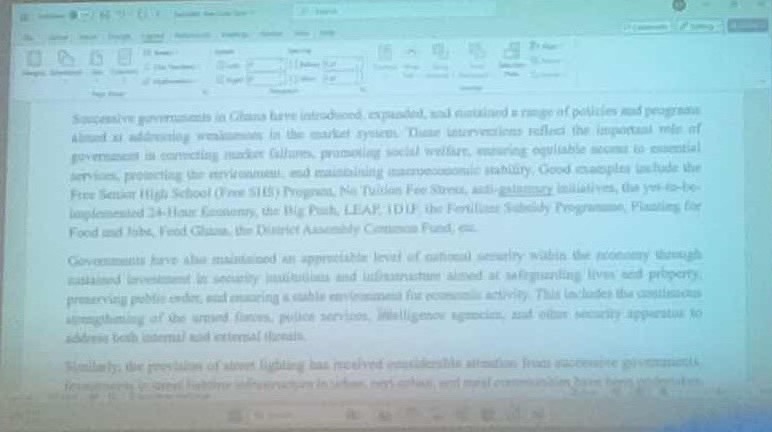
Analyze the economic context of the text
Using the Roles of Government knowledge point
The text describes how successive Ghanaian governments intervene to correct market failures, promote social welfare, and maintain macroeconomic stability. Key examples mentioned include the Free Senior High School (Free SHS) Program, LEAP, and the Fertilizer Subsidy Programme.
Classify national security and street lighting
Using the Public Goods and Infrastructure Investment knowledge points
The second and third paragraphs highlight national security and street lighting. These represent classic public goods characterized by non-excludability and non-rivalry, requiring direct government funding and infrastructure investment to ensure public safety and economic order.
Map policy interventions to economic functions
Using the Roles of Government knowledge point
- Allocative Function: Providing public goods (national security, street lighting) and infrastructure where private markets fail to allocate resources efficiently.
- Distributive Function: Enhancing social welfare and equity through programs like Free SHS, LEAP, and subsidies.
- Stabilization Function: Maintaining macroeconomic stability, security, and a stable environment for economic activity.

Snap & solve any problem in the app
Get step-by-step solutions on Sovi AI
Photo-based solutions with guided steps
Explore more problems and detailed explanations
Based on the provided text, the policy interventions implemented by successive governments in Ghana align with the primary macroeconomic and microeconomic roles of government as follows:
- Correcting Market Failures (Allocative Role):
- Public Goods Provision: National security and street lighting are classic public goods (non-rivalrous and non-excludable). Because the free market fails to provide them efficiently, direct government Infrastructure Investment and funding are required to safeguard lives, property, and public order.
- Positive Externalities: Programs like Free Senior High School (Free SHS) and agricultural subsidies (Fertilizer Subsidy Programme, Planting for Food and Jobs) yield high social benefits that exceed private returns, justifying state intervention.
- Promoting Social Welfare and Equity (Distributive Role):
- Direct social safety nets such as the Livelihood Empowerment Against Poverty (LEAP) program and tuition-free policies redistribute resources to ensure equitable access to essential services and reduce poverty.
- Maintaining Macroeconomic Stability (Stabilization Role):
- Sustained investment in security institutions (armed forces, police, intelligence agencies) ensures a stable, secure, and predictable environment necessary for continuous economic activity and investment.