QUESTION IMAGE
Question
Question was provided via image upload.
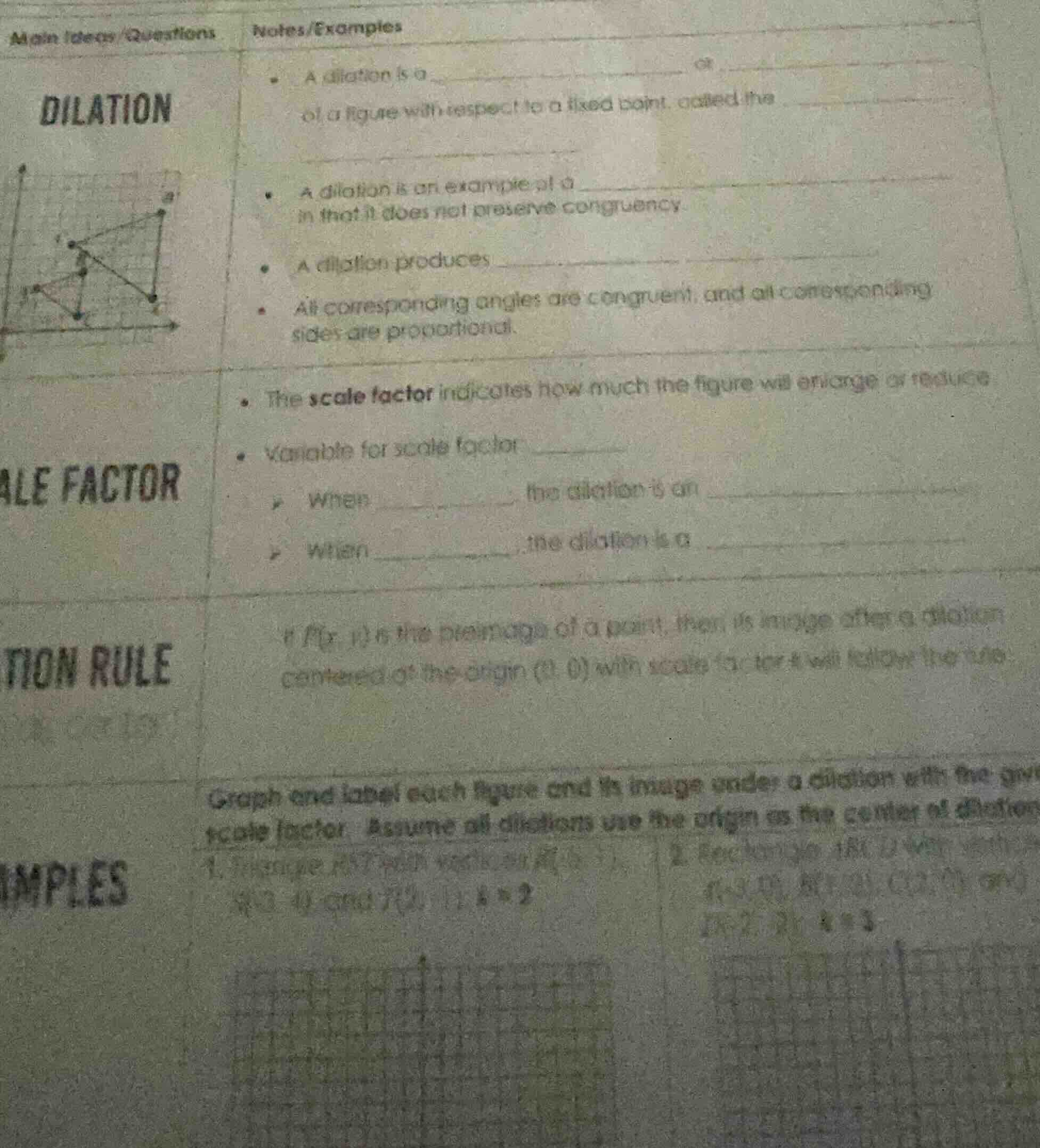
Define dilation and its properties
A dilation is a transformation that changes the size of a figure but not its shape. It is an enlargement or reduction of a figure with respect to a fixed point, called the center of dilation. Because it changes the size, a dilation is an example of a non-rigid transformation (or similarity transformation) in that it does not preserve congruency. Instead, a dilation produces similar figures, where all corresponding angles are congruent and all corresponding sides are proportional.
Define scale factor and its conditions
The scale factor indicates how much the figure will enlarge or reduce. The variable commonly used for the scale factor is \(k\).
- When \(k > 1\), the dilation is an enlargement.
- When \(0 < k < 1\), the dilation is a reduction.
State the coordinate rule for dilation
If \(P(x, y)\) is the preimage of a point, then its image after a dilation centered at the origin \((0, 0)\) with scale factor \(k\) will follow the rule:
Solve Example 1
The problem asks to graph and label the figure and its image under a dilation with the origin as the center.
- Preimage: Triangle \(RST\) with vertices \(R(-5, 1)\), \(S(-3, 4)\), and \(T(2, -1)\).
- Scale factor: \(k = 2\).
Applying the rule \((x, y)
ightarrow (2x, 2y)\):
- \(R' = (2 \cdot (-5), 2 \cdot 1) = (-10, 2)\)
- \(S' = (2 \cdot (-3), 2 \cdot 4) = (-6, 8)\)
- \(T' = (2 \cdot 2, 2 \cdot (-1)) = (4, -2)\)
Solve Example 2
- Preimage: Rectangle \(ABCD\) with vertices \(A(-3, 0)\), \(B(1, 2)\), \(C(2, 0)\), and \(D(-2, -2)\).
- Scale factor: \(k = 3\).
Applying the rule \((x, y)
ightarrow (3x, 3y)\):
- \(A' = (3 \cdot (-3), 3 \cdot 0) = (-9, 0)\)
- \(B' = (3 \cdot 1, 3 \cdot 2) = (3, 6)\)
- \(C' = (3 \cdot 2, 3 \cdot 0) = (6, 0)\)
- \(D' = (3 \cdot (-2), 3 \cdot (-2)) = (-6, -6)\)

Snap & solve any problem in the app
Get step-by-step solutions on Sovi AI
Photo-based solutions with guided steps
Explore more problems and detailed explanations
Dilation Section
- A dilation is an enlargement or reduction of a figure with respect to a fixed point, called the center of dilation.
- A dilation is an example of a non-rigid transformation (or similarity transformation) in that it does not preserve congruency.
- A dilation produces similar figures.
Scale Factor Section
- Variable for scale factor: \(k\)
- When \(k > 1\), the dilation is an enlargement.
- When \(0 < k < 1\), the dilation is a reduction.
Dilation Rule Section
- Rule: \((x, y)
ightarrow\) \((kx, ky)\)
Examples Section
Question 1
- Preimage Vertices: \(R(-5, 1)\), \(S(-3, 4)\), \(T(2, -1)\)
- Dilation Rule (\(k = 2\)): \((x, y)
ightarrow (2x, 2y)\)
- Image Vertices:
- \(R'(-10, 2)\)
- \(S'(-6, 8)\)
- \(T'(4, -2)\)
Question 2
- Preimage Vertices: \(A(-3, 0)\), \(B(1, 2)\), \(C(2, 0)\), \(D(-2, -2)\)
- Dilation Rule (\(k = 3\)): \((x, y)
ightarrow (3x, 3y)\)
- Image Vertices:
- \(A'(-9, 0)\)
- \(B'(3, 6)\)
- \(C'(6, 0)\)
- \(D'(-6, -6)\)