QUESTION IMAGE
Question
Question was provided via image upload.
Real-world road geometry
Using the Map Scale Distance knowledge point:
Straight-line distance (as the crow flies) ignores geographic obstacles, terrain, and actual road layouts. Roads must curve around lakes, hills, and private properties, making actual travel distance longer than a straight line.
Map scale estimation
Using the Proportional Reasoning and Map Scale Distance knowledge points:
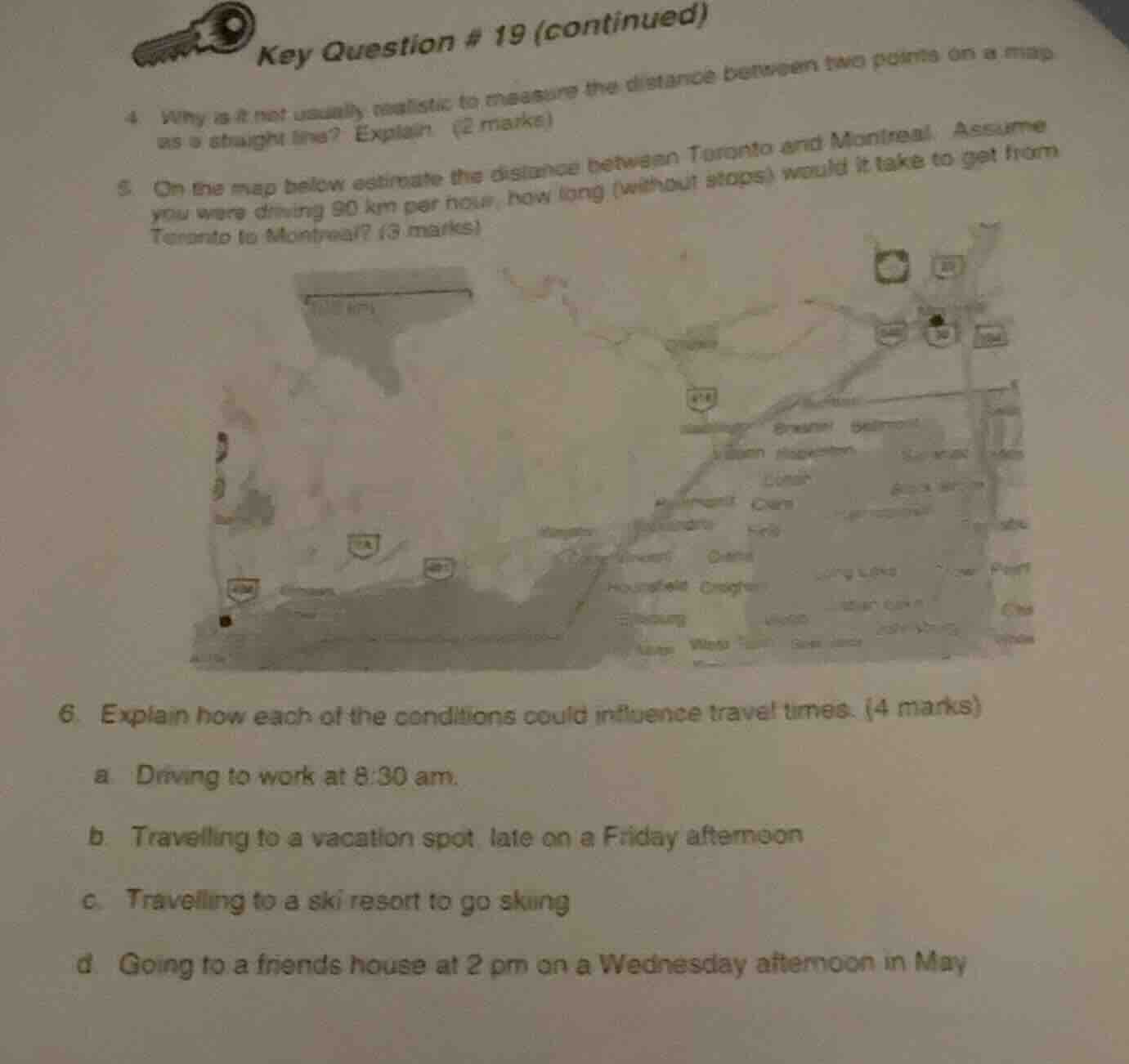
The map scale bar shows a length representing \(100\text{ km}\). Measuring the straight-line distance between Toronto and Montreal on this map, it is approximately 5 to 5.5 times the length of the \(100\text{ km}\) scale bar. This gives an estimated driving distance of about \(500\text{ km}\) to \(550\text{ km}\).
Travel time calculation
Using the Proportional Reasoning knowledge point:
Using the formula \(\text{Time} = \frac{\text{Distance}}{\text{Speed}}\) with an estimated distance of \(540\text{ km}\) and a speed of \(90\text{ km/h}\):
Traffic and peak hours
Commuting at 8:30 am coincides with morning rush hour, increasing travel times due to heavy traffic. Friday afternoon travel to vacation spots faces heavy weekend getaway traffic, causing significant delays.
Weather and off-peak travel
Traveling to a ski resort usually involves winter weather, where snow and ice reduce speeds and increase travel times. Traveling at 2 pm on a Wednesday in May avoids rush hours and poor weather, resulting in minimal delays and optimal travel times.

Snap & solve any problem in the app
Get step-by-step solutions on Sovi AI
Photo-based solutions with guided steps
Explore more problems and detailed explanations
Question 4
It is not realistic because roads are rarely perfectly straight. Roads must follow terrain, avoid obstacles like water bodies or mountains, and connect through established infrastructure, making the actual driving distance longer than a straight line.
Question 5
- Estimated Distance: Approximately \(540\text{ km}\) (based on the map scale).
- Estimated Travel Time:
It would take approximately \(6\text{ hours}\) (without stops).
Question 6
- a. Driving to work at 8:30 am: Increases travel time due to heavy morning rush-hour commuter traffic.
- b. Travelling to a vacation spot late on a Friday afternoon: Increases travel time significantly due to weekend getaway traffic leaving the city.
- c. Travelling to a ski resort to go skiing: Increases travel time because winter weather conditions (snow, ice) require slower, more cautious driving.
- d. Going to a friend's house at 2 pm on a Wednesday afternoon in May: Minimizes travel time because it is during off-peak hours with favorable spring weather and light traffic.