QUESTION IMAGE
Question
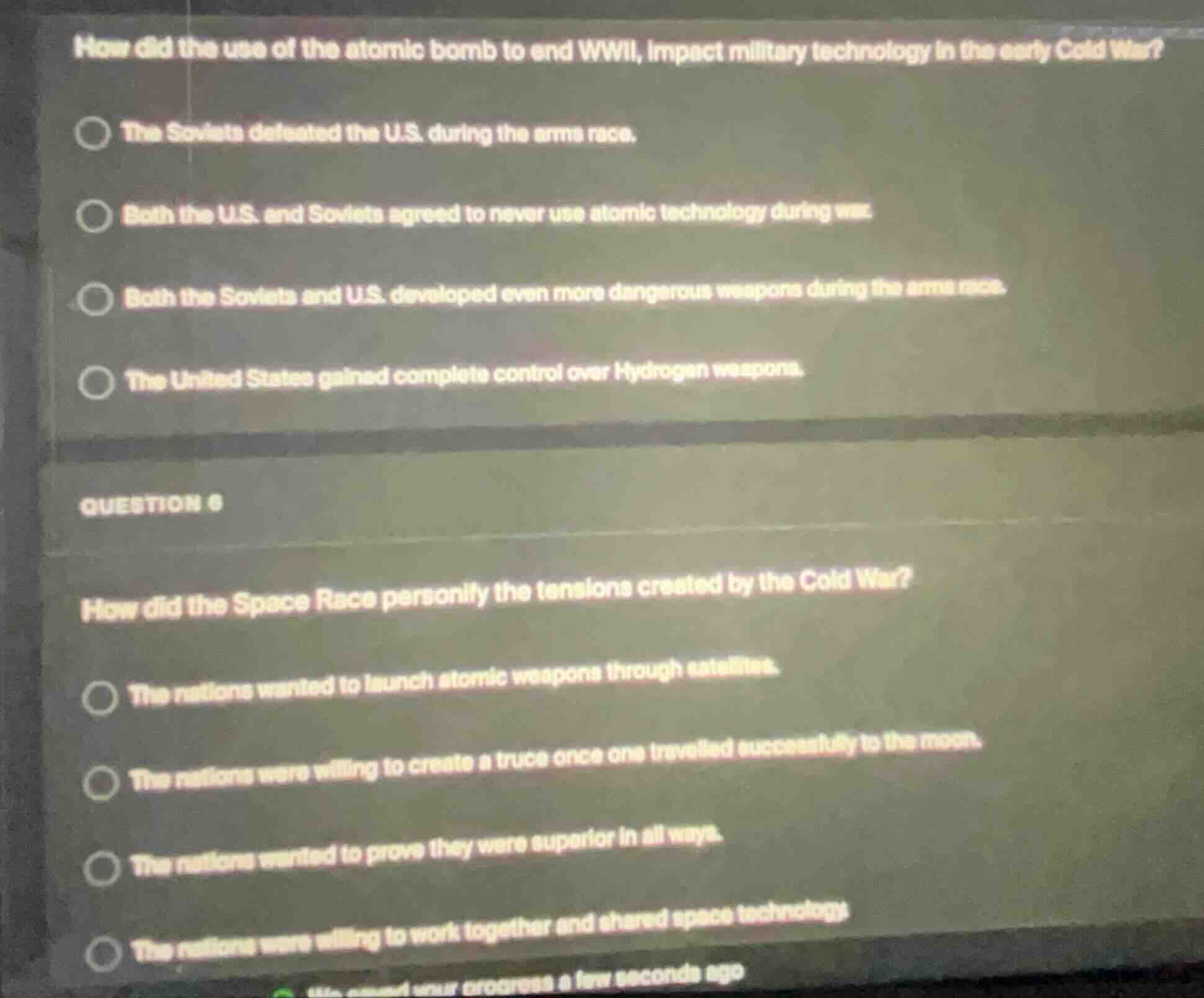
how did the use of the atomic bomb to end wwii, impact military technology in the early cold war?
the soviets defeated the u.s. during the arms race.
both the u.s. and soviets agreed to never use atomic technology during war.
both the soviets and u.s. developed even more dangerous weapons during the arms race.
the united states gained complete control over hydrogen weapons.
question 6
how did the space race personify the tensions created by the cold war?
the nations wanted to launch atomic weapons through satellites.
the nations were willing to create a truce once one travelled successfully to the moon.
the nations wanted to prove they were superior in all ways.
the nations were willing to work together and shared space technology.
Analyze the impact of the atomic bomb on Cold War military technology
The introduction of atomic weapons at the end of World War II initiated a competitive nuclear arms race between the United States and the Soviet Union. Rather than agreeing to ban these weapons, both superpowers rapidly accelerated their research and development to build increasingly destructive arsenals, leading to the creation of thermonuclear (hydrogen) bombs and advanced delivery systems.
Evaluate the options for the first question
- Option 1: "The Soviets defeated the U.S. during the arms race." This is historically incorrect; the arms race ended with the collapse of the Soviet Union, not a Soviet victory.
- Option 2: "Both the U.S. and Soviets agreed to never use atomic technology during war." This is incorrect; no such absolute agreement was reached during the early Cold War, and both maintained doctrines of nuclear deterrence.
- Option 3: "Both the Soviets and U.S. developed even more dangerous weapons during the arms race." This is correct, as both nations developed hydrogen bombs and intercontinental ballistic missiles.
- Option 4: "The United States gained complete control over Hydrogen weapons." This is incorrect; the Soviet Union successfully tested its own thermonuclear devices shortly after the United States.
Analyze how the Space Race reflected Cold War tensions
The Space Race was a proxy arena for the ideological and geopolitical rivalry between the United States and the Soviet Union. Achieving milestones in space exploration was used by each superpower to demonstrate scientific, technological, and ideological superiority over the other without engaging in direct military conflict.
Evaluate the options for the second question (Question 6)
- Option 1: "The nations wanted to launch atomic weapons through satellites." While military applications were considered, this does not capture the primary symbolic and ideological nature of the Space Race.
- Option 2: "The nations were willing to create a truce once one travelled successfully to the moon." This is incorrect; the competition continued in various forms after the 1969 Moon landing.
- Option 3: "The nations wanted to prove they were superior in all ways." This is correct, as the Space Race was primarily a battle for global prestige and ideological dominance.
- Option 4: "The nations were willing to work together and shared space technology." This is incorrect; the era was characterized by intense secrecy and competition rather than cooperation.

Snap & solve any problem in the app
Get step-by-step solutions on Sovi AI
Photo-based solutions with guided steps
Explore more problems and detailed explanations
Question 1
- (A) The Soviets defeated the U.S. during the arms race.
- (B) Both the U.S. and Soviets agreed to never use atomic technology during war.
- (C) Both the Soviets and U.S. developed even more dangerous weapons during the arms race. (Correct answer)
- (D) The United States gained complete control over Hydrogen weapons.
Question 2
- (A) The nations wanted to launch atomic weapons through satellites.
- (B) The nations were willing to create a truce once one travelled successfully to the moon.
- (C) The nations wanted to prove they were superior in all ways. (Correct answer)
- (D) The nations were willing to work together and shared space technology.