QUESTION IMAGE
Question
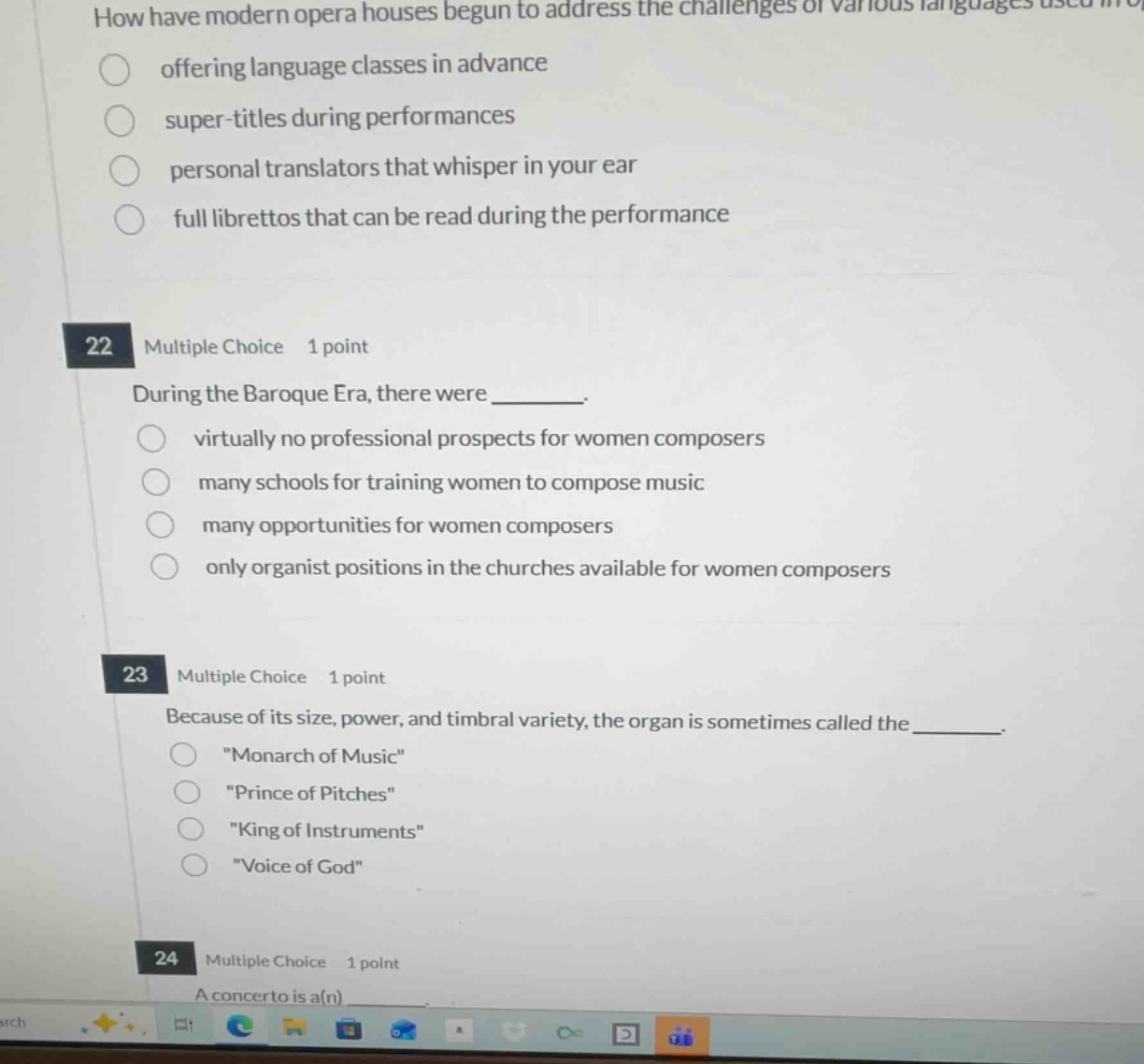
how have modern opera houses begun to address the challenges of various languages used in opera?
offering language classes in advance
super-titles during performances
personal translators that whisper in your ear
full librettos that can be read during the performance
22 multiple choice 1 point
during the baroque era, there were ______.
virtually no professional prospects for women composers
many schools for training women to compose music
many opportunities for women composers
only organist positions in the churches available for women composers
23 multiple choice 1 point
because of its size, power, and timbral variety, the organ is sometimes called the ______.
\monarch of music\
\prince of pitches\
\king of instruments\
\voice of god\
24 multiple choice 1 point
a concerto is a(n) ______.
Analyze the first question on opera translation
The first question asks how modern opera houses address the challenges of various languages used in opera. Modern opera houses commonly project translated or transcribed lyrics above the stage. This practice is known as using super-titles (or surtitles), allowing audiences to follow the plot in real-time.
Analyze Question 22 on Baroque women composers
This question addresses the professional landscape for female composers during the Baroque Era. Applying our understanding of Baroque Women Composers, we know that women faced severe societal restrictions. There were virtually no formal professional prospects, public posts, or training academies for women composers, with very few exceptions who often published under restricted circumstances or within convents.
Analyze Question 23 on the organ
This question asks for the common historical moniker given to the organ due to its size, power, and timbral variety. Drawing from Organ History, the organ has traditionally been referred to as the "King of Instruments" (a term famously attributed to Wolfgang Amadeus Mozart).
Analyze Question 24 on the concerto
The visible fragment of Question 24 asks: "A concerto is a(n) _________". A concerto is classically defined as an instrumental genre for a solo instrument (or group of soloists) accompanied by an orchestra, typically consisting of three movements.

Snap & solve any problem in the app
Get step-by-step solutions on Sovi AI
Photo-based solutions with guided steps
Explore more problems and detailed explanations
Question 1
- offering language classes in advance
- super-titles during performances (Correct answer)
- personal translators that whisper in your ear
- full librettos that can be read during the performance
Question 22
- virtually no professional prospects for women composers (Correct answer)
- many schools for training women to compose music
- many opportunities for women composers
- only organist positions in the churches available for women composers
Question 23
- "Monarch of Music"
- "Prince of Pitches"
- "King of Instruments" (Correct answer)
- "Voice of God"
Question 24
- instrumental work for a soloist (or group of soloists) and orchestra (Correct answer)