QUESTION IMAGE
Question
how does the last supper reflect renaissance interest in perspective and narrative clarity?
Analyze the use of linear perspective
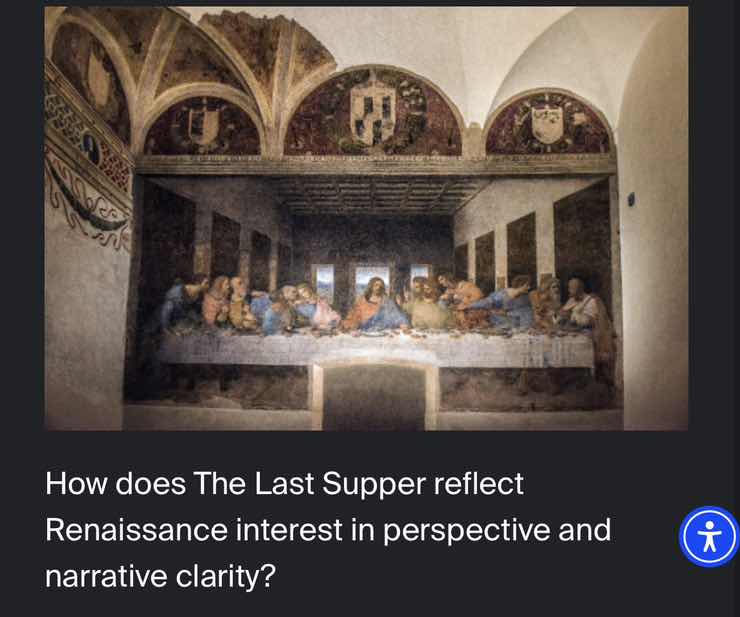
The painting utilizes one-point linear perspective where all the orthogonal lines of the ceiling tapestries and side walls converge at a single vanishing point located directly behind the head of Jesus Christ, establishing him as the absolute focal point of the composition.
Analyze narrative clarity and composition
Leonardo organizes the twelve apostles into four distinct groups of three, creating a balanced, symmetrical arrangement that frames Jesus. This grouping allows for clear visual storytelling, capturing the individual psychological reactions of each apostle immediately after Jesus announces that one of them will betray him.
Synthesize perspective and narrative focus
The integration of mathematical perspective with emotional grouping ensures that the viewer's eye is naturally drawn to Jesus's calm, central figure, contrasting his serenity with the dynamic gestures of the disciples to maximize the dramatic and narrative clarity of the scene.

Snap & solve any problem in the app
Get step-by-step solutions on Sovi AI
Photo-based solutions with guided steps
Explore more problems and detailed explanations
Leonardo da Vinci's The Last Supper reflects Renaissance interests through:
- Linear Perspective: The orthogonal lines of the ceiling coffering and side walls converge at a single vanishing point directly behind the head of Jesus, making him the mathematical and visual center of the work.
- Narrative Clarity: The twelve apostles are organized into four distinct, symmetrical groups of three. This structured arrangement captures their varied, highly expressive psychological reactions to Jesus's announcement of betrayal, creating a clear and dramatic visual narrative.