QUESTION IMAGE
Question
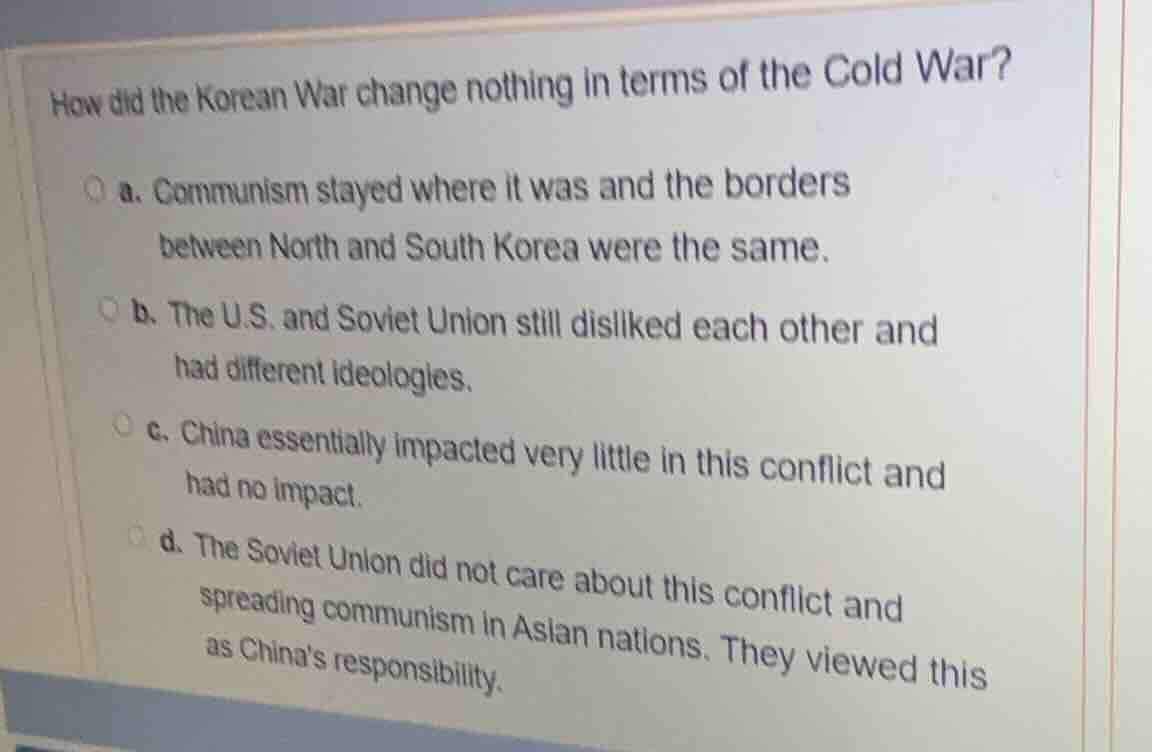
how did the korean war change nothing in terms of the cold war?
a. communism stayed where it was and the borders between north and south korea were the same.
b. the u.s. and soviet union still disliked each other and had different ideologies.
c. china essentially impacted very little in this conflict and had no impact.
d. the soviet union did not care about this conflict and spreading communism in asian nations. they viewed this as chinas responsibility.
Analyze the question
The question asks how the Korean War "change[d] nothing" in terms of the Cold War. This refers to the geopolitical outcome of the conflict, specifically regarding territorial boundaries and the containment of communism.
Evaluate the options
- Option a: "Communism stayed where it was and the borders between North and South Korea were the same."
- Before the war, Korea was divided along the 38th parallel, with a communist regime in the north and a capitalist/democratic-aligned regime in the south.
- After three years of fighting, the armistice signed in 1953 established the Korean Demilitarized Zone (DMZ) very close to the original 38th parallel.
- This outcome aligned with the U.S. Containment Policy, as communist expansion was stopped, but rollback was not achieved. Thus, in terms of territorial control and the spread of communism on the peninsula, nothing fundamentally changed. This is historically accurate.
- Option b: "The U.S. and Soviet Union still disliked each other and had different ideologies."
- While true, this describes a continuation of the overall Cold War dynamic rather than explaining how the specific conflict of the Korean War itself resulted in no territorial or political change on the peninsula.
- Option c: "China essentially impacted very little in this conflict and had no impact."
- This is historically incorrect. China intervened heavily in late 1950, pushing UN forces back down the peninsula and drastically altering the course of the war.
- Option d: "The Soviet Union did not care about this conflict and spreading communism in Asian nations..."
- This is historically incorrect. The Soviet Union supported North Korea with military equipment, planning, and pilots.
Formulate the explanation
Using our understanding of the Korean War and the Containment Policy, we can explain that the war ended in a stalemate near the original 38th parallel. This meant that the geopolitical status quo was maintained, making option (a) the correct choice.

Snap & solve any problem in the app
Get step-by-step solutions on Sovi AI
Photo-based solutions with guided steps
Explore more problems and detailed explanations
- (a) Communism stayed where it was and the borders between North and South Korea were the same. (Correct answer)
- (b) The U.S. and Soviet Union still disliked each other and had different ideologies.
- (c) China essentially impacted very little in this conflict and had no impact.
- (d) The Soviet Union did not care about this conflict and spreading communism in Asian nations. They viewed this as China's responsibility.