QUESTION IMAGE
Question
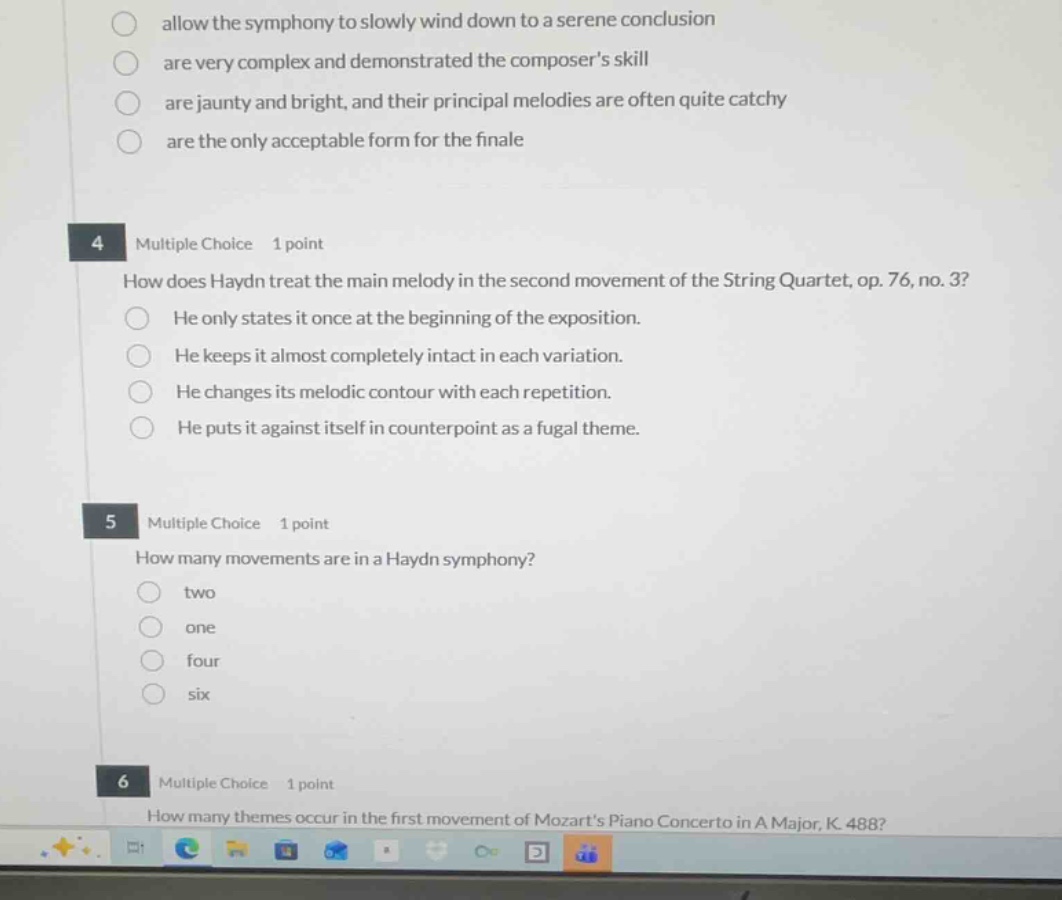
how does haydn treat the main melody in the second movement of the string quartet, op. 76, no. 3?
he only states it once at the beginning of the exposition.
he keeps it almost completely intact in each variation.
he changes its melodic contour with each repetition.
he puts it against itself in counterpoint as a fugal theme.
how many movements are in a haydn symphony?
two
one
four
six
how many themes occur in the first movement of mozarts piano concerto in a major, k. 488?
Analyze Haydn's String Quartet Op. 76, No. 3
The second movement of Joseph Haydn's String Quartet in C major, Op. 76, No. 3 ("Emperor"), is a set of theme and variations based on the "Emperor's Hymn" (Gott erhalte Franz den Kaiser). In this specific movement, Haydn treats the main melody in an unusual way for a theme and variations: instead of ornamenting or altering the melody itself, he keeps the cantus firmus-like melody almost completely intact and unchanged in each variation. The variation and interest come from changing the accompaniment, the instrumentation, and the counter-melodies surrounding the main theme as it passes from instrument to instrument.
Determine movements in a Haydn symphony
During the Classical period, Joseph Haydn played a crucial role in establishing the standard structure of the classical symphony. The standard format that Haydn settled on and popularized consists of four movements:
- A fast movement (often in sonata-allegro form, sometimes with a slow introduction).
- A slow movement (often in theme and variations, ABA, or sonata form).
- A minuet and trio (a dance-like movement in triple meter).
- A fast finale (often in rondo or sonata-rondo form).
Analyze Mozart's Piano Concerto No. 23, K. 488
In the first movement (Allegro) of Wolfgang Amadeus Mozart's Piano Concerto No. 23 in A major, K. 488, Mozart utilizes a modified sonata form (often called double exposition form). This movement is exceptionally rich in thematic material. Instead of the standard two contrasting themes, Mozart introduces several distinct melodic ideas. Specifically, there are three main thematic groups or themes that occur in the orchestral exposition, and additional thematic material is introduced during the solo exposition, leading to a total of several distinct themes (often analyzed as containing multiple principal themes, typically summarized as three main thematic ideas in the primary exposition). Let's look at the standard textbook options for this specific curriculum question: it typically identifies three main themes occurring in the first movement.

Snap & solve any problem in the app
Get step-by-step solutions on Sovi AI
Photo-based solutions with guided steps
Explore more problems and detailed explanations
Question 4
- He only states it once at the beginning of the exposition.
- He keeps it almost completely intact in each variation. (Correct answer)
- He changes its melodic contour with each repetition.
- He puts it against itself in counterpoint as a fugal theme.
Question 5
- two
- one
- four (Correct answer)
- six
Question 6
- two
- three (Correct answer)
- four
- five