QUESTION IMAGE
Question
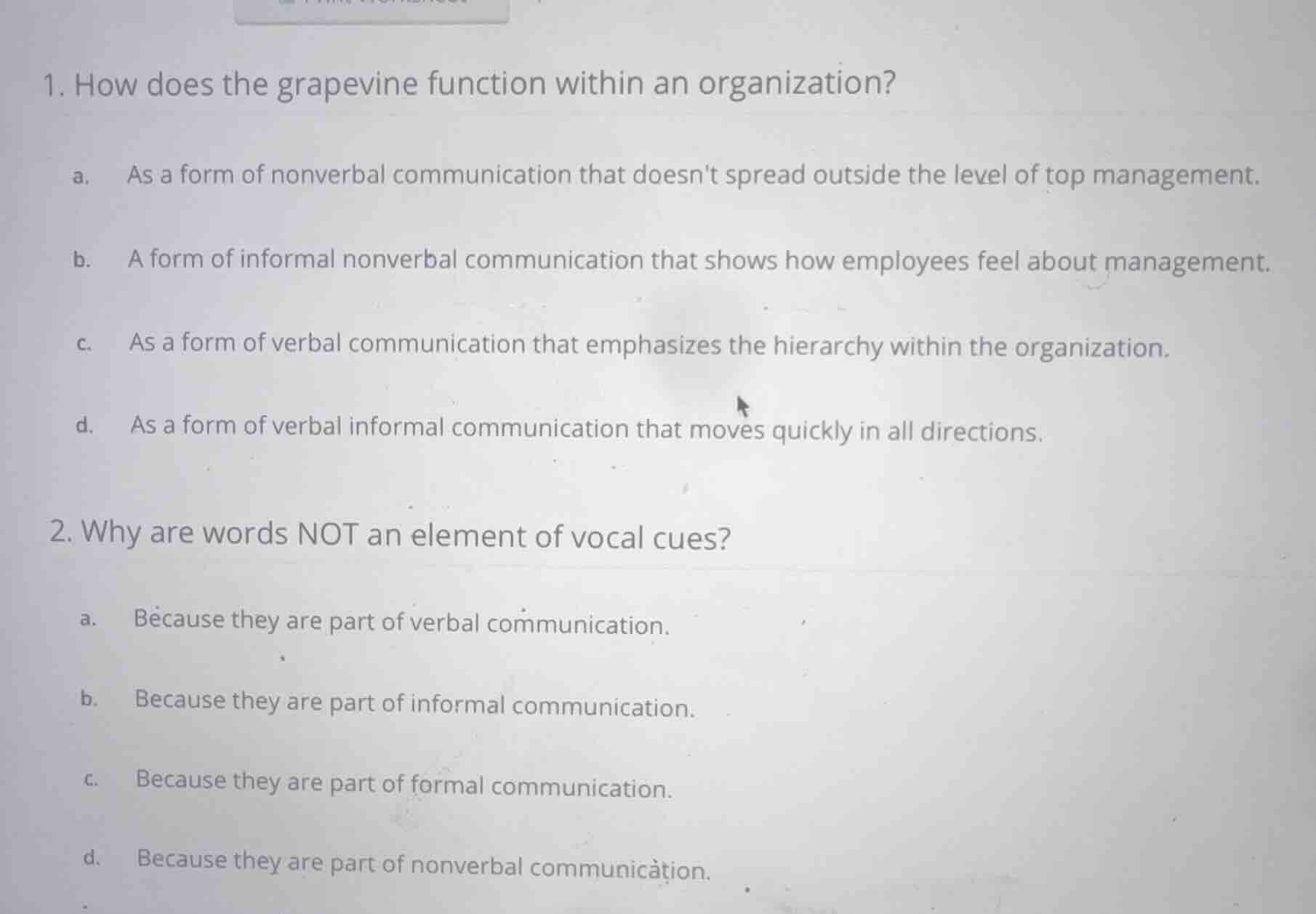
- how does the grapevine function within an organization?
a. as a form of nonverbal communication that doesnt spread outside the level of top management.
b. a form of informal nonverbal communication that shows how employees feel about management.
c. as a form of verbal communication that emphasizes the hierarchy within the organization.
d. as a form of verbal informal communication that moves quickly in all directions.
- why are words not an element of vocal cues?
a. because they are part of verbal communication.
b. because they are part of informal communication.
c. because they are part of formal communication.
d. because they are part of nonverbal communication.
Analyze grapevine communication
The "grapevine" is an informal communication network within an organization. It is verbal (spoken or written words) rather than nonverbal, and it bypasses formal hierarchical channels, allowing information to travel rapidly in all directions (upward, downward, and horizontally) among employees. Therefore, option (d) is the correct description.
Analyze vocal cues
Vocal cues (paralanguage) refer to how something is said (pitch, tone, volume, rate) rather than the actual words spoken. Words themselves constitute verbal communication, which is why they are not considered vocal cues. Therefore, option (a) is the correct explanation.

Snap & solve any problem in the app
Get step-by-step solutions on Sovi AI
Photo-based solutions with guided steps
Explore more problems and detailed explanations
Question 1
- a. As a form of nonverbal communication that doesn't spread outside the level of top management.
- b. A form of informal nonverbal communication that shows how employees feel about management.
- c. As a form of verbal communication that emphasizes the hierarchy within the organization.
- d. As a form of verbal informal communication that moves quickly in all directions. (Correct answer)
Question 2
- a. Because they are part of verbal communication. (Correct answer)
- b. Because they are part of informal communication.
- c. Because they are part of formal communication.
- d. Because they are part of nonverbal communication.