QUESTION IMAGE
Question
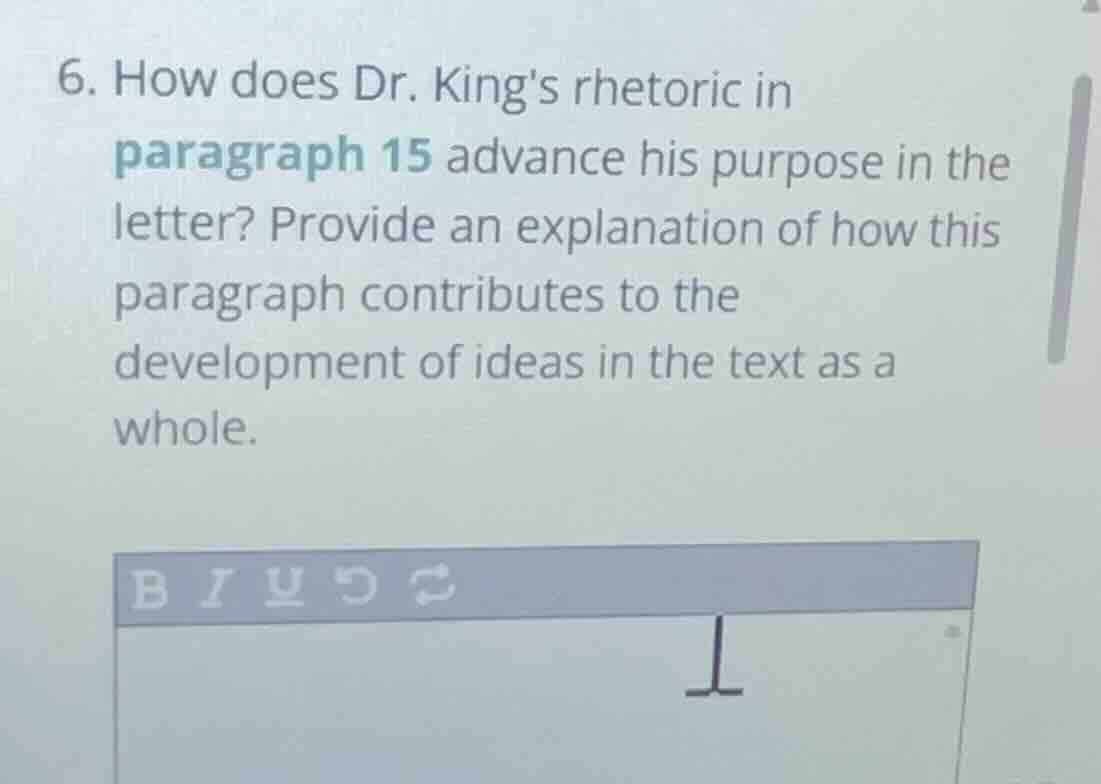
- how does dr. kings rhetoric in paragraph 15 advance his purpose in the letter? provide an explanation of how this paragraph contributes to the development of ideas in the text as a whole.
To answer this, we analyze Dr. King's rhetoric in the relevant paragraph (likely from "Letter from Birmingham Jail"):
- Identify Rhetorical Tools: In paragraph 15, Dr. King likely uses devices like allusions (e.g., to biblical figures, historical justice movements), parallelism (repeating structures for emphasis), or appeals to ethics/reason (ethos, logos) to argue for nonviolent resistance and civil rights.
- Connect to Purpose: His purpose is to defend nonviolent protest and critique unjust laws. The rhetoric reinforces the idea that civil disobedience is moral when laws are unjust, uniting religious/ethical reasoning with social justice.
- Contribution to Ideas: The paragraph deepens the text’s argument by framing the civil rights struggle as a moral/religious duty (aligning with his audience of clergy), while logically dismantling arguments against protest. It bridges personal faith with collective action, advancing the text’s call for justice.

Snap & solve any problem in the app
Get step-by-step solutions on Sovi AI
Photo-based solutions with guided steps
Explore more problems and detailed explanations
In paragraph 15 of “Letter from Birmingham Jail,” Dr. King’s rhetoric (e.g., allusions to biblical figures, parallelism, ethical appeals) advances his purpose of justifying nonviolent civil disobedience. By framing the civil rights struggle as a moral/religious duty (aligning with his clergy audience) and logically critiquing unjust laws, the paragraph deepens the text’s argument: it bridges personal faith with collective action, reinforcing that civil disobedience is ethical when laws oppress. This unifies the text’s themes of justice, morality, and resistance, persuading readers that the fight for civil rights is a sacred, necessary endeavor.