QUESTION IMAGE
Question
hi everyone and welcome to week 3 of math 102!
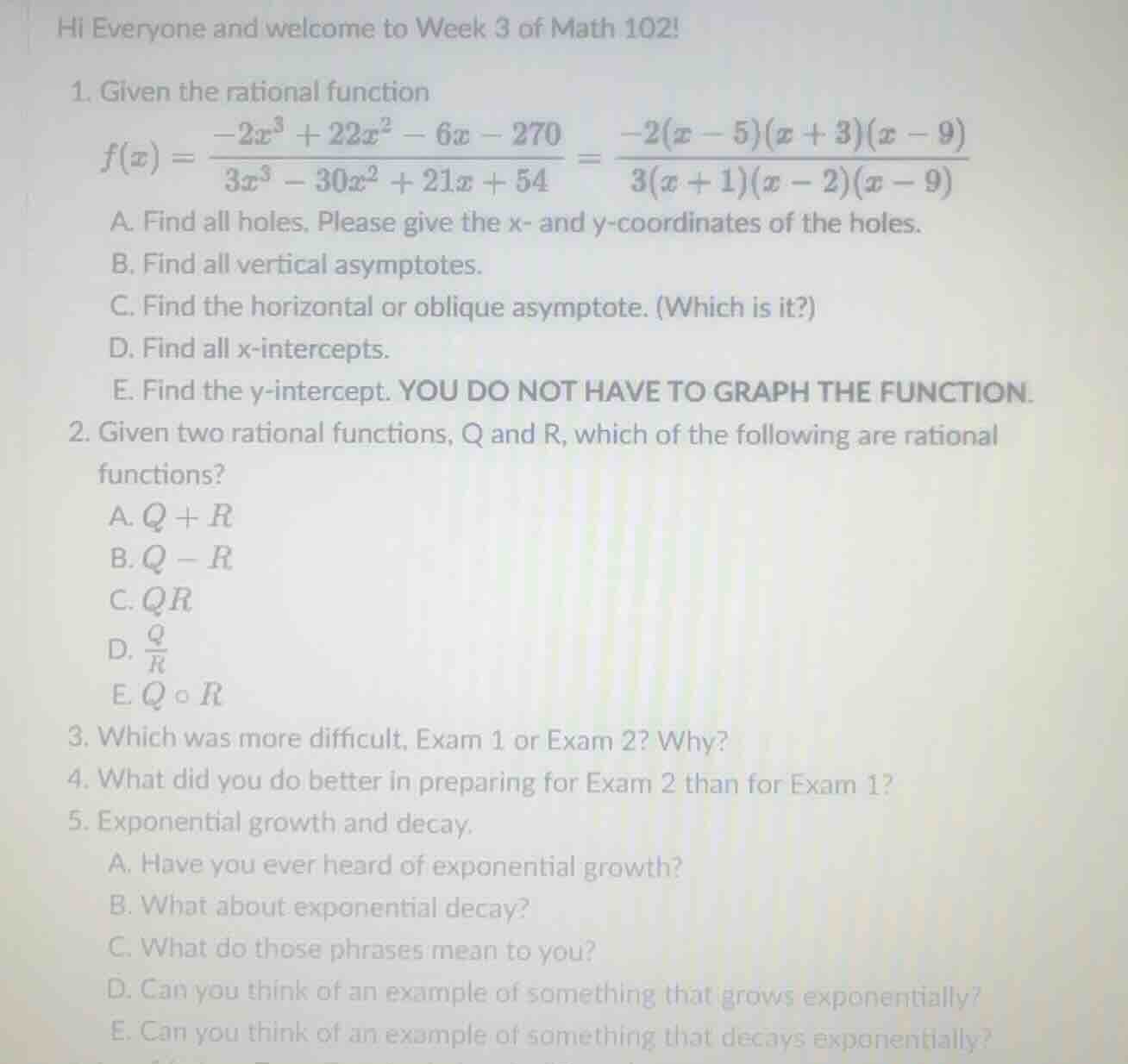
- given the rational function
\\ f(x) = \frac{-2x^3 + 22x^2 - 6x - 270}{3x^3 - 30x^2 + 21x + 54} = \frac{-2(x - 5)(x + 3)(x - 9)}{3(x + 1)(x - 2)(x - 9)} \\
a. find all holes. please give the x- and y-coordinates of the holes.
b. find all vertical asymptotes.
c. find the horizontal or oblique asymptote. (which is it?)
d. find all x-intercepts.
e. find the y-intercept. you do not have to graph the function.
- given two rational functions, q and r, which of the following are rational functions?
a. \\( q + r \\)
b. \\( q - r \\)
c. \\( qr \\)
d. \\( \frac{q}{r} \\)
e. \\( q \circ r \\)
- which was more difficult, exam 1 or exam 2? why?
- what did you do better in preparing for exam 2 than for exam 1?
- exponential growth and decay.
a. have you ever heard of exponential growth?
b. what about exponential decay?
c. what do those phrases mean to you?
d. can you think of an example of something that grows exponentially?
e. can you think of an example of something that decays exponentially?
Step1: Identify common factors for holes
Step2: Calculate y-coordinate of the hole
Step3: Find vertical asymptotes from remaining denominator
Step4: Determine horizontal asymptote using leading coefficients
Step5: Find x-intercepts from remaining numerator
Step6: Calculate y-intercept by setting x to 0
Step7: Determine closure properties of rational functions
All operations A, B, C, D, and E yield rational functions.

Snap & solve any problem in the app
Get step-by-step solutions on Sovi AI
Photo-based solutions with guided steps
Explore more problems and detailed explanations
1.
A. Hole at \((9, -\frac{16}{15})\)
B. Vertical asymptotes at \(x = -1\) and \(x = 2\)
C. Horizontal asymptote at \(y = -\frac{2}{3}\)
D. x-intercepts at \((5, 0)\) and \((-3, 0)\)
E. y-intercept at \((0, -5)\)
- A. \(Q + R\), B. \(Q - R\), C. \(QR\), D. \(\frac{Q}{R}\), E. \(Q \circ R\)