QUESTION IMAGE
Question
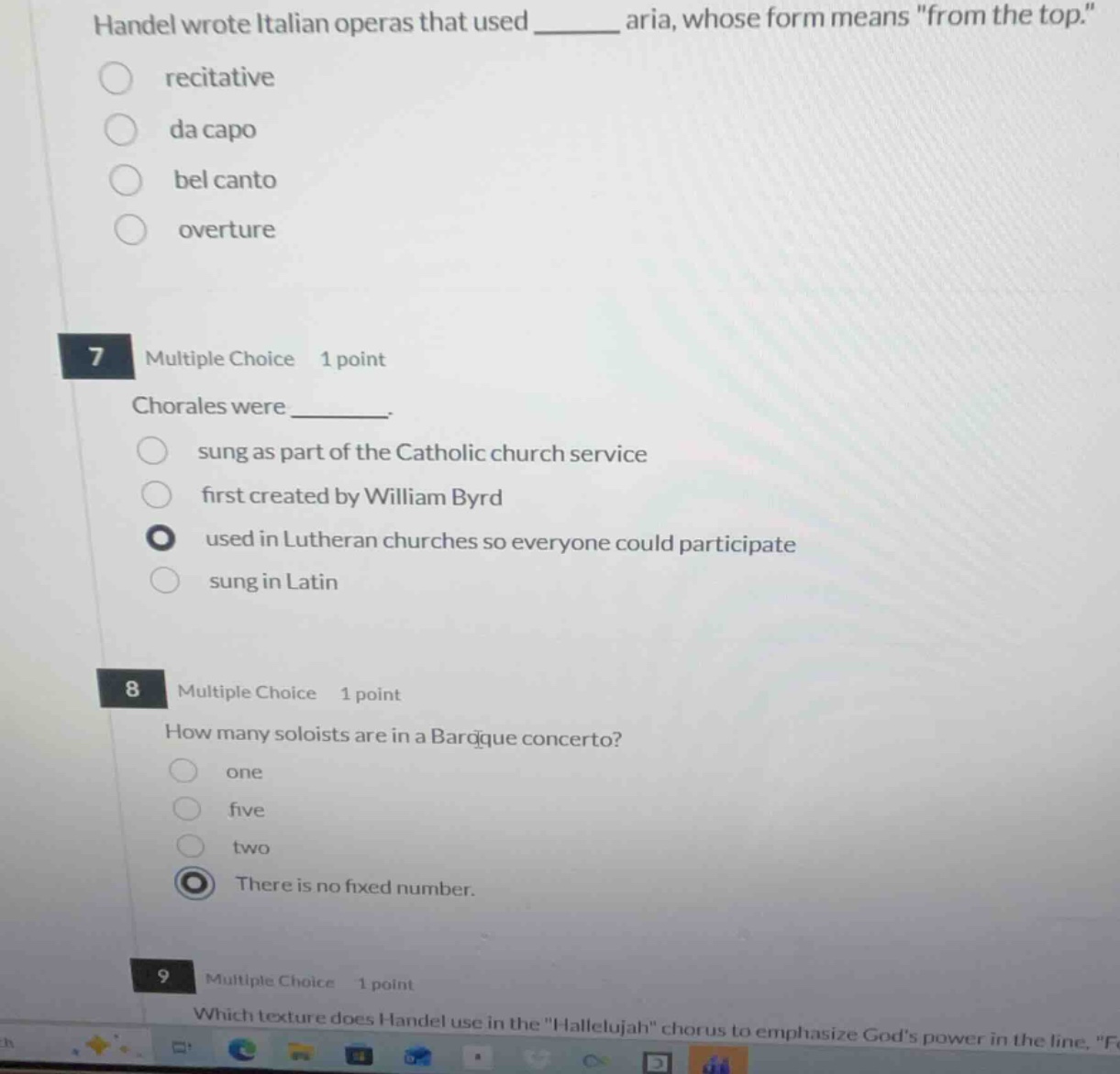
handel wrote italian operas that used ______ aria, whose form means \from the top.\
recitative
da capo
bel canto
overture
7 multiple choice 1 point
chorales were ______.
sung as part of the catholic church service
first created by william byrd
used in lutheran churches so everyone could participate
sung in latin
8 multiple choice 1 point
how many soloists are in a baroque concerto?
one
five
two
there is no fixed number.
9 multiple choice 1 point
which texture does handel use in the \hallelujah\ chorus to emphasize gods power in the line, \for the lord god omnipotent reigneth\?
Analyze the first question on Italian opera
The first question asks about a type of aria used by Handel in his Italian operas, whose name literally translates to "from the top."
- The term "da capo" in Italian literally means "from the head" or "from the top," directing the performer to repeat the first section of the piece.
- Therefore, the correct option is da capo.
- This applies the Da Capo Aria concept.
Analyze Question 7 on Chorales
Question 7 asks about the nature of chorales.
- Chorales were congregational hymns developed during the Protestant Reformation.
- Martin Luther introduced them in German (rather than Latin) so that the entire congregation could actively participate in worship, rather than just the choir or clergy.
- Therefore, the correct option is used in Lutheran churches so everyone could participate.
- This applies the Protestant Chorale concept.
Analyze Question 8 on Baroque concertos
Question 8 asks about the number of soloists in a Baroque concerto.
- A Baroque concerto can be a solo concerto (featuring one soloist) or a concerto grosso (featuring a small group of soloists, known as the concertino, which typically has two, three, or four soloists).
- Because the genre encompasses both solo concertos and concerti grossi with varying group sizes, there is no single set number of soloists.
- Therefore, the correct option is There is no fixed number.
- This applies the Baroque Concerto concept.
Analyze Question 9 on Handel's "Hallelujah" chorus
Question 9 is partially cut off at the bottom, but the visible text asks: "Which texture does Handel use in the 'Hallelujah' chorus to emphasize God's power in the line..."
- In Handel's "Hallelujah" chorus from Messiah, Handel famously uses a block-like, homophonic texture (where all voices sing the same syllables at the same time) to create a powerful, unified declaration of God's power (such as on the words "For the Lord God Omnipotent reigneth").
- This applies the Handel Messiah Textures concept.
- Since the options for Question 9 are completely cut off and not visible in the image, we will provide the answers for the first three fully visible questions.

Snap & solve any problem in the app
Get step-by-step solutions on Sovi AI
Photo-based solutions with guided steps
Explore more problems and detailed explanations
Question 1
- (A) recitative
- (B) da capo (Correct answer)
- (C) bel canto
- (D) overture
Question 7
- (A) sung as part of the Catholic church service
- (B) first created by William Byrd
- (C) used in Lutheran churches so everyone could participate (Correct answer)
- (D) sung in Latin
Question 8
- (A) one
- (B) five
- (C) two
- (D) There is no fixed number. (Correct answer)