QUESTION IMAGE
Question
guided example 3
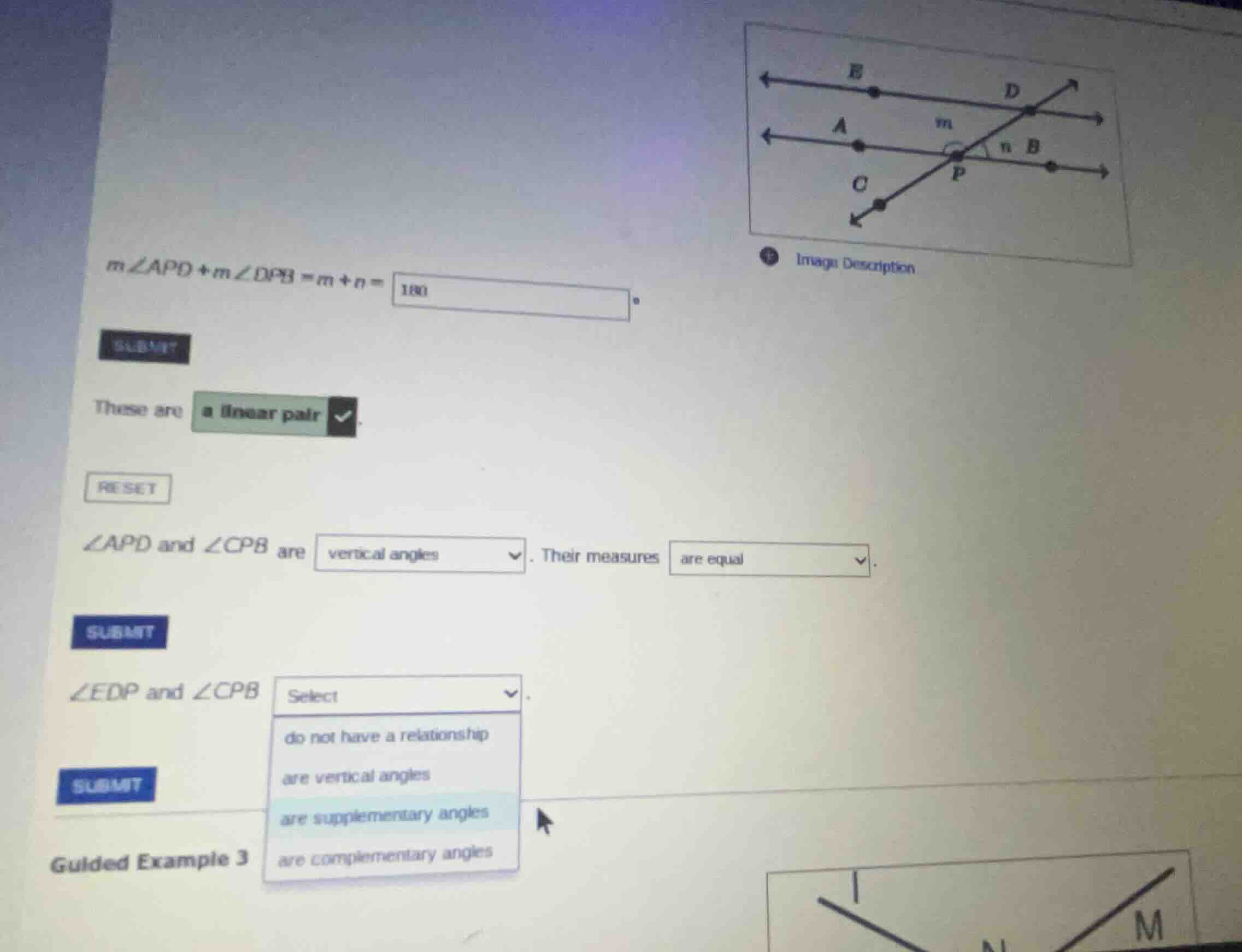
\\(m\angle apd + m\angle dpb = m + n = \\) 180
these are a linear pair
\\(\angle apd\\) and \\(\angle cpb\\) are vertical angles. their measures are equal.
\\(\angle edp\\) and \\(\angle cpb\\) select
options:
- do not have a relationship
- are vertical angles
- are supplementary angles
- are complementary angles
<pre_analysis>
{
"quality": "clear",
"question_count": 1,
"skills_matched": [
"direct_cot",
"blank_filling_formatter",
"explain_then_answer",
"tutor"
],
"needs_drawing": false,
"concepts_used": [
"Vertical Angles"
],
"new_concepts": [
"Transversal Angle Relationships"
],
"current_concepts": [
"Vertical Angles",
"Linear Pair",
"Transversal Angle Relationships"
]
}
</pre_analysis>
<reasoning>
Identify the angles
We need to find the relationship between \(\angle EDP\) and \(\angle CPB\).
Analyze the geometric figure
Using the Vertical Angles concept, let's locate the vertices and lines:
- Line \(AB\) and line \(CD\) intersect at point \(P\).
- Point \(E\) lies on a parallel line above line \(AB\), intersecting the transversal line \(CD\) at point \(D\).
- \(\angle EDP\) is located at vertex \(D\).
- \(\angle CPB\) is located at vertex \(P\).
Determine the relationship
Since vertex \(D\) and vertex \(P\) are distinct intersection points on the transversal line, angles at these different vertices do not share a simple vertical or linear pair relationship.
- \(\angle EDP\) and \(\angle CPB\) are not vertical angles (they have different vertices).
- They are not supplementary or complementary angles based on any standard parallel line theorems here (one is an exterior angle at \(D\), the other is an interior/opposite angle at \(P\)).
- Therefore, they do not have a standard geometric relationship.
</reasoning>
<answer>
\(\angle EDP\) and \(\angle CPB\) <blank>do not have a relationship</blank>.
</answer>
<post_analysis>
{
"subject": "Mathematics",
"question_type": "Fill-in-the-blank",
"knowledge_point": [
"Mathematics",
"Geometry",
"Vertical Angles"
]
}
</post_analysis>
Snap & solve any problem in the app
Get step-by-step solutions on Sovi AI
Photo-based solutions with guided steps
Explore more problems and detailed explanations
<pre_analysis>
{
"quality": "clear",
"question_count": 1,
"skills_matched": [
"direct_cot",
"blank_filling_formatter",
"explain_then_answer",
"tutor"
],
"needs_drawing": false,
"concepts_used": [
"Vertical Angles"
],
"new_concepts": [
"Transversal Angle Relationships"
],
"current_concepts": [
"Vertical Angles",
"Linear Pair",
"Transversal Angle Relationships"
]
}
</pre_analysis>
<reasoning>
Identify the angles
We need to find the relationship between \(\angle EDP\) and \(\angle CPB\).
Analyze the geometric figure
Using the Vertical Angles concept, let's locate the vertices and lines:
- Line \(AB\) and line \(CD\) intersect at point \(P\).
- Point \(E\) lies on a parallel line above line \(AB\), intersecting the transversal line \(CD\) at point \(D\).
- \(\angle EDP\) is located at vertex \(D\).
- \(\angle CPB\) is located at vertex \(P\).
Determine the relationship
Since vertex \(D\) and vertex \(P\) are distinct intersection points on the transversal line, angles at these different vertices do not share a simple vertical or linear pair relationship.
- \(\angle EDP\) and \(\angle CPB\) are not vertical angles (they have different vertices).
- They are not supplementary or complementary angles based on any standard parallel line theorems here (one is an exterior angle at \(D\), the other is an interior/opposite angle at \(P\)).
- Therefore, they do not have a standard geometric relationship.
</reasoning>
<answer>
\(\angle EDP\) and \(\angle CPB\) <blank>do not have a relationship</blank>.
</answer>
<post_analysis>
{
"subject": "Mathematics",
"question_type": "Fill-in-the-blank",
"knowledge_point": [
"Mathematics",
"Geometry",
"Vertical Angles"
]
}
</post_analysis>