QUESTION IMAGE
Question
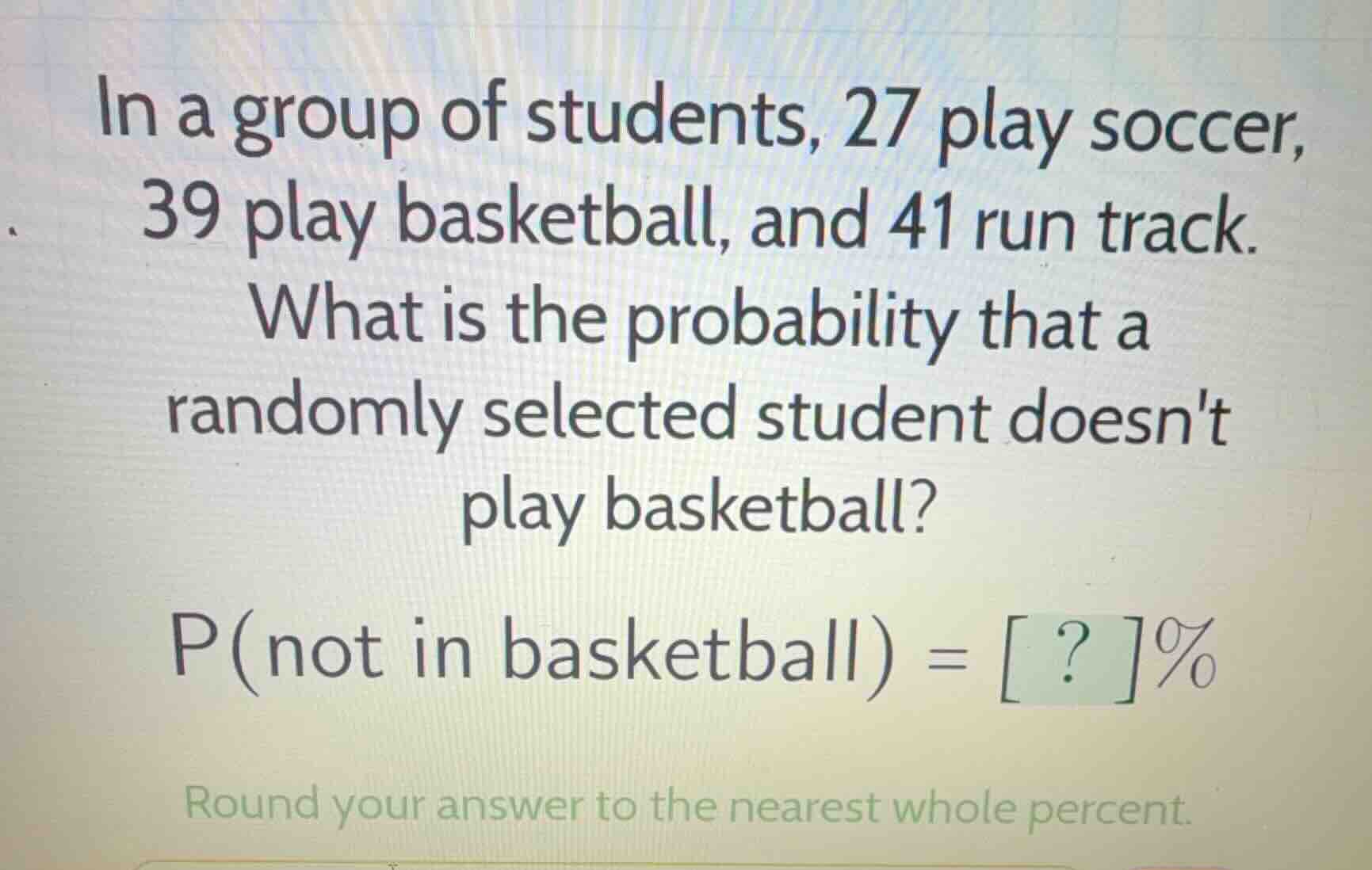
in a group of students, 27 play soccer, 39 play basketball, and 41 run track. what is the probability that a randomly selected student doesnt play basketball?
\\(p(\text{not in basketball}) = \quad\\%\\)
round your answer to the nearest whole percent.
<pre_analysis>
{
"quality": "clear",
"question_count": 1,
"skills_matched": [
"step_cot",
"blank_filling_formatter",
"explain_then_answer",
"tutor"
],
"needs_drawing": false,
"concepts_used": [
"Theoretical Probability",
"Sample Space",
"Complementary Probability"
],
"new_concepts": [],
"current_concepts": [
"Theoretical Probability",
"Sample Space",
"Complementary Probability"
]
}
</pre_analysis>
<reasoning>
Determine the sample space size
We find the total number of students in the group.
Using the Sample Space knowledge point:
\[
\text{Total} = 27 + 39 + 41 = 107
\]
Find the number of students not playing basketball
We calculate how many students do not play basketball.
Using the Complementary Probability knowledge point:
\[
\text{Not Basketball} = 107 - 39 = 68
\]
Calculate the probability
We find the probability as a fraction.
Using the Theoretical Probability knowledge point:
\[
P(\text{not in basketball}) = \frac{68}{107}
\]
Convert to a percentage
We convert the fraction to a percentage and round to the nearest whole percent.
\[
\frac{68}{107} \approx 0.6355
\]
\[
0.6355 \times 100\% \approx 64\%
\]
</reasoning>
<answer>
In a group of students, 27 play soccer, 39 play basketball, and 41 run track. What is the probability that a randomly selected student doesn't play basketball?
\(P(\text{not in basketball}) =\) <blank>64</blank>%
</answer>
<post_analysis>
{
"subject": "Mathematics",
"question_type": "Fill-in-the-blank",
"knowledge_point": [
"Mathematics",
"Statistics",
"Complementary Probability"
]
}
</post_analysis>
Snap & solve any problem in the app
Get step-by-step solutions on Sovi AI
Photo-based solutions with guided steps
Explore more problems and detailed explanations
<pre_analysis>
{
"quality": "clear",
"question_count": 1,
"skills_matched": [
"step_cot",
"blank_filling_formatter",
"explain_then_answer",
"tutor"
],
"needs_drawing": false,
"concepts_used": [
"Theoretical Probability",
"Sample Space",
"Complementary Probability"
],
"new_concepts": [],
"current_concepts": [
"Theoretical Probability",
"Sample Space",
"Complementary Probability"
]
}
</pre_analysis>
<reasoning>
Determine the sample space size
We find the total number of students in the group.
Using the Sample Space knowledge point:
\[
\text{Total} = 27 + 39 + 41 = 107
\]
Find the number of students not playing basketball
We calculate how many students do not play basketball.
Using the Complementary Probability knowledge point:
\[
\text{Not Basketball} = 107 - 39 = 68
\]
Calculate the probability
We find the probability as a fraction.
Using the Theoretical Probability knowledge point:
\[
P(\text{not in basketball}) = \frac{68}{107}
\]
Convert to a percentage
We convert the fraction to a percentage and round to the nearest whole percent.
\[
\frac{68}{107} \approx 0.6355
\]
\[
0.6355 \times 100\% \approx 64\%
\]
</reasoning>
<answer>
In a group of students, 27 play soccer, 39 play basketball, and 41 run track. What is the probability that a randomly selected student doesn't play basketball?
\(P(\text{not in basketball}) =\) <blank>64</blank>%
</answer>
<post_analysis>
{
"subject": "Mathematics",
"question_type": "Fill-in-the-blank",
"knowledge_point": [
"Mathematics",
"Statistics",
"Complementary Probability"
]
}
</post_analysis>