QUESTION IMAGE
Question
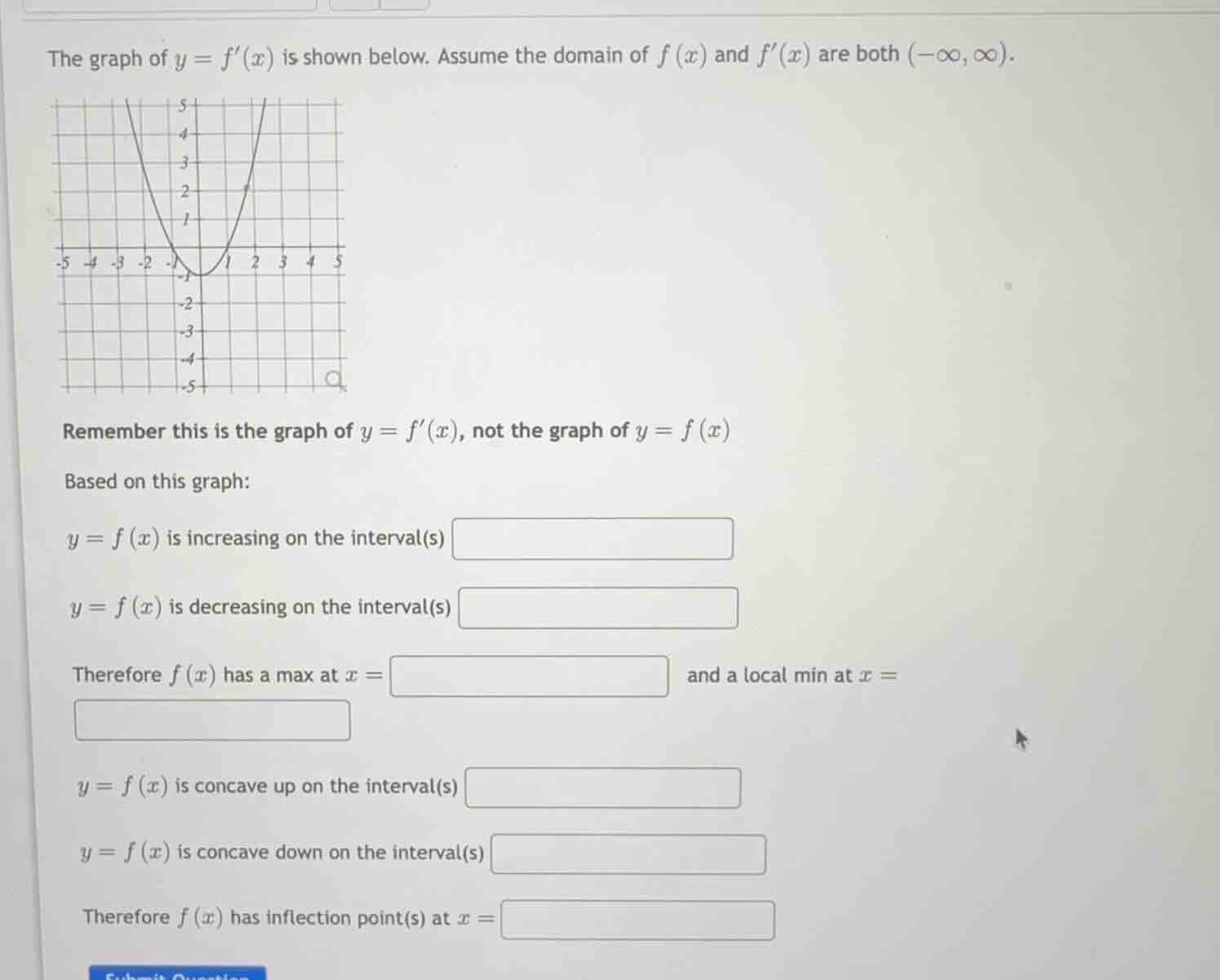
the graph of (y = f(x)) is shown below. assume the domain of (f(x)) and (f(x)) are both ((-\infty, \infty)).
remember this is the graph of (y = f(x)), not the graph of (y = f(x))
based on this graph:
(y = f(x)) is increasing on the interval(s)
(y = f(x)) is decreasing on the interval(s)
therefore (f(x)) has a max at (x =) and a local min at (x =)
(y = f(x)) is concave up on the interval(s)
(y = f(x)) is concave down on the interval(s)
therefore (f(x)) has inflection point(s) at (x =)
Determine increasing and decreasing intervals
Using the Increasing and Decreasing Intervals and Interval Notation knowledge points
Identify local extrema
Using the Critical Points and Local Extrema knowledge points
Determine concavity intervals
Using the Concavity and Interval Notation knowledge points
Identify inflection points
Using the Inflection Points knowledge point

Snap & solve any problem in the app
Get step-by-step solutions on Sovi AI
Photo-based solutions with guided steps
Explore more problems and detailed explanations
Based on this graph:
\(y = f(x)\) is increasing on the interval(s) <blank>\((-\infty, -1) \cup (1, \infty)\)</blank>
\(y = f(x)\) is decreasing on the interval(s) <blank>\((-1, 1)\)</blank>
Therefore \(f(x)\) has a max at \(x =\) <blank>\(-1\)</blank> and a local min at \(x =\) <blank>\(1\)</blank>
\(y = f(x)\) is concave up on the interval(s) <blank>\((0, \infty)\)</blank>
\(y = f(x)\) is concave down on the interval(s) <blank>\((-\infty, 0)\)</blank>
Therefore \(f(x)\) has inflection point(s) at \(x =\) <blank>\(0\)</blank>