QUESTION IMAGE
Question
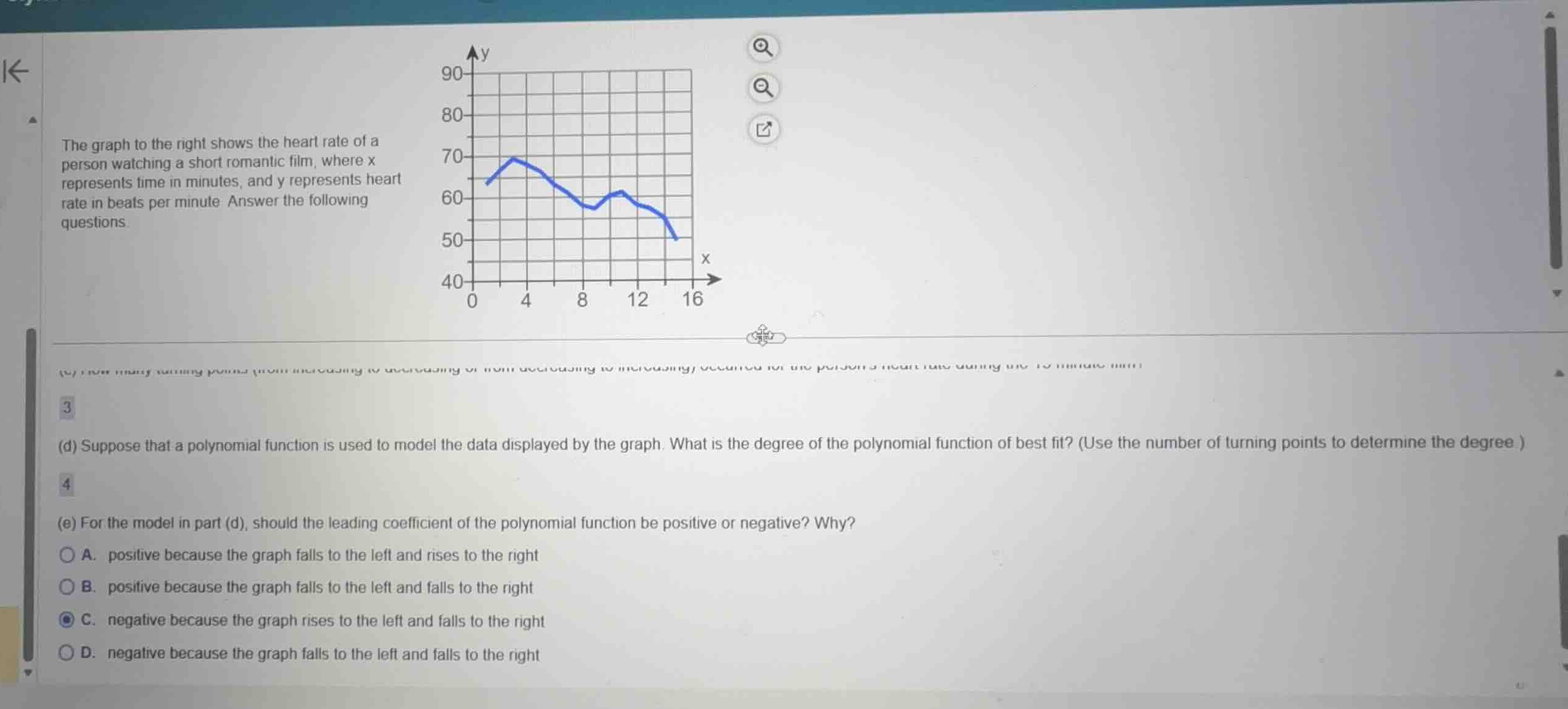
the graph to the right shows the heart rate of a person watching a short romantic film, where x represents time in minutes, and y represents heart rate in beats per minute. answer the following questions.
(d) suppose that a polynomial function is used to model the data displayed by the graph. what is the degree of the polynomial function of best fit? (use the number of turning points to determine the degree.)
(e) for the model in part (d), should the leading coefficient of the polynomial function be positive or negative? why?
a. positive because the graph falls to the left and rises to the right
b. positive because the graph falls to the left and falls to the right
c. negative because the graph rises to the left and falls to the right
d. negative because the graph falls to the left and falls to the right
Identify the turning points from the graph
Using the Turning Points knowledge point, we locate where the graph changes direction.
- From \(x = 0\) to \(x = 3\), the graph increases to a local maximum at \((3, 70)\).
- From \(x = 3\) to \(x = 9\), it decreases to a local minimum at \((9, 58)\).
- From \(x = 9\) to \(x = 11\), it increases to a local maximum at \((11, 62)\).
- From \(x = 11\) to \(x = 15\), it decreases.
Thus, there are exactly 3 turning points.
Determine the degree of the polynomial
Using the Degree of Polynomial knowledge point, a polynomial of degree \(n\) has at most \(n-1\) turning points.
Conversely, the minimum degree of a polynomial with \(k\) turning points is:
With \(k = 3\) turning points, the degree of the polynomial of best fit is:
Analyze the end behavior and leading coefficient
Using the Leading Coefficient Test and End Behavior of Polynomials knowledge points:
- As \(x \to -\infty\) (extrapolating to the left), the graph rises.
- As \(x \to \infty\) (extrapolating to the right), the graph falls.
For an even-degree polynomial (\(n = 4\)), both ends should point in the same direction. However, looking at the local behavior at the boundaries:
- The graph starts at \(x=1\) going up (rising to the left of the peak).
- The graph ends at \(x=15\) going down (falling to the right).
This behavior matches a negative leading coefficient for an even-degree polynomial where both ends eventually fall, or we look at the options provided:
- Option C states: "negative because the graph rises to the left and falls to the right".
This matches the visible behavior of the graph within the domain.

Snap & solve any problem in the app
Get step-by-step solutions on Sovi AI
Photo-based solutions with guided steps
Explore more problems and detailed explanations
Question (c)
3
Question (d)
4
Question (e)
- A. positive because the graph falls to the left and rises to the right
- B. positive because the graph falls to the left and falls to the right
- C. negative because the graph rises to the left and falls to the right (Correct answer)
- D. negative because the graph falls to the left and falls to the right