QUESTION IMAGE
Question
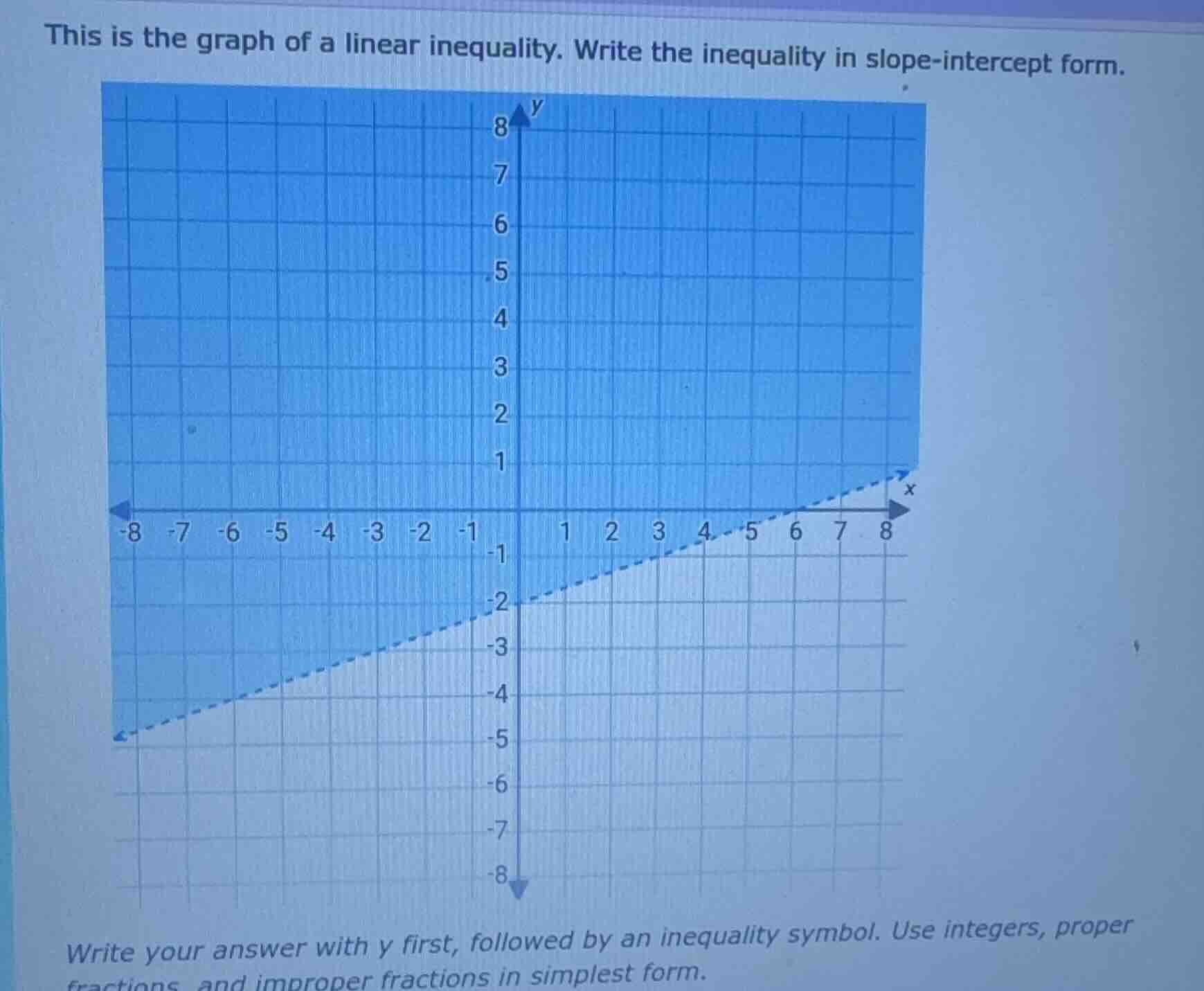
this is the graph of a linear inequality. write the inequality in slope - intercept form.
write your answer with y first, followed by an inequality symbol. use integers, proper fractions, and improper fractions in simplest form.
Step1: Find the slope of the line
The line passes through \((0, 3)\) and \((2, 0)\). The slope \(m=\frac{y_2 - y_1}{x_2 - x_1}=\frac{0 - 3}{2 - 0}=-\frac{3}{2}\).
Step2: Determine the y - intercept
The y - intercept \(b\) is the value of \(y\) when \(x = 0\). From the point \((0, 3)\), \(b = 3\). So the equation of the line in slope - intercept form (\(y=mx + b\)) is \(y=-\frac{3}{2}x + 3\).
Step3: Determine the inequality symbol
The line is dashed, so the inequality is either \(y>-\frac{3}{2}x + 3\) or \(y<-\frac{3}{2}x + 3\). The shaded region is above the line (since when we test a point in the shaded region, say \((0,4)\), \(4>-\frac{3}{2}(0)+3 = 3\)), so the inequality is \(y\geq-\frac{3}{2}x + 3\)? Wait, no, the line is dashed, so it should be \(y>-\frac{3}{2}x + 3\)? Wait, let's check the graph again. Wait, the shaded area: looking at the graph, when \(x = 0\), the shaded area is above \(y = 3\)? Wait, no, the line goes through \((0,3)\) and \((2,0)\). The dashed line, and the shaded region: let's take a point in the shaded region, like \((-2,5)\). Plug into \(y=-\frac{3}{2}x + 3\): RHS is \(-\frac{3}{2}(-2)+3=3 + 3=6\). And \(5<6\)? Wait, maybe I made a mistake. Wait, let's recalculate the slope. Points \((0,3)\) and \((2,0)\): \(m=\frac{0 - 3}{2-0}=-\frac{3}{2}\). Equation of line: \(y=-\frac{3}{2}x + 3\). Now, let's take a point in the shaded region, say \((-1,4)\). Plug into the line equation: \(y=-\frac{3}{2}(-1)+3=\frac{3}{2}+3=\frac{9}{2}=4.5\). And \(4<4.5\), so the shaded region is below the line? Wait, no, the graph's shaded area: looking at the original graph, the left - hand side is shaded. Wait, maybe I mixed up. Wait, the line is dashed, and the shaded region: let's check the direction. The line has a negative slope, going from \((0,3)\) down to \((2,0)\). The shaded area: if we look at the grid, when \(x\) is negative, the \(y\) - values in the shaded area are higher. Wait, maybe the correct inequality is \(y>-\frac{3}{2}x + 3\)? Wait, no, let's do the test properly. Let's take the point \((0,4)\): plug into \(y=-\frac{3}{2}x + 3\), we get \(y = 3\) when \(x = 0\). \(4>3\), so \((0,4)\) is in the shaded region and \(4>3\), so the inequality is \(y>-\frac{3}{2}x + 3\)? But the line is dashed, so the inequality is strict. Wait, but maybe I made a mistake in the slope. Wait, another way: the line equation is \(y=-\frac{3}{2}x + 3\). The dashed line means the inequality is either \(y>-\frac{3}{2}x + 3\) or \(y<-\frac{3}{2}x + 3\). Let's take a point in the shaded area, say \((-2,5)\). Plug into \(y=-\frac{3}{2}x + 3\): \(y=-\frac{3}{2}(-2)+3=3 + 3=6\). \(5<6\), so \(y<-\frac{3}{2}x + 3\)? But that contradicts the earlier point. Wait, maybe the two points are \((0,3)\) and \((2,0)\), so the line is \(y=-\frac{3}{2}x + 3\). Now, the shaded region: looking at the graph, the area to the left of the line (where \(x\) is smaller) is shaded. Let's take \(x=-2\), then \(y=-\frac{3}{2}(-2)+3=3 + 3=6\). The shaded area at \(x=-2\) has \(y\) values less than 6? Wait, the graph's shaded area: the top - left part is shaded. Wait, maybe the correct inequality is \(y\geq-\frac{3}{2}x + 3\) is wrong, because the line is dashed. Wait, maybe I messed up the slope. Wait, let's re - express the line. The line passes through \((0,3)\) and \((2,0)\). So the slope is \(\frac{0 - 3}{2-0}=-\frac{3}{2}\), correct. The equation is \(y=-\frac{3}{2}x + 3\). Now, the dashed line means the inequality is strict. Now, to determine the direction: if we take a point in the shaded region, say \((0,4)\), plug into \(y\) and the line equation:…
Snap & solve any problem in the app
Get step-by-step solutions on Sovi AI
Photo-based solutions with guided steps
Explore more problems and detailed explanations
\(y>-\frac{3}{2}x + 3\)