QUESTION IMAGE
Question
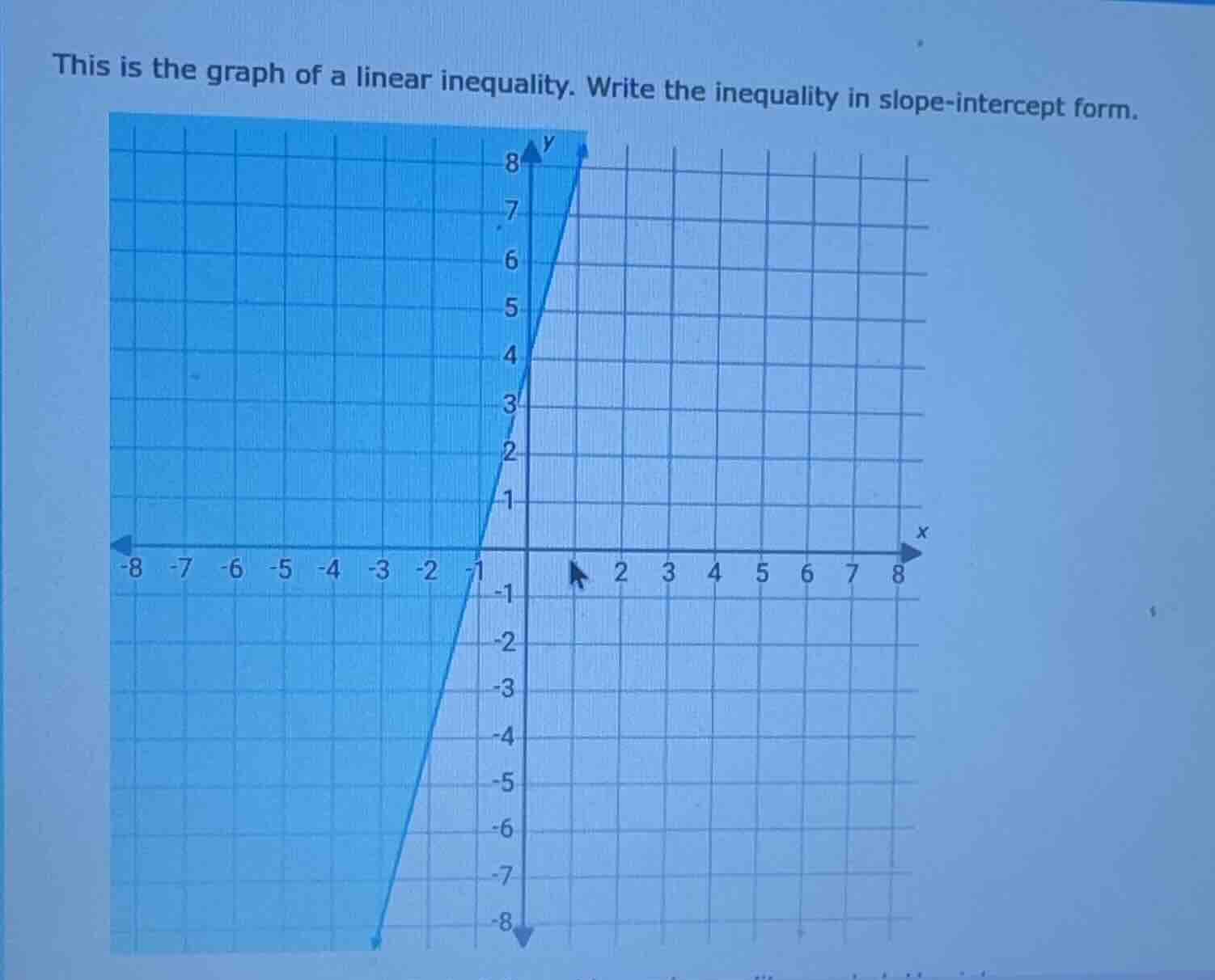
this is the graph of a linear inequality. write the inequality in slope - intercept form.
Step1: Find the slope-intercept form of the line
The slope-intercept form of a line is \( y = mx + b \), where \( m \) is the slope and \( b \) is the y-intercept. From the graph, the line passes through \( (0, 3) \) (so \( b = 3 \)) and another point, say \( (1, 7) \) (we can see the line goes up 4 units when x increases by 1, so slope \( m = 4 \)). So the equation of the line is \( y = 4x + 3 \).
Step2: Determine the inequality symbol
The line is solid (wait, no, looking at the graph, the line is a boundary, and the shaded region is to the left of the line? Wait, no, the shaded area is blue, and the line is a boundary. Wait, actually, when x=0, y=3, and as x increases, y increases. The shaded region is where y is less than or greater than? Wait, the line is \( y = 4x + 3 \), and the shaded area is to the left of the line (since for a given x, the y-values in the shaded area are less than \( 4x + 3 \)? Wait, no, let's check a point. Take (0,0): plug into \( y \) vs \( 4x + 3 \). \( 0 \) vs \( 3 \). 0 < 3, but is (0,0) in the shaded area? No, the shaded area at x=0 is above y=3? Wait, no, the graph shows at x=0, the shaded area is from y=3 up? Wait, no, the blue shaded area: looking at the graph, the line goes through (0,3) and (1,7), so slope 4. The shaded region is to the left of the line (since when x is smaller, the y-values in the shaded area are... Wait, maybe I got the slope wrong. Wait, let's recalculate the slope. From (0,3) to (1,7): rise is 7 - 3 = 4, run is 1 - 0 = 1, so slope \( m = 4 \). Now, the line is a boundary, and the shaded region: let's pick a test point, say (-1, 0). Plug into \( y \) and \( 4x + 3 \): \( 0 \) vs \( 4(-1) + 3 = -1 \). 0 > -1, and (-1, 0) is in the shaded area? Wait, no, the shaded area is blue, and at x=-1, the shaded area is from y=-1 up? Wait, maybe the line is \( y = 4x + 3 \), and the shaded region is \( y \leq 4x + 3 \)? Wait, no, the line is a solid or dashed? Wait, the graph shows a solid line? Wait, no, the original problem: the line is a boundary. Wait, actually, looking at the graph, the line is a solid line (since the inequality includes equality), and the shaded region is to the left of the line, meaning that for a given x, y is less than or equal to \( 4x + 3 \)? Wait, no, let's check the y-intercept. Wait, maybe I made a mistake in the y-intercept. Wait, when x=0, the line is at y=3? Wait, no, looking at the graph, at x=0, the line is at y=3? Wait, the grid: the y-axis has 3 at (0,3), 7 at (0,7)? Wait, no, the y-axis labels: 8,7,6,5,4,3,2,1,0,-1,... So (0,3) is on the line, and (1,7) is on the line. So the line is \( y = 4x + 3 \). Now, the shaded region: let's take a point in the shaded area, say (0,5). Plug into \( y \) and \( 4x + 3 \): 5 vs 3. 5 > 3, so 5 > 4(0) + 3. So the inequality is \( y \geq 4x + 3 \)? Wait, no, (0,5) is in the shaded area, and 5 ≥ 3, so yes. Wait, but the line is solid, so the inequality is \( y \geq 4x + 3 \)? Wait, no, maybe the line is dashed? Wait, the original graph: the line is a boundary, and the shaded region is above the line? Wait, no, the blue shaded area: looking at the graph, the line is going up steeply, and the shaded area is to the left of the line (for x < 1, the shaded area is more extensive). Wait, maybe I messed up the slope. Wait, let's take two points: (0,3) and (-1, -1). Then rise is -1 - 3 = -4, run is -1 - 0 = -1, so slope is 4. So the line is \( y = 4x + 3 \). Now, the shaded region: if we take (0,0), which is below the line (since 0 < 3), but (0,0) is not in the shaded area. The shaded area at x=0 is above y=3, so y ≥ 4…

Snap & solve any problem in the app
Get step-by-step solutions on Sovi AI
Photo-based solutions with guided steps
Explore more problems and detailed explanations
\( y \geq 4x + 3 \)