QUESTION IMAGE
Question
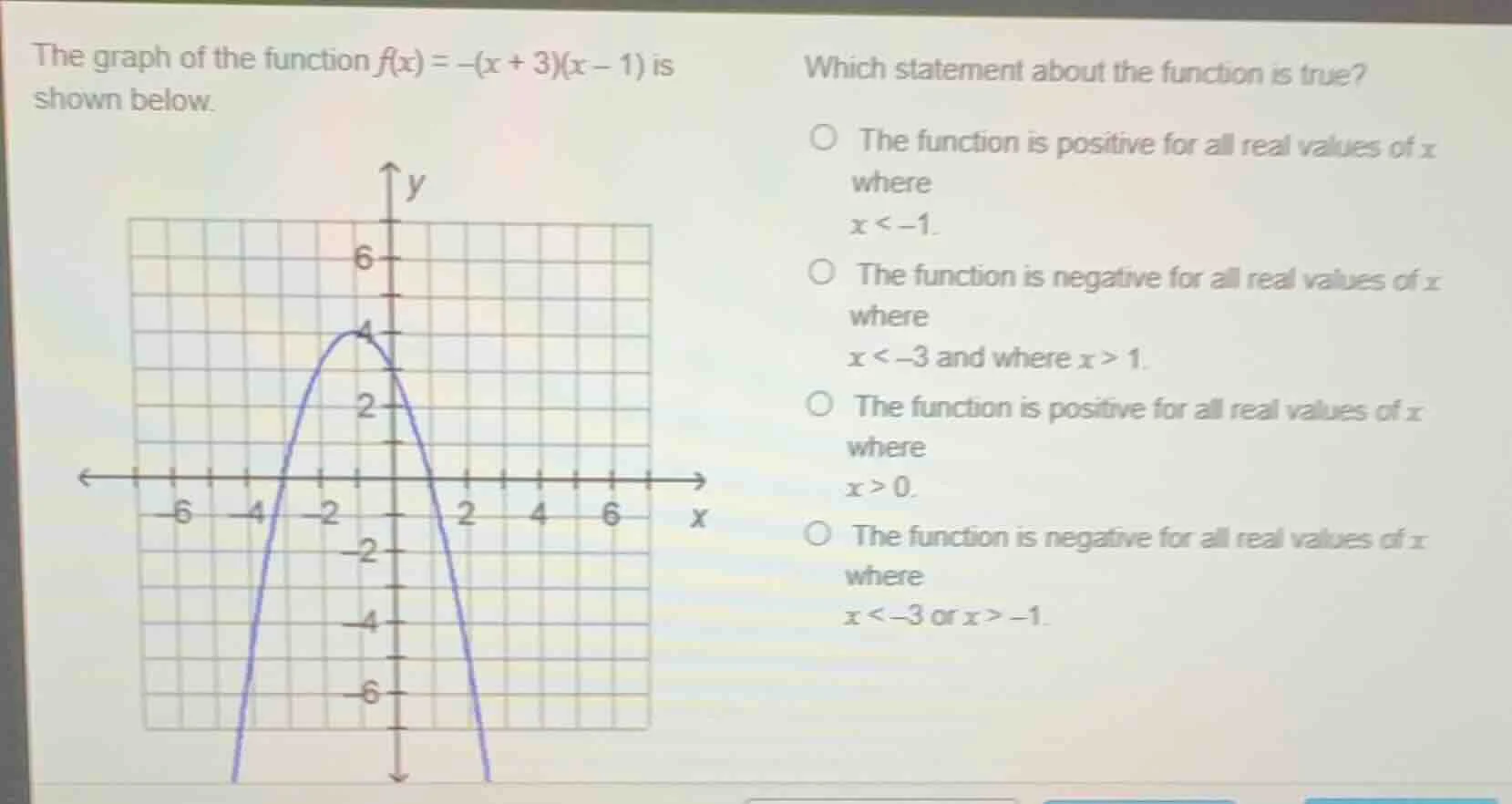
the graph of the function $f(x) = -(x + 3)(x - 1)$ is shown below.
graph of a parabola opening downward with vertex near ( -1, 4), x-intercepts at -3 and 1, y-intercept around 3
which statement about the function is true?
- the function is positive for all real values of $x$ where $x < -1$.
- the function is negative for all real values of $x$ where $x < -3$ and where $x > 1$.
- the function is positive for all real values of $x$ where $x > 0$.
- the function is negative for all real values of $x$ where $x < -3$ or $x > -1$.
Step1: Find the roots of the function
The function is given by \( f(x) = -(x + 3)(x - 1) \). To find the roots, set \( f(x) = 0 \):
\[
-(x + 3)(x - 1) = 0
\]
This gives \( x + 3 = 0 \) or \( x - 1 = 0 \), so the roots are \( x = -3 \) and \( x = 1 \).
Step2: Analyze the leading coefficient and the parabola's direction
The leading term of the quadratic function (when expanded) will have a coefficient of \( -1 \) (since the product of the \( x \)-terms is \( x \cdot x = x^2 \), and we have a negative sign in front). A negative leading coefficient means the parabola opens downward.
Step3: Determine the sign of the function in different intervals
- For \( x < -3 \): Let's pick a test point, say \( x = -4 \). Plug into \( f(x) = -(-4 + 3)(-4 - 1) = -(-1)(-5) = -5 \), which is negative.
- For \( -3 < x < 1 \): Pick \( x = 0 \). \( f(0) = -(0 + 3)(0 - 1) = -(-3) = 3 \), which is positive.
- For \( x > 1 \): Pick \( x = 2 \). \( f(2) = -(2 + 3)(2 - 1) = -5(1) = -5 \), which is negative.
Now let's check each option:
- Option 1: "The function is positive for all real values of \( x \) where \( x < -1 \)". But for \( x < -3 \) (which is part of \( x < -1 \)), the function is negative. So this is false.
- Option 2: "The function is negative for all real values of \( x \) where \( x < -3 \) and where \( x > 1 \)". From our analysis, for \( x < -3 \) and \( x > 1 \), the function is negative. This matches.
- Option 3: "The function is positive for all real values of \( x \) where \( x > 0 \)". For \( x > 1 \) (which is part of \( x > 0 \)), the function is negative. So this is false.
- Option 4: "The function is negative for all real values of \( x \) where \( x < -3 \) or \( x > -1 \)". For \( -3 < x < 1 \) (which is part of \( x > -1 \)), the function is positive. So this is false.

Snap & solve any problem in the app
Get step-by-step solutions on Sovi AI
Photo-based solutions with guided steps
Explore more problems and detailed explanations
The function is negative for all real values of \( x \) where \( x < -3 \) and where \( x > 1 \) (the second option).