QUESTION IMAGE
Question
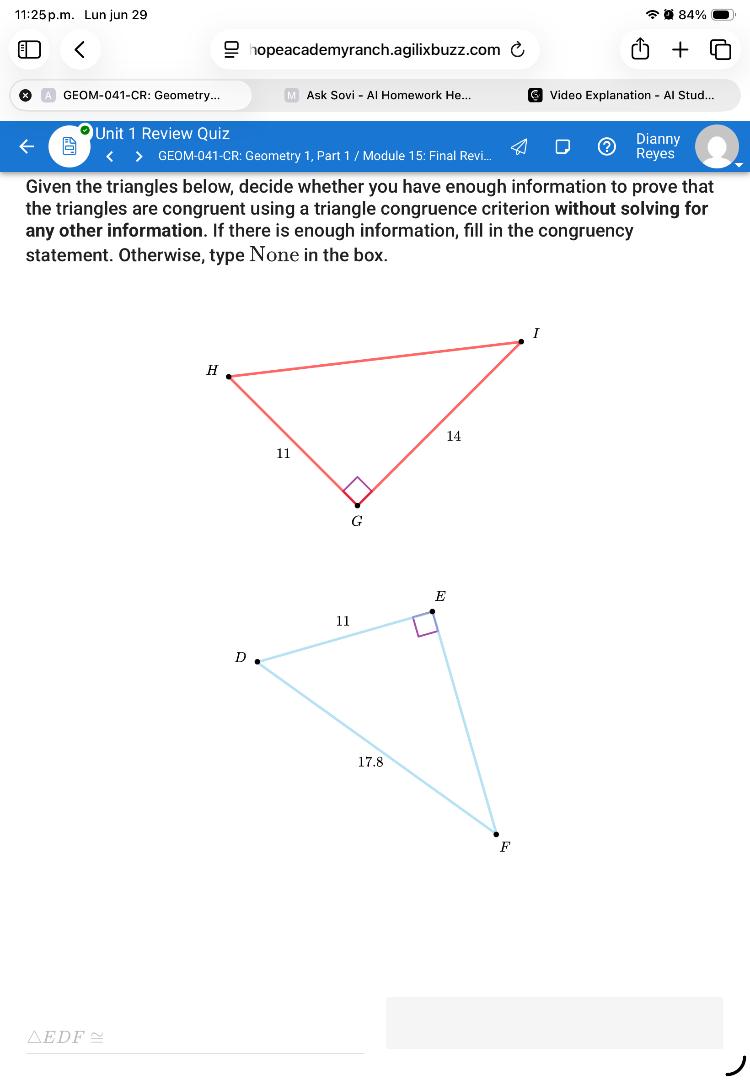
given the triangles below, decide whether you have enough information to prove that the triangles are congruent using a triangle congruence criterion without solving for any other information. if there is enough information, fill in the congruency statement. otherwise, type none in the box.
\\(\delta edf \cong\\)
🆕 New Concept Discovered: Triangle Congruence Criteria
Checking if triangles match using sides and angles.
Step 1: Identify given information for each triangle
For the first triangle, \(\triangle HGI\):
- It is a right triangle with the right angle at vertex \(G\), so \(\angle G = 90^\circ\).
- The two legs forming the right angle are given: \(HG = 11\) and \(GI = 14\).
- This gives us a Side-Angle-Side (SAS) configuration: Side (\(11\)) - Included Angle (\(90^\circ\)) - Side (\(14\)).
For the second triangle, \(\triangle EDF\):
- It is a right triangle with the right angle at vertex \(E\), so \(\angle E = 90^\circ\).
- We are given one leg, \(DE = 11\), and the hypotenuse, \(DF = 17.8\).
- This gives us a Right-Angle-Hypotenuse-Side (HL) configuration.
Step 2: Compare the available criteria
To prove congruence directly without solving for any other information:
- We cannot use SAS because we do not know the length of leg \(EF\) in the second triangle.
- We cannot use HL (Hypotenuse-Leg) because we do not know the length of the hypotenuse \(HI\) in the first triangle.
- Since the known parts do not directly match any single congruence criterion (such as SAS, ASA, AAS, SSS, or HL) without calculating the missing sides first, we do not have enough immediate information.
Therefore, we cannot write a direct congruency statement.

Snap & solve any problem in the app
Get step-by-step solutions on Sovi AI
Photo-based solutions with guided steps
Explore more problems and detailed explanations
None